Tripura University Showcases NEP 2020 in Action Through Seven-Day Workshop on Indigenous Cultural Documentation
By Our Correspondent
Agartala, July 31, 2026
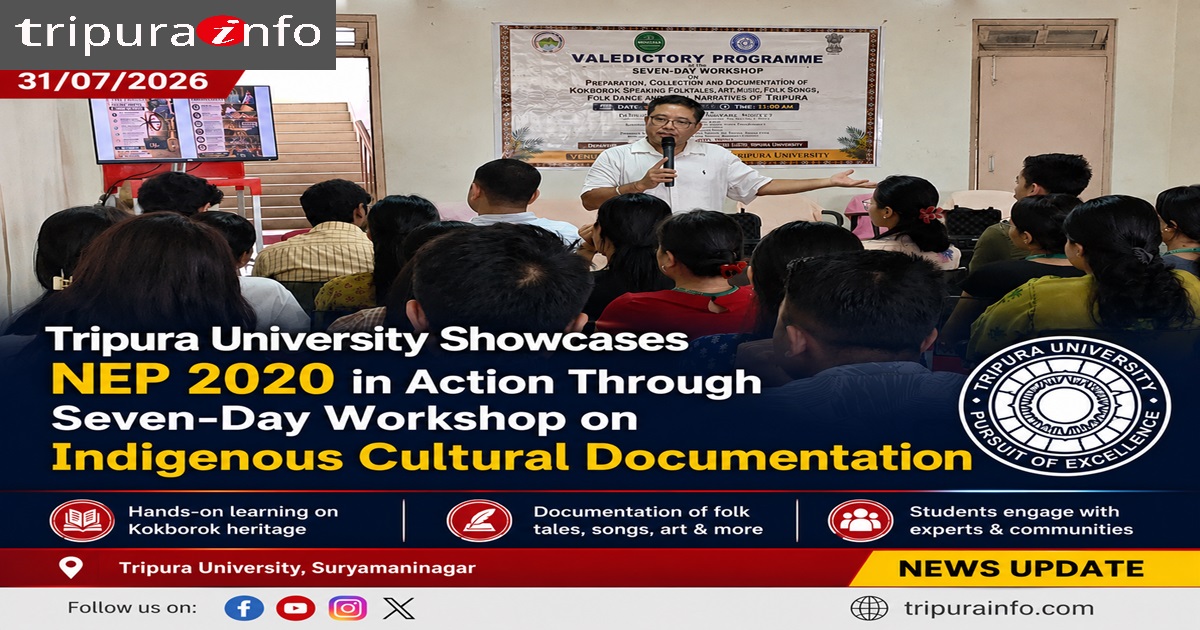 Demonstrating how higher education can effectively integrate classroom learning with community engagement, a seven-day workshop on the Preparation, Collection and Documentation of Kokborok Speakers’ Art, Music, Folk Songs, Folk Dances and Folk Tales of Tripura concluded on Friday at the Department of Journalism and Mass Communication (JMC), Tripura University.
The workshop was organised by MONDRA – A Social Welfare Society, in association with the Department of Kokborok and Other Minority Languages, TTAADC, and in collaboration with the Department of Journalism and Mass Communication, Tripura University, with financial assistance under the Grant-in-Aid Scheme of the Ministry of Development of North Eastern Region (DoNER), North Eastern Council (NEC).
The valedictory programme was graced by Prof. Debabrata Das, Hon’ble Vice-Chancellor of Tripura University, as the Chief Guest. Other distinguished guests included Prof. Asesh Gupta, Mr. Bijesh Debbarma, Principal Officer of the Department of Kokborok and Other Minority Languages, TTAADC, Mr. Nanda Kumar Debbarma, eminent Kokborok scholar and author, and Dr. Deepak Upadhyaya from the Department of Journalism and Mass Communication.
Addressing the gathering, Prof. Debabrata Das lauded the collaborative initiative between MONDRA and the Department of Journalism and Mass Communication, describing it as an exemplary model of Experiential Learning that aligns closely with the vision of the National Education Policy (NEP) 2020. He observed that the programme successfully connected academic knowledge with field-based learning, encouraging students to engage directly with indigenous communities while documenting their cultural heritage.
The workshop equipped participants with practical skills in ethnographic research, oral history documentation, interviewing, photography, audio-visual recording, metadata preparation, consent protocols, and digital archiving. Students also received hands-on exposure to professional documentation techniques required for preserving intangible cultural heritage.
Speaking during the valedictory session, Dr. Sunil Kalai, Founder-President of MONDRA and Head of the Department of Journalism and Mass Communication, emphasized that documentation is a powerful tool for preserving identity and collective memory. He noted that indigenous languages, oral traditions, music, folklore, and performing arts represent invaluable knowledge systems that must be systematically documented before they disappear.
“Documentation is not simply about recording traditions; it is about preserving the identity, wisdom, and history of communities for future generations. Today’s documentation will become tomorrow’s cultural archive,” Dr. Kalai said.
Throughout the seven-day programme, experts conducted interactive sessions on research ethics, field documentation methodologies, photography, videography, sound recording, metadata management, and digital preservation. Participants actively engaged in practical exercises, discussions, and documentation planning, preparing them for future community-based cultural research.
The workshop concluded with the distribution of certificates to participants, recognising their successful completion of the training. Organisers expressed confidence that the initiative would encourage a new generation of researchers, journalists, filmmakers, and cultural practitioners to contribute towards safeguarding Tripura’s rich indigenous heritage.
The programme stands as an important example of how universities, government institutions, and civil society organisations can collaborate to strengthen cultural preservation while promoting experiential education. As the workshop concluded, participants reaffirmed their commitment to documenting and preserving the living traditions of the Kokborok-speaking communities, ensuring that their rich cultural legacy continues to inspire future generations.
more news...