Demand Grows for Introduction of Journalism and Mass Communication Degree Courses in Tripura Colleges
By Our Correspondent
Agartala, July 22, 2026
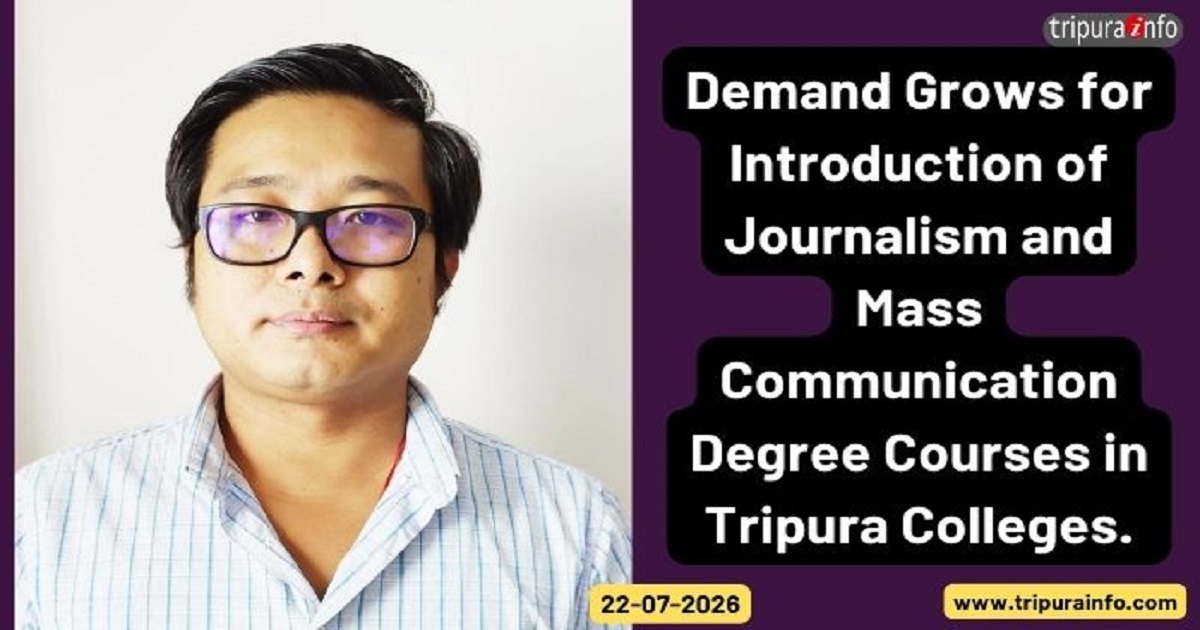 A strong appeal has been made to the Government of Tripura to introduce Bachelor’s Degree programmes in Journalism and Mass Communication (JMC) in government degree colleges across the state, highlighting the growing need for media education in an era dominated by digital communication, artificial intelligence, and rapidly evolving information technologies.
Dr. Sunil Kalai, Head (i/c), Department of Journalism and Mass Communication, Tripura University, has urged the Hon’ble Minister of Higher Education to consider introducing the undergraduate programme, stating that Tripura’s students deserve equal access to quality media education without being compelled to leave the state to pursue their academic aspirations.
According to Dr. Kalai, the Department of Journalism and Mass Communication at Tripura University has already developed a comprehensive undergraduate syllabus in line with the National Education Policy (NEP) 2020, making the programme academically prepared for immediate implementation in affiliated colleges.
He observed that while communication has become one of the most dynamic and influential sectors globally, many students from Tripura continue to face limited opportunities to study journalism and media at the undergraduate level. This, he noted, often forces aspiring students to seek admission outside the state, increasing financial burdens on families and resulting in the migration of talented youth.
Experts believe that the introduction of JMC programmes would create significant employment opportunities for the state’s educated youth. Tripura has a growing pool of NET, JRF, and PhD-qualified scholars in Journalism and Mass Communication who are well-equipped to serve as faculty members, researchers, and academic mentors. Establishing undergraduate departments would not only strengthen higher education but also provide meaningful employment for these qualified professionals.
The proposed programme is also expected to prepare students for a wide range of careers in journalism, television, digital media, filmmaking, advertising, public relations, corporate communication, social media management, government communication, content creation, and media entrepreneurship. With the rapid expansion of India’s digital economy, communication professionals are increasingly in demand across both public and private sectors.
Beyond employment, the course is seen as an important step towards strengthening media literacy among young citizens. In an age where misinformation, fake news, and digital manipulation have become major societal challenges, formal education in journalism can equip students with the ability to critically evaluate information, verify facts, and practice ethical communication. Such skills are considered essential for nurturing responsible digital citizens and strengthening democratic participation.
The proposed programme would also play a crucial role in preserving Tripura’s rich cultural heritage. Students trained in journalism and visual storytelling can document indigenous languages, oral traditions, folk culture, festivals, and local histories, creating valuable archives for future generations while promoting the state’s unique identity at national and international levels.
Academicians further point out that trained communication professionals contribute significantly to good governance by helping government departments, development agencies, educational institutions, and civil society organisations communicate effectively with the public. Accurate, transparent, and inclusive communication is increasingly recognised as an essential component of successful development initiatives.
Media education today extends far beyond newspaper reporting. It encompasses digital storytelling, multimedia production, data journalism, strategic communication, artificial intelligence in media, podcasting, mobile journalism, documentary filmmaking, and community engagement. As industries continue to evolve, communication has emerged as one of the fastest-growing professional sectors globally.
Educationists have therefore described the introduction of undergraduate Journalism and Mass Communication programmes as a forward-looking investment in Tripura’s human resource development. They believe that such an initiative would strengthen higher education, generate employment, encourage innovation, promote media literacy, and prepare the state’s youth to actively participate in India’s knowledge and communication economy.
The appeal has received attention on social media, where many students, educators, and citizens have expressed support for expanding media education opportunities in Tripura. Observers hope that the Government will consider the proposal as part of its broader vision for educational reform, youth empowerment, and the creation of a skilled workforce capable of meeting the communication challenges of the twenty-first century.
more news...