Drug Cases Overtake Murder: Over 37% of Inmates Booked Under NDPS Act, Data Reveals Changing Crime Pattern in Tripura
By Our Correspondent
Agartala, July 19, 2026
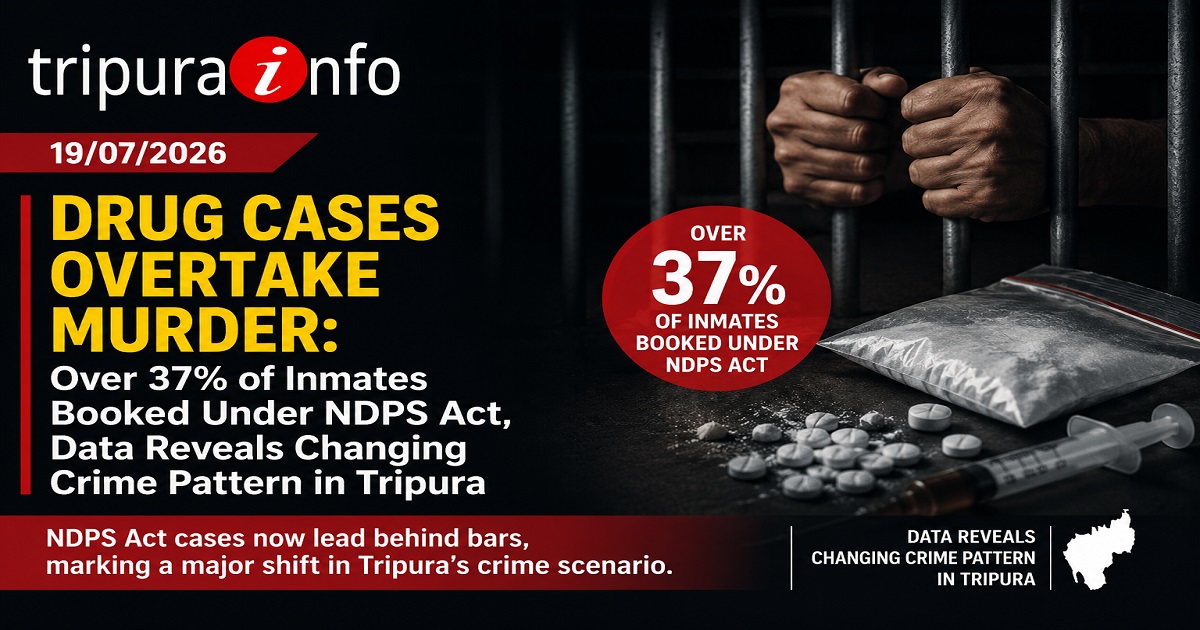 A detailed analysis of the latest prison statistics has revealed a significant shift in Tripura's crime profile, with narcotics-related offences emerging as the single largest category of prison inmates, surpassing even murder cases. The figures suggest that while law enforcement agencies have intensified anti-drug operations across the state, the growing number of undertrial prisoners in NDPS cases points to the continuing challenge posed by drug trafficking networks and the need for faster investigation and judicial disposal.
According to available data, 229 cases under the Narcotic Drugs and Psychotropic Substances (NDPS) Act were registered in Tripura up to June 30, 2026, leading to the arrest of 324 persons. During the operations, enforcement agencies seized 16,495 kilograms of cannabis, 94,199 bottles of codeine-based cough syrup, 5,071 Yaba tablets, 540.04 grams of heroin and other prohibited narcotic substances. Separately, the Directorate of Revenue Intelligence (DRI) has registered 228 NDPS cases and arrested 469 persons since 2024, highlighting the scale of coordinated enforcement efforts against interstate and cross-border drug trafficking.
However, prison data indicates that narcotics-related offences continue to dominate the state's criminal landscape.
According to the Available Report of Prisoners in Tripura, dated July 18, 2026, which analyses 754 inmates by offence category, 284 prisoners
or 37.67 percent of the total
are lodged in connection with NDPS cases, making drug-related offences the single largest category of inmates in Tripura's correctional system.
The report reveals that of the 284 NDPS prisoners, 265 are undertrial while only 19 have been convicted. Nearly 93 percent of all inmates booked under the NDPS Act are still awaiting the completion of their trials. This suggests that although anti-drug enforcement has resulted in a large number of arrests, investigations, forensic examinations and judicial proceedings are taking considerably longer to conclude.
Murder is the second-largest offence category, accounting for 171 inmates or 22.68 percent of the analysed prison population. Unlike NDPS cases, however, murder cases are dominated by convicted prisoners. The data records 131 convicted inmates compared to only 40 undertrials, indicating that a substantial number of homicide cases have already completed the judicial process and that convicted offenders continue serving long-term prison sentences.
Crimes relating to sexual offences against women and children, including offences under the Protection of Children from Sexual Offences (POCSO) Act, account for 81 inmates or 10.74 percent of the total. Theft-related offences account for 75 inmates, followed by 72 inmates booked under miscellaneous offences. Cases involving foreign nationals, illegal immigration and related offences account for 57 inmates, reflecting the continuing importance of border security in Tripura. Fraud cases account for 14 prisoners.
The statistics also reveal notable trends among female prisoners. Women are not only lodged in murder, theft and fraud cases but also constitute a significant share of inmates booked under the NDPS Act. Sixteen women are undertrial and two have been convicted in narcotics-related cases, making drug offences the largest identifiable category among female prisoners as well. Female inmates are also involved in immigration-related offences, theft and fraud, indicating that women are increasingly appearing across diverse categories of criminal prosecutions.
Prison occupancy data presents another important aspect of the state's correctional system. As of July 16, 2026, Tripura has 13 correctional institutions comprising one Central Correctional Home, two District Jails, nine functional Sub-Jails and one Women's Jail, while Sabroom Sub-Jail has remained non-functional since 2019. Together, these institutions have a sanctioned capacity of 2,365 inmates, against which 1,693 prisoners are currently lodged, including 1,569 men, 118 women, one transgender inmate and five prisoners undergoing treatment in hospitals.
Although the state's overall prison occupancy remains below its sanctioned capacity, overcrowding persists in certain institutions. Sonamura Sub-Jail houses 193 inmates against a capacity of 125, making it the most overcrowded prison in the state with an occupancy level of approximately 154 percent. The Women's Jail is also operating well beyond its sanctioned capacity, accommodating 45 inmates against only 25 authorised seats. Belonia Sub-Jail houses 92 inmates against a capacity of 85, while Dharmanagar Sub-Jail is operating almost at full capacity with 133 inmates against 135 seats. In contrast, the Central Correctional Home at Bishalgarh houses 708 inmates against a capacity of 975.
The prison statistics point to a changing crime pattern in Tripura. While murder continues to account for a large number of convicted prisoners because of lengthy sentences, narcotics offences have emerged as the state's most dominant category in terms of fresh arrests and undertrial inmates. The relatively low conviction rate in NDPS cases also underlines the need to strengthen investigations, forensic support, prosecution and the timely disposal of cases.
more news...