NABARD livelihood initiatives deepen tribal farm transformation in Tripura
By Our Correspondent
Agartala, July 19, 2026
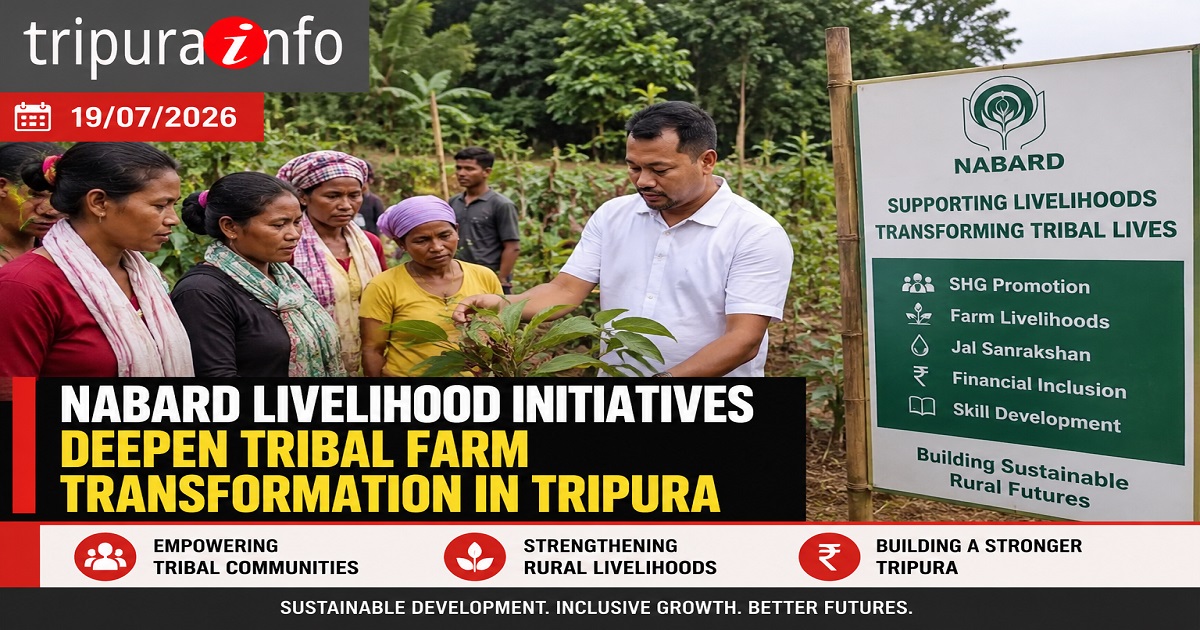 A series of livelihood interventions supported by the National Bank for Agriculture and Rural Development (NABARD) is steadily reshaping the socio-economic landscape of Tripura's tribal farming communities, with projects focused on sustainable agriculture, producer collectives and long-term income generation beginning to yield tangible results.
Development practitioners attribute much of the state's progress in community-based livelihood promotion to institutional initiatives launched during the tenure of former NABARD General Manager Loken Das, whose emphasis on integrated rural development laid the groundwork for several projects that continue to expand across the State.
One of the most visible outcomes of this approach is Bagma Agri Producer Company Limited (BAPCL), a NABARD-promoted Farmers Producer Organisation (FPO), which has evolved into a model for implementing farmer-centred development programmes in Tripura. The organisation has diversified its activities beyond conventional agriculture to include financial literacy, integrated farming systems, fisheries, livestock development, value-chain promotion and livelihood enhancement programmes for tribal households.
Officials associated with the programme said the FPO model has enabled farmers to access institutional support, improve production practices and strengthen market linkages while encouraging collective entrepreneurship in rural areas.
Another example of the programme's impact can be seen in Thakurachhara ADC Village under Raishyabari Block in Dhalai district, where a tribal beneficiary has adopted orchard-based farming under NABARD's Integrated Tribal Development Programme (ITDP) implemented through the Tribal Development Fund (TDF).
The one-acre livelihood project for beneficiary Kukila Chakma has been financed by NABARD's Tripura Regional Office and is being implemented with technical support from Seven Sisters Development Assistance (SeSTA). The intervention combines plantation development with scientific farming practices aimed at creating sustainable and climate-resilient livelihoods.
Apart from financial assistance, beneficiaries receive regular technical guidance, field demonstrations, skill development training and continuous monitoring to improve productivity and ensure better management of natural resources.
Programme officials said the Tribal Development Fund seeks to convert small and fragmented tribal landholdings into economically productive assets capable of generating stable income over an extended period. The approach integrates orchard development with improved land management, soil conservation and diversified farming systems, thereby enhancing household income while strengthening food security and ecological sustainability.
SeSTA has been responsible for beneficiary mobilisation, field-level technical supervision, plantation management and facilitating market access wherever feasible, making the intervention more comprehensive than conventional subsidy-driven agricultural schemes.
Development experts believe such integrated livelihood models hold particular significance for the North-East, where a large proportion of tribal households continue to depend on small-scale agriculture. They argue that combining financial support with technical assistance and community participation creates more durable livelihood opportunities than standalone welfare interventions.
Dhalai district, one of Tripura's predominantly tribal regions, has witnessed several livelihood initiatives under NABARD's Tribal Development Fund in recent years, contributing to agricultural diversification, income enhancement, environmental conservation and greater financial inclusion.
The momentum has continued under the leadership of Tanushree Bhattacharyya, General Manager of NABARD's Tripura Regional Office, with renewed emphasis on strengthening Farmers Producer Organisations, expanding livelihood projects, promoting rural infrastructure and improving access to institutional finance.
The institution's contribution to rural development was also acknowledged by Tripura Chief Secretary J.K. Sinha during NABARD's 45th Foundation Day celebrations earlier this week. He highlighted the organisation's role in promoting inclusive growth, strengthening the agricultural economy and creating sustainable livelihood opportunities across the State.
As Tripura seeks to diversify its rural economy while improving the resilience of tribal farming communities, NABARD's continuing investment in institution-building, sustainable agriculture and community-led development is emerging as a significant driver of inclusive growth, offering a model that could be replicated in other parts of the North-East.
more news...