Tripura CM presented ambitious roadmap to transform Tripura into India's most attractive investment destinations while inaugurating the Destination Tripura, Business Conclave 2026
By Our Correspondent
Agartala, July 10, 2026
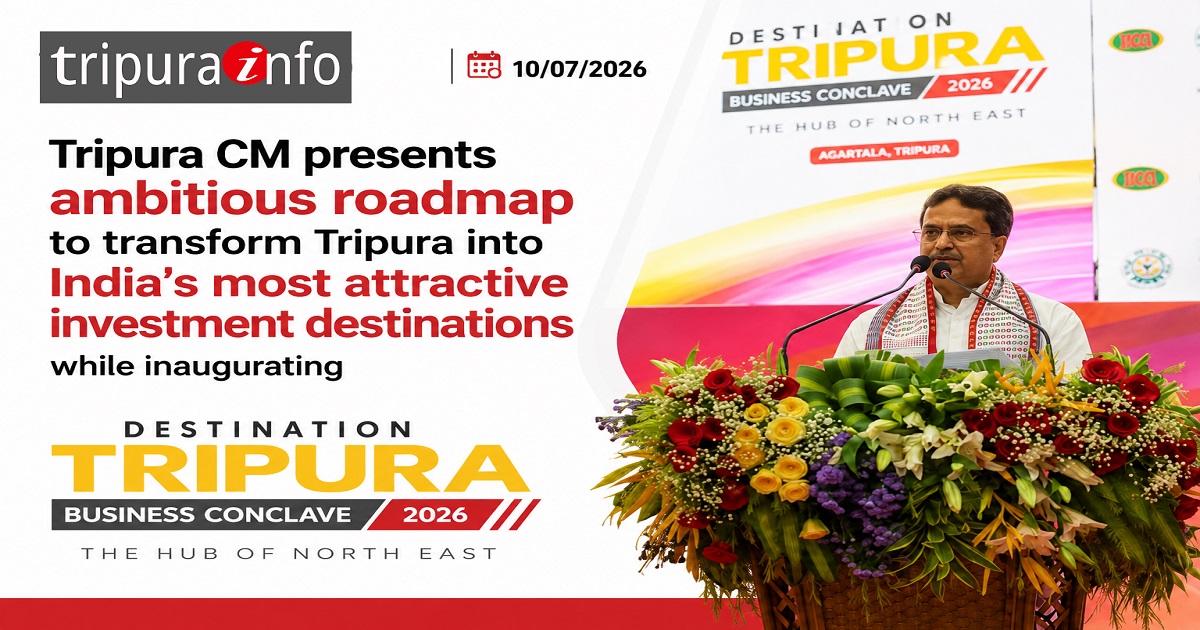 Chief Minister Prof. (Dr.) Manik Saha on Thursday presented an ambitious roadmap to transform Tripura into one of India's most attractive investment destinations while inaugurating the Destination Tripura, Business Conclave 2026 at the International Exhibition Hall in Hapania. Addressing a gathering of Union Ministers, diplomats, industrialists, investors and entrepreneurs from India and abroad, the Chief Minister highlighted the state's rapid economic growth, policy reforms, strategic location and abundant natural resources, while announcing that the conclave has attracted more than 500 delegates and over 250 Memorandums of Understanding (MoUs) with a proposed investment intent exceeding Rs.1 lakh crore.
The inaugural session was attended by Union Minister for Development of North Eastern Region Jyotiraditya M. Scindia, Union Commerce and Industry Minister Piyush Goyal, who joined virtually from New Delhi, members of the Tripura Council of Ministers, senior government officials, FICCI representatives, business leaders and ambassadors and diplomats from Bangladesh, Chile, Timor-Leste, Laos, Nepal, South Africa, Kazakhstan, Uzbekistan and the Philippines.
Welcoming investors to the state, the Chief Minister said Tripura has emerged as one of the fastest-growing states in the country, having doubled its Gross State Domestic Product (GSDP) within just six years. He said substantial investments by both the Central and State Governments in highways, railways, airports, internet connectivity, waterways and banking infrastructure have created a strong foundation for industrial expansion.
Highlighting Tripura's strengths, the Chief Minister pointed to its abundant reserves of natural gas, extensive rubber plantations, GI-tagged Queen Pineapple, premium agarwood resources, rich bamboo wealth and diversified horticultural production. He said the state is India's third fully literate state and possesses a large pool of skilled and technically qualified manpower, making it an ideal destination for private investment.
He said the state government has introduced extensive reforms across land administration, urban planning, industry, tourism, education and healthcare to improve the ease of doing business. Inspired by Prime Minister Narendra Modi's "Reform Express" initiative, Tripura secured the first rank among all states and Union Territories in both Phase I and Phase II of the Deregulation and Compliance Reduction programme.
The Chief Minister said the government has simplified land conversion procedures, streamlined industrial approvals through the SWAAGAT Single Window Portal, introduced risk-based inspections and developed a GIS-based digital land bank called "Bhunaksha" to facilitate online inspection of available land by prospective investors. Government land, he added, is available on lease at affordable rates for educational, commercial and social infrastructure projects.
Emphasising the state's investor-friendly governance model, he stated that Tripura follows the principle of "One Business One License" with all industrial approvals being processed through a single agency. According to him, investment proposals worth more than Rs.30,000 crore were received during the past year, while projects worth over Rs.8,000 crore have already entered the implementation stage.
The Chief Minister outlined sector-specific opportunities across multiple industries. He said Tripura, with over 1.58 lakh hectares of rubber plantations, the second largest in India, offers immense potential in rubber-based manufacturing, rubber wood processing, latex products, surgical gloves, plywood, veneer and biochar production. A new Rubber Park at Santirbazar with research and development facilities is expected to strengthen the state's rubber ecosystem.
Similarly, he announced plans to expand industrial bamboo cultivation to 45,000 hectares while establishing an Integrated Bamboo Value Chain Park in Unakoti. Investment opportunities exist in engineered bamboo products, bamboo boards, biomass, briquettes, pulp and paper manufacturing and bamboo composites.
Speaking about agarwood, he said Tripura possesses more than 2.27 crore agar trees, making it India's leading agarwood ecosystem. The proposed International Agar Trade and Research Centre and the Integrated Agarwood Cluster at Kadamtala will facilitate research, certification, processing, exports and value addition. Investors have been invited to establish agar oil distillation units, perfume manufacturing facilities, inoculum production centres and wellness product industries.
The Chief Minister also highlighted opportunities in agriculture, horticulture, fisheries and livestock. He called for investments in cold chain infrastructure, pineapple and jackfruit processing, tissue culture, fish feed manufacturing, commercial dairy farming, poultry, hatcheries, meat processing units and veterinary healthcare facilities.
Tea was identified as another promising sector with opportunities in organic plantations, premium tea processing, packaging, herbal tea manufacturing, catechin extraction, tea tourism and tea museums.
On energy, the Chief Minister said Tripura's abundant natural gas reserves, with exploration blocks operated by ONGC, Oil India Limited, GAIL, Jubilant and Vedanta, provide reliable and affordable fuel for industrial growth. He said the upcoming 253-kilometre North East Gas Grid will connect Tripura to the national gas network, opening new possibilities for petrochemicals, fertilisers, ceramics, food processing and other gas-based industries.
The state has also set a target of achieving 815 MW of renewable energy capacity by 2030 through solar parks, floating solar projects, rooftop installations, pumped hydro storage and biomass-based compressed biogas and bio-ethanol projects.
Describing Tripura's strategic location as a gateway to Southeast Asia, the Chief Minister said the state shares an 856-kilometre international border with Bangladesh and benefits from major connectivity projects including the Agartala-Akhaura international rail link, Maitri Setu connecting Sabroom with Chattogram Port, the Sonamura-Daudkandi inland waterway route and the proposed international expansion of Maharaja Bir Bikram Airport. These projects, he said, create significant opportunities for logistics parks, warehousing, cargo hubs, aviation services, pilot training and seaplane operations.
Tourism was projected as another major growth sector. The Chief Minister said the government is promoting eco-tourism, heritage tourism, religious tourism, wellness tourism, archaeological tourism and adventure tourism through investor-friendly policies. Projects including luxury hotels, resorts, houseboats, destination wedding venues near Neermahal, ropeways, cable cars, skywalks, wellness centres and tourism infrastructure around Matabari and the Buddhist Circuit have been identified for private investment.
In education and healthcare, the Chief Minister said Tripura has liberalised regulations for establishing higher educational institutions and invited investments in world-class universities, foreign university campuses, management institutes and vocational training centres. He noted that MBBS seats have increased from 225 to 550, postgraduate medical seats from 85 to 196, while referrals of patients outside the state have declined by 80 percent due to improved healthcare infrastructure. He also encouraged investments in multi-speciality hospitals, pharmaceutical manufacturing, biotechnology, diagnostics and medical education.
The Chief Minister said the state's urban transformation is progressing through the Smart City Mission, AMRUT and Asian Development Bank-supported projects. GIS-based master plans have been prepared for Agartala and 20 other towns, while satellite townships are planned around Agartala, Dharmanagar and Udaipur.
Highlighting Tripura's digital transformation, he said the state has fully digitised governance from the Cabinet level to Gram Panchayats. Agartala hosts India's third International Internet Gateway after Mumbai and Chennai, while projects such as the Tripura IT and Data Ecosystem Zone (TIDEZ), IT Parks and Innovation Centres are expected to attract investments in artificial intelligence, cybersecurity, gaming, electronics manufacturing, semiconductor design and global capability centres.
The Chief Minister further highlighted the Tripura Startup Policy 2024 under which more than 200 startups have already been recognised and supported through incubation and venture capital assistance. Industrial Training Institutes are being upgraded with Industry 4.0 courses in partnership with Tata Technologies, while a World Skills Centre and School of Languages are being established with the Ramakrishna Mission.
On law and order, Prof. Saha stated that the surrender of insurgent groups in 2024 has made Tripura completely free from insurgency and extremist activities. He claimed that the state recorded its lowest crime figures in the past two decades during 2025 and ranks second lowest among Indian states in overall crime rate per lakh population.
Concluding his address, the Chief Minister expressed confidence that the more than 250 investment agreements proposed during the conclave would be translated into projects on the ground with the support of "Team Tripura." He assured investors of time-bound approvals, continuous government support and seamless facilitation, inviting industries to partner with the state in building what he described as the next chapter of Tripura's economic transformation and contributing to the vision of Viksit Tripura and Viksit Bharat.
more news...