Tripura Human Rights Commission Orders Ecological Restoration of MBB College Lake, Seeks Action Taken Report Within Three Months
By Our Correspondent
Agartala, June 30, 2026
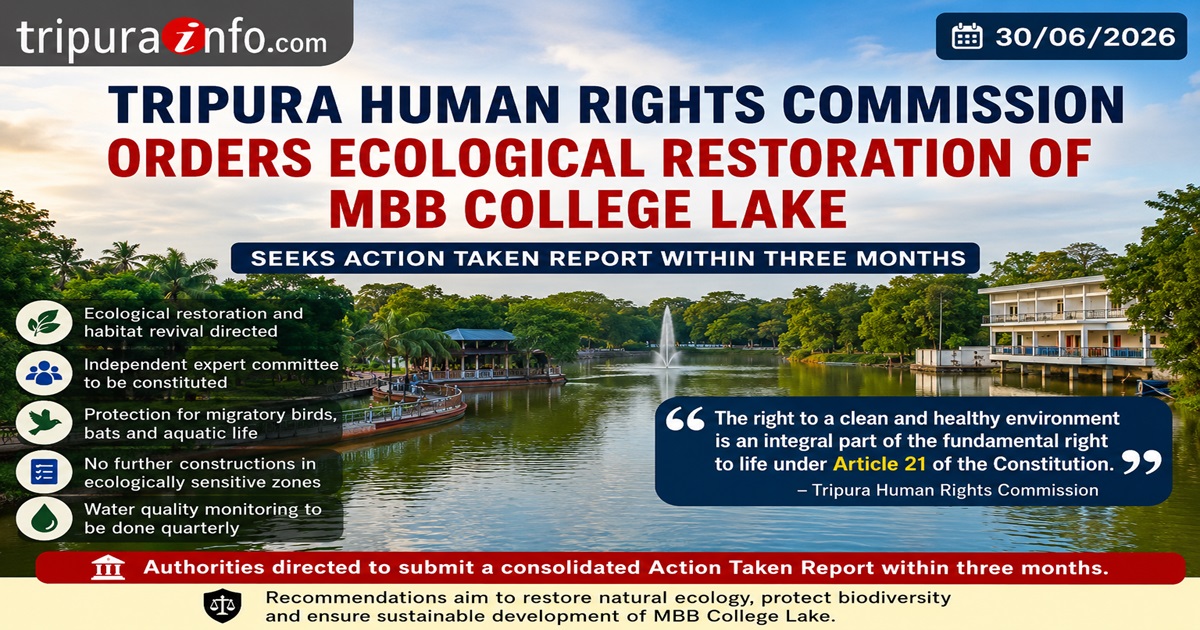 In a significant order aimed at protecting the ecology of the historic MBB College Lake, the Tripura Human Rights Commission (THRC) has recommended a series of comprehensive environmental restoration measures while directing the State Government and other authorities to submit a consolidated Action Taken Report (ATR) within three months.
The order was passed in Complaint No. 98 of 2025 by a Bench comprising Justice Arindam Lodh, Chairperson, and Udit Choudhuri, Member of the Tripura Human Rights Commission.
The complaint was filed by Sri Nikhil Debnath, President, and Sri Jayanta Bhattacharjee, Secretary of the NGO Forum for Protection of Environment and Water Bodies, Kalyani, Dhaleswar, Agartala. Both complainants were present before the Commission when the final order was delivered on June 30, 2026.
After examining pleadings, documentary evidence, expert opinions and reports submitted by the Forest Department, Tripura State Pollution Control Board, Revenue Department and CEO Sailesh Kumar Yadav, IAS Agartala Smart City Limited, the Commission held that the right to a clean and healthy environment forms an integral part of the fundamental right to life guaranteed under Article 21 of the Constitution of India.
The Commission observed that although the Smart City Project had involved substantial public expenditure and therefore should not be dismantled entirely, the evidence clearly established that several developmental activities had disturbed the natural ecology of the MBB College Lake, including the undergrowth, natural habitat surrounding the lake, bat colonies, migratory birds and other aquatic wildlife. The Commission further noted that partitioning of the lake had adversely affected the free movement of aquatic animals.
Accordingly, the Commission issued detailed recommendations for ecological restoration. It directed the Government of Tripura and Agartala Smart City Limited to undertake scientific ecological restoration of the lake and its surrounding habitat, restore ecological conditions existing before execution of the project wherever feasible, and remove artificial barriers restricting the movement of aquatic animals and migratory birds.
The Commission further recommended gradual replacement of ornamental and non-native plantations introduced under the project with indigenous trees, shrubs, herbs and aquatic vegetation in accordance with the Environmental Management Plan and expert advice.
To restore wildlife habitat, the Commission recommended minimizing commercialization within the lake area, preserving natural vegetation and reducing human interference in areas used by bats, migratory birds and other wildlife so that ecological corridors could be re-established.
One of the major directions issued by the Commission is the constitution of an Independent Ecological Restoration Committee within two months. The committee will include representatives from the Tripura Biodiversity Board, Wetland Authority of Tripura, Forest Department, Tripura State Pollution Control Board, the Department of Forestry and Biodiversity and Department of Zoology of Tripura University or other suitable universities, along with independent experts including Shri Sabyasachi Dasgupta, Priyasankar Chowdhury, Dr. Krishnendu Das and Dr. Dipak Sinha. The committee has been asked to inspect every permanent structure constructed under the Smart City Project and identify structures that unnecessarily interfere with the ecological integrity of the lake.
The Commission further recommended that if the committee concludes that any deck, platform, bridge, embankment, lighting installation or other permanent structure has an adverse ecological impact without serving any indispensable public purpose, the concerned authorities should suitably modify, relocate or remove such structures to restore the natural ecosystem.
The order also recommends declaration of the ecologically sensitive portions of the lake, including breeding areas and lake extremities, as Ecological Conservation Zones, where no further commercial or recreational construction should be permitted.
With regard to artificial illumination, the Commission directed that lighting around the lake must be wildlife-friendly, light spill towards trees and the water body should be avoided, and except for essential security purposes, illumination should remain switched off after 6:00 p.m.
In another important recommendation, the Commission directed the State Government to permanently close the restaurant-cum-marriage hall/club operating on the banks of MBB College Lake if it is found responsible for polluting the lake, in accordance with the findings of the Tripura State Pollution Control Board. The Commission further directed that no similar commercial establishments should be allowed within the lake's periphery in future if they pose any threat to the water body.
The Tripura State Pollution Control Board has been directed to conduct quarterly monitoring of water quality, including Biological Oxygen Demand (BOD), dissolved oxygen, coliform count and other ecological indicators, and place the reports in the public domain.
The Tripura Biodiversity Board has also been directed to conduct annual scientific surveys covering migratory birds, bat colonies, aquatic biodiversity, native vegetation and the overall ecological health of the lake. These reports are to be submitted to the Commission for the next three years.
The Commission also prohibited dumping of plastic waste, construction debris, sewage or any other pollutants into the lake and ordered regular removal of floating waste. It directed that the Environmental Management Plan prepared as part of the Detailed Project Report must be implemented in letter and spirit, and any deviation identified by the Independent Ecological Restoration Committee must be rectified within the prescribed time.
The Commission further stated that no additional permanent construction should be undertaken inside the lake or within ecologically sensitive zones unless an independent scientific assessment certifies that such activity would not adversely affect biodiversity or ecological balance. It also emphasized that all future developmental or conservation activities must be undertaken only after consultation with environmental experts, educational institutions, local residents and civil society organisations.
For compliance, the Commission directed the Chief Secretary, Government of Tripura, Principal Chief Conservator of Forests, Member Secretary, Tripura State Pollution Control Board, Member Secretary, Tripura Biodiversity Board, Secretary, Urban Development Department, District Magistrate, West Tripura and the Chief Executive Officer, Agartala Smart City Limited to submit a consolidated Action Taken Report within three months from receipt of the recommendations.
The matter has been directed to be listed after three months for consideration of the Action Taken Report. The Commission observed that recommendations made by a Human Rights Commission carry persuasive value and are mandatory in nature, and copies of the recommendations have been directed to be supplied to all concerned authorities as well as the complainants for necessary compliance.
more news...