Five Years After Bank Mergers: Tripura's MSME Credit Surges While Agricultural Lending Raises Concerns
By Our Correspondent
Agartala, June 29, 2026
 Five Years After Bank Mergers: Tripura's MSME Credit Surges While Agricultural Lending Raises Concerns
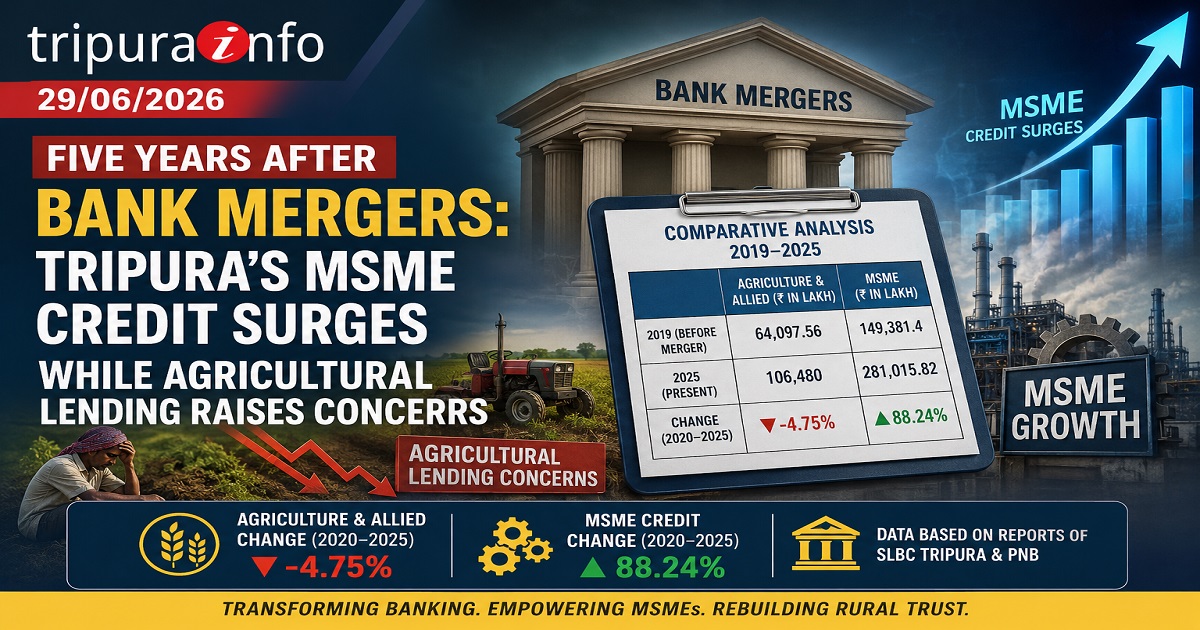
Agartala, June 29: Five years after the Government of India's landmark public sector bank mergers, Tripura's banking sector presents a mixed picture of financial reforms. While the consolidation has significantly strengthened credit flow to Micro, Small and Medium Enterprises (MSMEs), the pace of agricultural lending has remained comparatively modest, prompting experts to call for a more balanced credit strategy that supports both business growth and rural development.
An analysis of the State Level Bankers' Committee (SLBC), Tripura, data covering the period from 2019 to 2025 shows that the overall banking sector has expanded its lending portfolio substantially following the mergers. Agricultural and allied sector advances increased from Rs. 64,097.60 lakh before the mergers to Rs. 1,06,480 lakh in 2025, reflecting an overall increase of Rs. 42,382.83 lakh.
However, a closer examination of bank-wise performance reveals that the benefits have not been evenly distributed across the agricultural sector. Some merged public sector banks recorded stagnant or even declining agricultural lending despite the overall increase. Indian Bank's agricultural advances marginally declined from a combined pre-merger figure of Rs. 252.17 lakh to Rs. 247.42 lakh in 2025. Similarly, Punjab National Bank's agricultural lending fell from Rs. 31,542.41 lakh in 2020 to Rs. 31,211.53 lakh in 2025. UCO Bank also witnessed a decline, with agricultural advances dropping from Rs. 7,018.46 lakh to Rs. 5,616.28 lakh during the same period.
In contrast, lending to the MSME sector witnessed remarkable growth after the consolidation process. Total MSME advances nearly doubled, rising from Rs. 1,49,381.40 lakh in 2019 to Rs. 2,81,015.82 lakh in 2025—an impressive increase of Rs. 1,31,634.46 lakh. Among the major contributors, State Bank of India alone expanded its MSME portfolio by more than Rs. 43,024 lakh. Punjab National Bank, Union Bank of India, Bank of Baroda and Canara Bank also registered significant increases in credit extended to small businesses and enterprises.
Commenting on the trend, Kiran Bhowmik, Ph.D. Scholar in Agricultural Economics at Tripura University, observed that the mergers have undoubtedly enhanced the financial strength of public sector banks and improved their capacity to finance productive enterprises. However, he cautioned that agriculture, which continues to be the backbone of Tripura's rural economy, should receive equal policy attention.
"If commercial lending becomes the primary focus because of higher profitability, small and marginal farmers may gradually face greater challenges in accessing institutional credit. Balanced sectoral lending is essential for ensuring inclusive and sustainable economic development," he said.
Financial analysts note that the merger policy has largely succeeded in creating stronger banking institutions capable of supporting industrial and business expansion. Nevertheless, they argue that regulators and policymakers should closely monitor sector-wise credit distribution to ensure that agriculture does not lag behind other priority sectors.
Experts believe future banking reforms should focus not only on increasing overall credit volumes but also on maintaining equitable access to finance across sectors. Strengthening institutional credit for farmers alongside expanding support for MSMEs will be crucial for sustaining Tripura's rural economy and achieving long-term inclusive growth.
more news...