Ramnagar Apartment Blast Raises Questions Over Investigation as Fatal Explosion Exposes Gaps in Crime Scene Management and Forensic Preparedness in Tripura
By Our Correspondent
Agartala, June 28, 2026
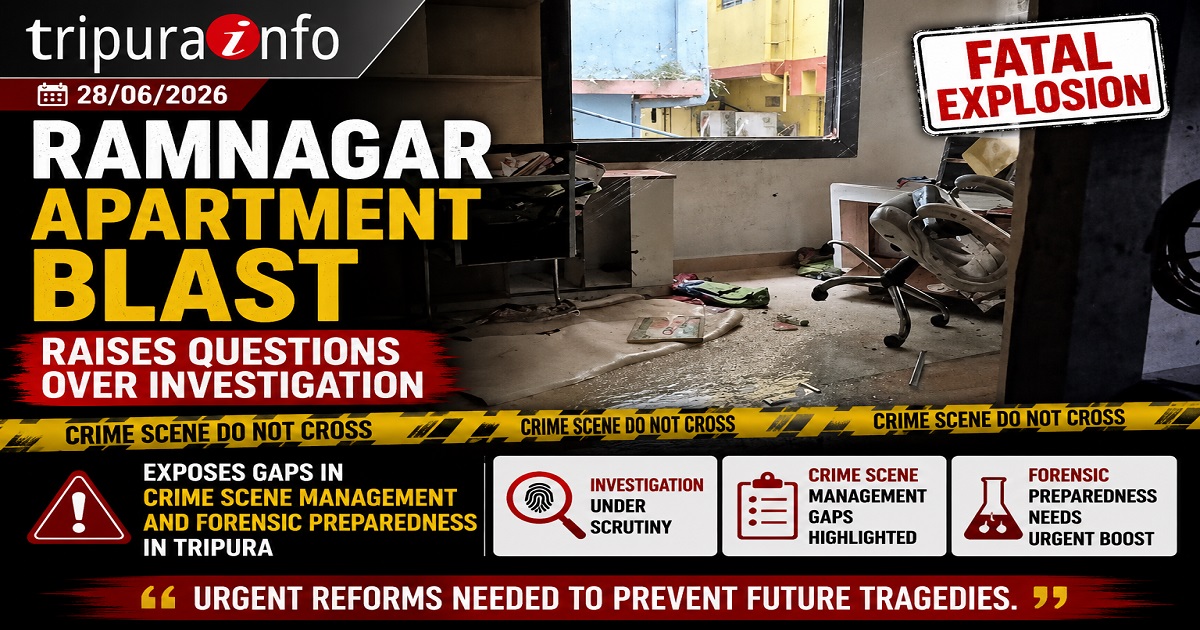 The fatal explosion at NS Apartments on Ramnagar Road No. 4 in Agartala has not only claimed the life of Subhrajit Chowdhury but has also sparked serious concerns over the manner in which the investigation was handled, the preservation of the crime scene, and the overall preparedness of Tripura's forensic and investigative agencies to deal with complex explosion cases. As multiple investigations continue into the incident, legal experts, forensic professionals and concerned citizens have questioned whether crucial evidence may have been compromised during the initial response to the tragedy.
The powerful explosion, which occurred on June 25 inside a flat being used as an office by a private organisation, left Subhrajit Chowdhury with nearly 90 percent burn injuries. He later succumbed to his injuries at GB Pant Hospital. The blast also damaged several neighbouring apartments, shattering windows, doors and household fixtures, while causing panic among residents.
Soon after the incident, the Tripura Government constituted a high-level inquiry committee comprising senior officials from the Urban Development Department, Fire and Emergency Services, Agartala Municipal Corporation, West Tripura Police and the Public Works Department. At the same time, police registered a criminal case after flat owner Sushanta Sur, proprietor of Abacus, lodged a complaint alleging negligence by Tripura Natural Gas Corporation Limited (TNGCL).
In his complaint, Sur alleged that TNGCL personnel had installed a piped natural gas line inside his flat without obtaining his permission and that the pipeline was left without properly sealing its open end. According to the complaint, gas allegedly accumulated inside the closed apartment overnight. The following morning, when an employee entered the flat and attempted to light an incense stick for daily worship, the accumulated gas allegedly ignited, triggering the devastating explosion. Sur has held TNGCL responsible for the death of his employee and the destruction caused by the blast.
TNGCL, however, has categorically denied the allegations. Following its own inspection, the corporation stated that preliminary findings indicated that the pipeline had been altered after installation. According to company officials, the original safety plug fitted at the pipeline's open end had been removed and the pipeline intended for future kitchen connection had allegedly been cut and levelled with the wall. Officials further claimed that apartment owners are informed about the presence of gas pipelines during installation and are advised not to modify them without informing the corporation. They also stated that a wooden cabinet had reportedly been installed in front of the pipeline, raising the possibility that alterations were made during interior renovation work. Police have begun investigating both versions, and authorities have stated that responsibility will be determined only after examination of forensic evidence, technical inspection reports and witness statements.
While the investigation into the cause of the blast continues, another equally significant issue has emerged regarding the handling of the scene immediately after the explosion. Local residents, journalists, content creators and numerous other individuals reportedly entered the affected apartment complex shortly after the incident. Photographs and videos from the site showed a large number of people moving around the damaged premises while rescue operations and inspections were underway. Questions are now being raised over whether adequate police restrictions and access control measures were implemented to preserve the integrity of the crime scene.
Forensic experts point out that internationally accepted crime scene management protocols require an explosion site to be immediately sealed by establishing inner and outer security perimeters. Except for emergency rescue personnel engaged in saving lives, access is generally restricted to authorised investigators wearing appropriate protective equipment so that physical evidence remains undisturbed. Every movement inside the scene is normally documented, and evidence is photographed, mapped and collected under a strict chain of custody before unnecessary entry is permitted. If an explosion scene is freely accessed by multiple individuals before forensic documentation is completed, trace evidence such as burn patterns, soot deposits, structural damage indicators, residue, fingerprints and other physical clues may be disturbed or contaminated, making scientific reconstruction of the incident more difficult. Whether any evidence was actually compromised in the Ramnagar case will ultimately depend on the findings of the official investigation.
The incident has once again highlighted broader concerns about the state's forensic infrastructure. Experts have argued that investigation of explosions requires specialised equipment including explosion scene investigation kits, combustible gas detectors, hydrocarbon analysers, thermal imaging systems, structural analysis tools and trained forensic personnel capable of determining the origin and cause of blasts. Digital evidence such as CCTV footage, electronic records and communication logs must also be collected using proper forensic procedures to ensure their admissibility in court. Concerns have been expressed that limitations in equipment, trained manpower and specialised investigation units could affect the scientific quality of complex investigations if adequate resources are not available.
The Ramnagar tragedy has also revived memories of an earlier major explosion near Fire Brigade Chowmuhani in Agartala, where questions regarding the final determination of the cause had also remained in public discussion. Observers believe that the latest incident should serve as an opportunity to strengthen Tripura's forensic science capabilities, improve crime scene management protocols, expand specialised training for first responders and ensure better coordination among police, forensic laboratories, fire services and technical agencies during major emergencies.
As the official inquiry proceeds, the Ramnagar apartment explosion has become more than a criminal investigation. It has evolved into a wider examination of public safety, urban infrastructure, emergency response and the scientific capacity of investigative agencies. The final findings of the inquiry committee, forensic experts and police investigation are expected to determine not only the immediate cause of the blast but also whether negligence by any individual or organisation contributed to the tragedy. At the same time, the incident has intensified calls for stronger forensic infrastructure, better-equipped crime scene investigation teams and stricter evidence preservation protocols so that future investigations can withstand both scientific scrutiny and judicial examination.
more news...