Revised RBI Fraud Compensation Rules Raise Concerns for Cybercrime Victims in Digitally Underprepared States like Tripura and NER
By Our Correspondent
Agartala, June 27, 2026
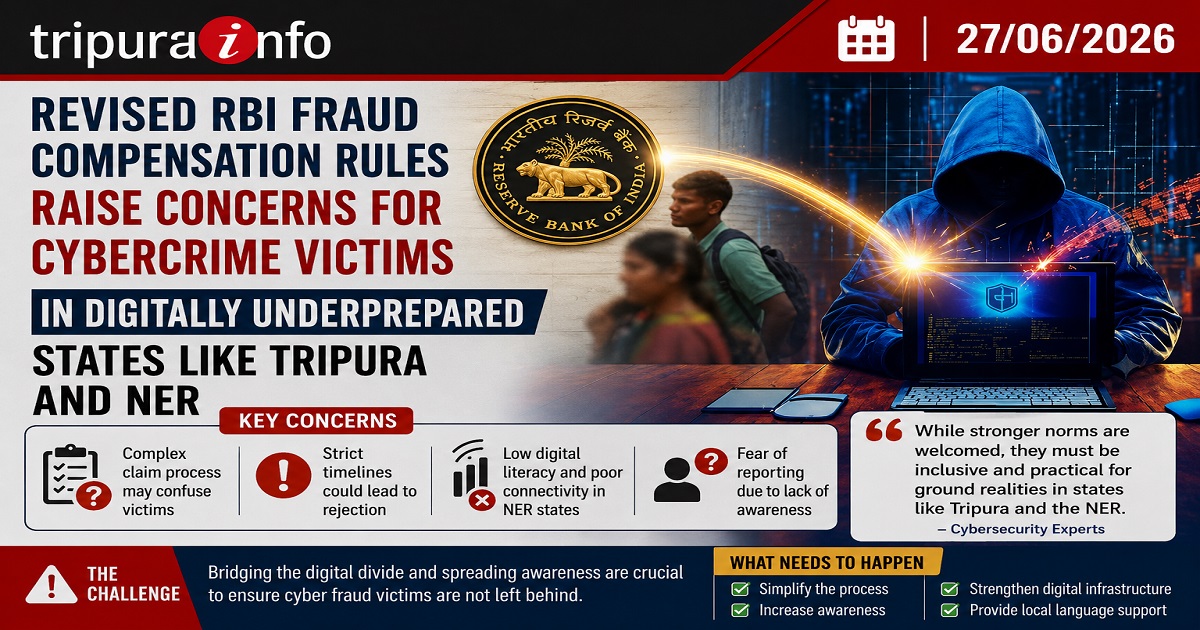 The Reserve Bank of India's revised rules on compensation for digital banking fraud have sparked concerns that victims in digitally underprepared states such as Tripura and other Northeast India’s state's could face greater difficulties in recovering their losses. Experts warn that the new framework does not guarantee a full refund of money lost to cyber fraud, making prevention and prompt reporting more important than ever.
Under the revised compensation mechanism, customers who become victims of digital banking fraud may receive only partial reimbursement, subject to prescribed limits and conditions. The rules require victims to report the fraud immediately through the National Cyber Crime Helpline (1930), the National Cyber Crime Reporting Portal, and their respective banks within the stipulated time. Delays in reporting could further reduce the chances of recovering lost funds.
Experts believe the challenge could be more severe in states where digital forensic capabilities and cybercrime investigation infrastructure are still developing. In such regions, tracing fraudulent transactions and securing timely action against cybercriminals can be more difficult, leaving victims with limited avenues for recovering their money.
Cybersecurity professionals have urged customers to exercise extreme caution while making digital payments. They advise users never to share OTPs, PINs, passwords or banking credentials, verify every transaction before authorising it, and remain alert to suspicious calls, messages and links. They stress that once a person becomes a victim of cyber fraud, the revised compensation rules may not ensure the return of the entire amount lost.
The revised framework serves as a reminder that public awareness, stronger cyber policing and responsible digital banking practices are essential to protect consumers from the growing threat of online financial fraud.
The revised rules will come into effect from January 1, 2027, and are aimed at providing financial relief for small-value fraudulent electronic banking transactions while encouraging customers to report cyber frauds promptly.
Under the new framework, customers who lose up to Rs.50,000 in a fraudulent digital banking transaction will be eligible to receive 85 percent of the net loss or a maximum of Rs.25,000, whichever is lower, provided the fraud is reported within five calendar days of the incident. Victims must immediately lodge complaints through the National Cyber Crime Reporting Portal, the National Cyber Crime Helpline (1930), and inform their respective banks without delay.
According to the revised mechanism, where the financial loss is below the prescribed threshold, the compensation will be shared among different stakeholders. The RBI will bear the largest portion of the compensation, while the customer's bank and the beneficiary bank will also contribute according to the prescribed formula. However, the notification does not specify any compensation mechanism for fraudulent transactions involving amounts exceeding Rs.50,000, creating uncertainty for victims of larger cyber frauds.
Cyber security experts have cautioned that the revised framework does not guarantee a full refund of the money lost. They warn that people living in states where cybercrime investigation infrastructure remains relatively weak could face greater challenges in recovering their losses. The new rules make timely reporting and customer vigilance more important than ever.
more news...