Bank Mergers Strengthened Deposits in Tripura, But Branch Expansion Still Falls Short in Underserved Areas
By Our Correspondent
Agartala, June 26, 2026
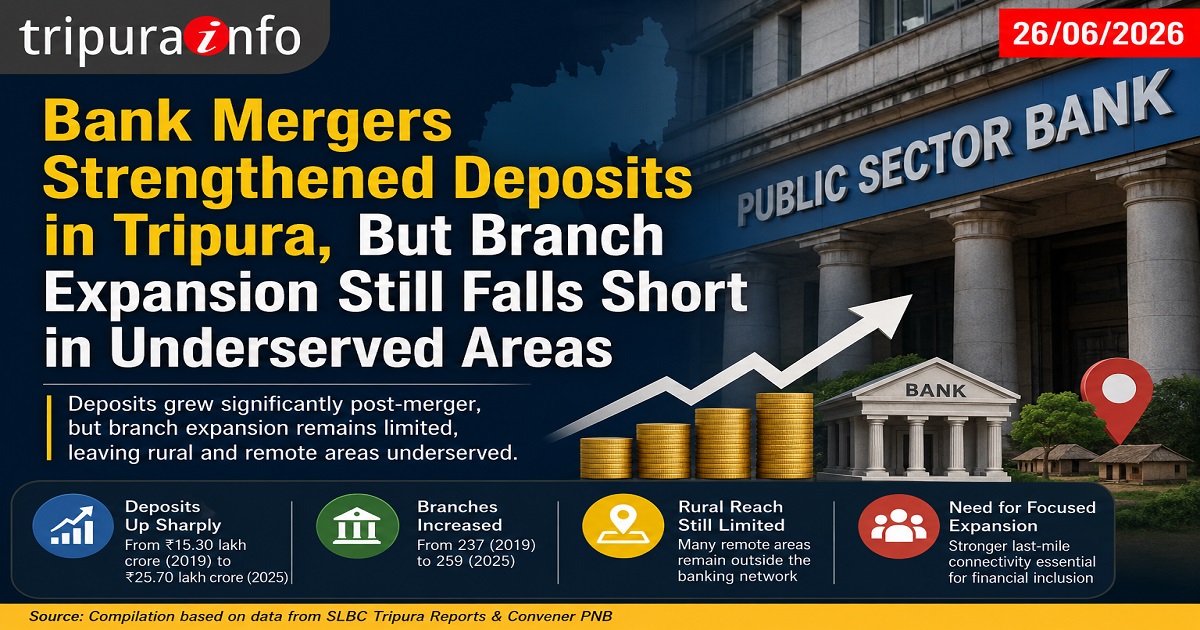 The consolidation of public sector banks in India has significantly strengthened the banking sector in Tripura by improving deposit mobilization and enhancing the operational strength of merged banks. However, a closer analysis of the State Level Bankers' Committee (SLBC), Tripura data reveals that while deposits have grown substantially after the mergers, the expansion of branch networks has remained modest, raising concerns over financial inclusion in rural and remote parts of the state.
According to a comparative analysis of bank mergers, Tripura had 237 public sector bank branches before the merger exercise in 2019. Despite the consolidation of several banks into 12 larger public sector banks in 2020, the total number of branches remained unchanged at 237. By 2025, the branch network increased only to 259, representing a growth of just 22 branches (9.3%) over six years.In contrast, deposit mobilization witnessed remarkable growth. Total deposits increased from Rs. 15,29,758.93 lakh in 2019 to Rs. 17,54,368.16 lakh immediately after the mergers in 2020. By 2025, deposits had climbed to Rs. 25,70,178.53 lakh, an increase of Rs. 10,40,419.60 lakh, or approximately 68 percent, compared to the pre-merger period.
Among the merged entities, Indian Bank, formed after the amalgamation of Allahabad Bank with Indian Bank, doubled its branch network from 3 to 6 branches and increased deposits from a combined Rs. 33,388.11 lakh in 2019 to Rs. 47,984.63 lakh in 2025.Similarly, Union Bank of India, after absorbing Andhra Bank and Corporation Bank, expanded from 10 branches in 2020 to 13 branches in 2025, while deposits nearly doubled from Rs. 60,389 lakh to Rs. 1,12,837.18 lakh. Canara Bank, following its merger with Syndicate Bank, increased its branches from a combined 19 before the merger to 22 branches by 2025. Deposits rose from Rs. 57,832.59 lakh in 2019 to Rs. 1,15,982.12 lakh, indicating one of the strongest post-merger performances.
The country's largest lender, State Bank of India, continued to dominate Tripura's banking landscape. Its branch network increased from 68 to 79, while deposits surged from Rs. 7,57,300 lakh in 2019 to Rs. 13,46,435.24 lakh in 2025, accounting for more than half of the total deposits in the state's public sector banking system. Likewise, Punjab National Bank, after merging with Oriental Bank of Commerce and United Bank of India, expanded marginally from 69 to 70 branches, whereas deposits increased significantly from Rs. 4,59,165.37 lakh in 2020 to Rs. 5,93,927.09 lakh in 2025.
The figures clearly indicate that the merger policy has succeeded in strengthening the financial position of public sector banks through higher deposits and improved operational efficiency. Nevertheless, the data also exposes a major policy concern. The objective of banking reforms extends beyond improving balance sheets; it also includes expanding access to banking services. In Tripura, branch expansion has not kept pace with deposit growth, particularly in rural, tribal and geographically difficult regions where physical banking infrastructure remains essential despite increasing digital banking adoption.
Kiran Bhowmik, Ph.D Scholar in the Department of Economics in Tripura University and Research Associate of the study under Sixteen Finance Commission, Government of India said that stronger banks should translate their improved financial capacity into greater outreach. The modest increase of only 22 branches over six years suggests that consolidation has largely focused on financial efficiency rather than geographical expansion.
more news...