Tripura Launches Solid Waste Management Rules 2026, But Questions Remain Over Ground-Level Waste Collection and Disposal
By Our Correspondent
Agartala, June 22, 2026
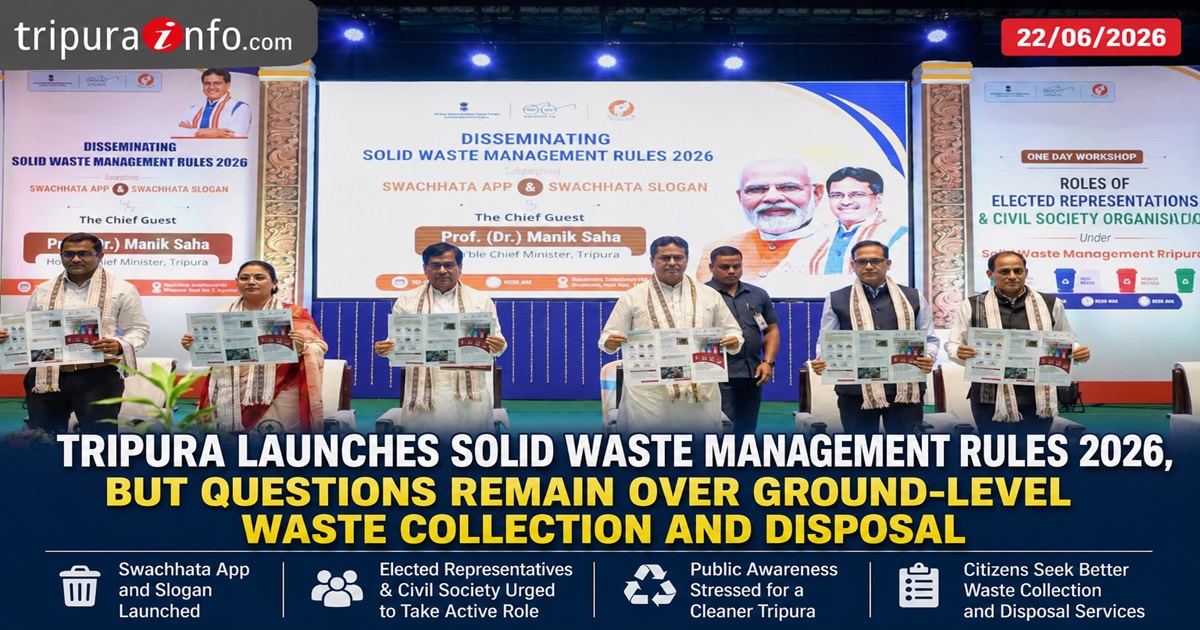 The Government of Tripura on Monday organized the inaugural programme and State-Level Workshop on the role of elected representatives and civil society organizations under the Solid Waste Management Rules, 2026 at Rabindra Satabarshiki Bhavan in Agartala.
The workshop was attended by Professor (Dr.) Manik Saha, Agartala Mayor and MLA Dipak Majumder, along with senior government officials, public representatives, and members of civil society.
Addressing the gathering, Chief Minister Dr. Manik Saha stressed that the active participation of elected representatives, civil society organizations, and ordinary citizens is essential for building a sustainable and environmentally conscious future in the state. He expressed confidence that the initiative would strengthen Tripura's collective commitment towards effective waste management, a cleaner environment, and the vision of a greener Tripura.
During the event, the Chief Minister also inaugurated the ‘Swachhata App’ and unveiled the ‘Swachhata Slogan’, describing them as important tools for promoting public awareness and participation in cleanliness and waste management initiatives.
However, despite the emphasis on public participation and environmental sustainability, questions remain regarding the practical challenges faced by residents, particularly in Agartala, concerning the collection and disposal of household waste.
Many residents have repeatedly complained that municipal waste collection services at the cost of Rs. 60 rupees per household remain irregular in several localities. According to citizens, municipal workers often fail to visit households regularly, with some areas reportedly receiving waste collection services only once in several days. At the same time, roadside waste bins and collection points have gradually been removed from many parts of the city, while the remaining waste disposal drums are often insufficient in number and are not cleared on time.
Observers noted that neither the Chief Minister nor other speakers at the workshop specifically addressed one of the most pressing concerns faced by ordinary residents: where and how household waste should be disposed of when collection services are unavailable or irregular.
There was also no public information indicating whether the workshop discussed concrete measures to ensure daily collection of waste from households, timely transportation of garbage to designated dumping stations, or the systematic removal of the large volumes of waste that accumulate across the city every day.
While the launch of the Swachhata App and the introduction of new waste management guidelines were welcomed as positive steps, many citizens are expected to judge the success of the initiative by improvements in on-ground waste collection, sanitation services, and the availability of adequate waste disposal infrastructure.
Environmental experts and civic observers believe that public awareness campaigns and policy frameworks can only achieve their intended objectives if accompanied by efficient municipal services, regular waste collection mechanisms, adequate disposal facilities, and strict monitoring of implementation at the grassroots level.
As Tripura moves forward with the implementation of the Solid Waste Management Rules, 2026, residents will be closely watching whether the new initiatives translate into tangible improvements in cleanliness, waste disposal, and urban sanitation across the state.
more news...