Despite Supreme Court Directive on Highway Encroachments, Tripura Focuses on Border Evictions Allegedly Without Rehabilitation
By Our Correspondent
Agartala, June 21, 2026
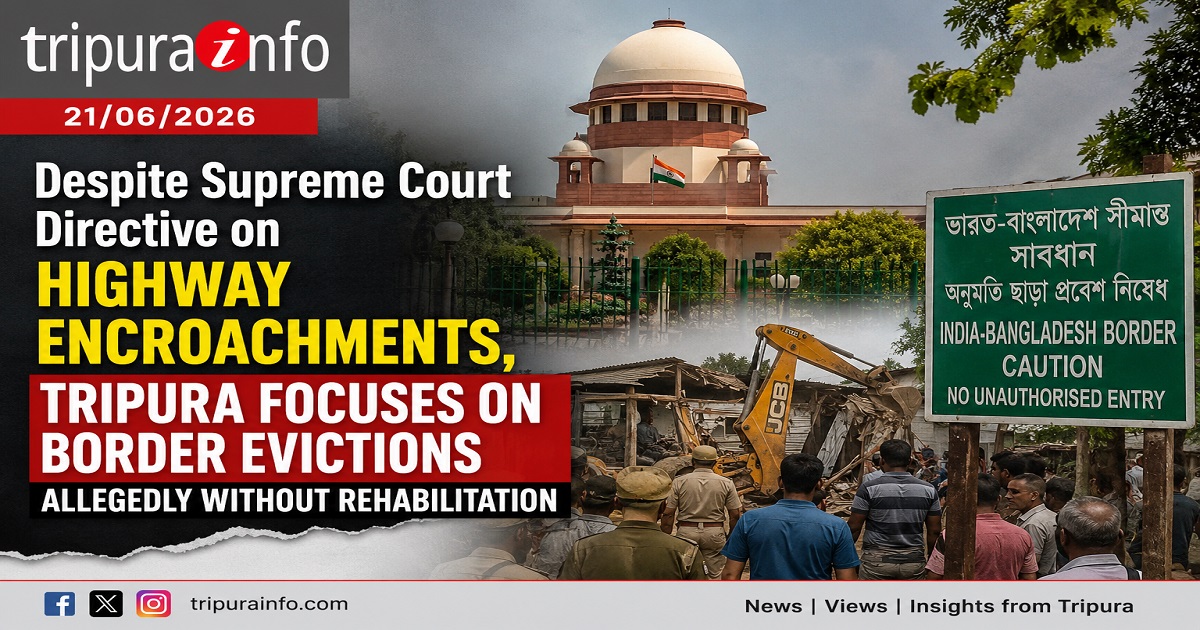 The recent eviction drive carried out by the administration in Tripura's Boxanagar area of Sepahijala district has once again brought the issue of illegal land occupation and selective enforcement of anti-encroachment measures into sharp focus. While authorities have justified the operation on security grounds along the sensitive India-Bangladesh border, questions are being raised over why similar action has not been taken against widespread encroachments on National Highways and public roads across the state despite clear directives from the Supreme Court of India.
According to reports, the Sonamura Sub-Divisional Administration, assisted by police, CRPF, BSF, TSR personnel and revenue officials, demolished several illegally occupied structures near the international border in Madhya Boxanagar under Sonamura subdivision. The operation followed repeated notices served to residents who had allegedly occupied government land adjacent to the border fencing for years.
Administrative officials stated that some of the structures were located in highly sensitive areas near the India-Bangladesh border and had reportedly become a concern for border management, security surveillance and anti-smuggling operations. Officials also claimed that many of the affected families had previously been offered rehabilitation opportunities but continued to occupy the disputed land.
The eviction drive reportedly lasted for nearly one and a half hours and was completed without any major law-and-order incident, despite initial tension in the area. Border security officials maintained that clearing encroachments near the fencing was essential for effective patrolling, surveillance and maintenance of border infrastructure.
However, the action has generated considerable debate among political observers, civil society members and local residents. Critics argue that while the government has demonstrated urgency in removing alleged encroachments in border areas, it has shown little willingness to address similar or even more extensive illegal occupations along National Highways, state roads and urban streets throughout Tripura.
Across Agartala and several district headquarters, unauthorized shops, commercial establishments, temporary structures, roadside markets and private constructions continue to occupy road shoulders, drains and public land. These encroachments often reduce road width, create traffic bottlenecks, obstruct pedestrian movement and increase the risk of accidents.
The issue gained further significance after the Supreme Court of India, in various judgments concerning public roads and highways, emphasized the responsibility of governments and local authorities to remove unauthorized encroachments from roads and public spaces in the interest of public safety, smooth traffic movement and protection of public property. The apex court has repeatedly observed that public roads cannot be allowed to be occupied by private individuals or commercial interests at the expense of citizens' right to safe mobility.
Critics therefore question why large-scale encroachments on National Highways and urban roads continue to remain untouched while vulnerable border residents are subjected to immediate eviction. They argue that a uniform and transparent policy should be adopted throughout the state, ensuring that all forms of illegal occupation of public land are addressed equally, irrespective of location, economic status or political influence.
Another concern being raised is the issue of rehabilitation. Human rights advocates and social activists maintain that while illegal occupation of government land cannot be legally justified, authorities must ensure that economically weaker families are not rendered homeless without adequate rehabilitation and livelihood support. They stress that eviction drives should balance legal enforcement with humanitarian considerations, particularly in cases involving long-settled families.
Government officials, however, maintain that the Boxanagar operation was necessitated by unique security concerns associated with the international border and cannot be directly compared with ordinary encroachment issues elsewhere. They argue that unrestricted occupation near border fencing hampers surveillance, facilitates illegal cross-border activities and poses challenges to security agencies.
The controversy has nevertheless reignited a broader discussion about land management, urban planning and governance in Tripura. Observers note that unless the state formulates a comprehensive encroachment removal policy applicable to highways, roadsides, urban areas and border zones alike, allegations of selective enforcement are likely to persist.
As the debate continues, many citizens are calling for a state-wide survey of encroachments on National Highways, municipal roads, public land and government property, followed by a transparent action plan that combines strict legal enforcement with fair rehabilitation measures. The Boxanagar eviction drive may have addressed immediate border security concerns, but it has also exposed deeper questions about consistency, accountability and fairness in the implementation of land and encroachment laws across Tripura.
more news...