Tripura’s Rural Employment System Under Strain : Unpaid GRS Workers Prepare for Statewide Agitation Amid Challenges in New VB-G RAM G Scheme
By Our Correspondent
Agartala, June 21, 2026
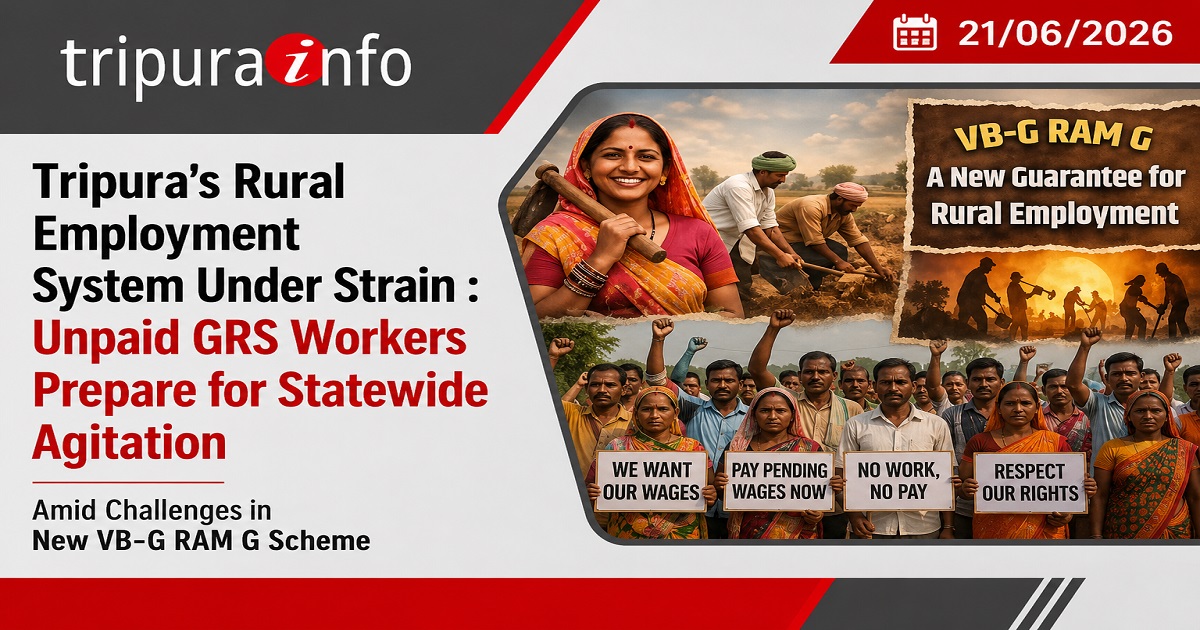 Tripura’s rural administration is facing mounting discontent as thousands of Gram Rozgar Sahayaks (GRS) and other contractual employees associated with rural development programmes are reportedly preparing for a statewide agitation over prolonged salary delays. The unrest comes at a critical juncture when the country’s flagship rural employment programme has transitioned from the Mahatma Gandhi National Rural Employment Guarantee Act (MGNREGA) to the newly introduced Viksit Bharat – Guarantee for Rozgar and Ajeevika Mission (Gramin), popularly known as VB-G RAM G.
The new legislation has increased the guaranteed rural employment entitlement from 100 days to 125 days per household annually. The Centre has projected the scheme as a major reform aimed at strengthening rural livelihoods, creating durable community assets, improving transparency, and advancing the vision of a developed India by 2047. However, on the ground in Tripura, questions are being raised over whether the objectives of the ambitious programme are translating into reality.
Several rural residents and local representatives allege that despite the enhanced guarantee of 125 days of employment, many beneficiaries are receiving only 30 to 40 days of work in a year. Panchayat functionaries also claim that compared to the previous MGNREGA framework, the scope for undertaking employment-generating works has been reduced significantly, limiting the ability of local bodies to provide adequate job opportunities to rural households. These concerns have been further amplified by the salary crisis affecting the frontline workforce responsible for implementing the scheme.
Across Tripura, nearly 2,000 Gram Rozgar Sahayaks play a crucial role in the functioning of Panchayats and rural development programmes. Originally engaged to supervise and coordinate employment generation activities under MGNREGA, their responsibilities have expanded substantially over the years. Today, GRS personnel are involved in maintaining official records, beneficiary verification, digital data entry, monitoring development works, managing employment-related documentation, and assisting Panchayat administrations in a wide range of day-to-day operations.
According to reports from various parts of the state, many GRS employees have not received their salaries for the past two months, pushing their families into severe financial distress. The situation is particularly alarming in Dhalai district’s Gandacherra subdivision, where 26 GRS personnel working under Dumburnagar and Raisyabari blocks are reportedly struggling to cope with mounting financial difficulties.
Affected employees say the salary delays have disrupted every aspect of their lives. Many claim they are finding it difficult to pay school fees and educational expenses for their children, purchase essential household commodities, meet routine family expenditures, or provide medical care and medicines for elderly parents. Despite these hardships, they continue to discharge their responsibilities to ensure the smooth functioning of Panchayat offices and rural development activities.
Sources indicate that memorandums and deputations demanding immediate release of pending salaries have already been submitted to District Magistrates and other administrative authorities in several districts. However, employees claim that no clear assurance has yet been provided regarding the timeline for payment of arrears. As frustration grows, GRS workers across the state are reportedly preparing to launch a larger coordinated movement if their demands remain unaddressed.
The salary crisis is not an isolated incident. Similar disputes have surfaced repeatedly over the years. In the past, allegations emerged that salaries of GRS personnel and other contractual staff were linked to the performance of Panchayats in generating employment mandays. Employees alleged that salaries were sometimes withheld when a Panchayat’s manday generation fell below the average performance of the block, effectively penalising workers for factors often beyond their control.
Apart from performance-related concerns, delays in fund releases under centrally sponsored rural employment programmes have also been cited as a major reason for payment disruptions. Since such schemes depend on coordinated financial support from both the Centre and the State Government, delays in fund flow, administrative approvals, and financial processing can directly affect the payment of contractual staff engaged in implementation.
The transition from MGNREGA to VB-G RAM G has increased the importance of field-level personnel such as GRS workers. The new framework places greater emphasis on accountability, digital monitoring, infrastructure creation, employment generation, and timely wage disbursement. Experts argue that the success of these objectives depends heavily on the efficiency and morale of grassroots workers, making timely payment of salaries a critical administrative requirement.
Official data indicate that Tripura has approximately 1,962 sanctioned GRS positions spread across 58 Rural Development blocks, assisting more than 1,193 Gram Panchayats and Village Committees throughout the state. Their services are considered indispensable to the functioning of rural governance. Any disruption in their work could affect Panchayat administration, implementation of welfare schemes, maintenance of records, and execution of employment-generation projects.
The growing resentment among GRS workers has therefore evolved beyond an employee welfare issue into a matter of wider concern for Tripura’s rural development machinery. As the state seeks to implement the ambitious goals of the VB-G RAM G programme, pressure is mounting on the government to address salary delays, improve employment generation at the grassroots level, and restore confidence among both workers and beneficiaries.
For thousands of GRS personnel and their families, the coming weeks may prove decisive. Whether the issue is resolved through dialogue and administrative intervention or escalates into a statewide agitation could have significant implications for the functioning of Tripura’s rural development sector and the future implementation of the new rural employment regime.
more news...