Tripura CM Urges Removal of Ceiling on Externally Aided Projects, Highlights State’s Rapid Economic Growth at Shillong Seminar
By Our Correspondent
Agartala, June 19, 2026
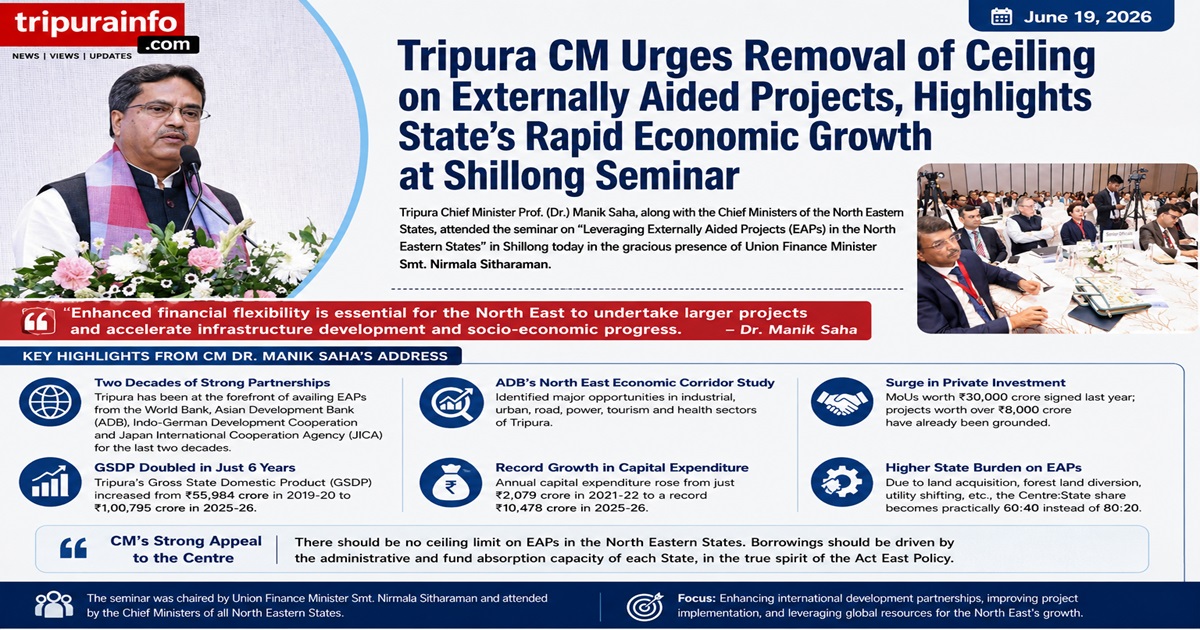 Tripura Chief Minister Professor Dr. Manik Saha strongly advocated for the removal of ceiling limits on Externally Aided Projects (EAPs) for North Eastern states while addressing a high-level seminar on “Leveraging Externally Aided Projects (EAPs) in the North Eastern States” held in Shillong on Friday.
The seminar was attended by the Chief Ministers of all North Eastern states and chaired by Union Finance Minister Nirmala Sitharaman, focusing on strategies to maximize the benefits of international development financing for the region's infrastructure and socio-economic advancement.
During his address, Dr. Saha emphasized that the North Eastern states require greater financial flexibility to undertake large-scale development projects and accelerate infrastructure creation. He urged the Central Government to remove borrowing ceilings on EAPs and instead assess projects based on each state's administrative and fund absorption capacity.
Regarding Tripura's achievements, the Chief Minister said the state has been one of the leading beneficiaries of externally aided projects over the last two decades. Tripura has successfully partnered with several international development agencies, including the World Bank, Asian Development Bank (ADB), Indo-German Development Cooperatio, and Japan International Cooperation Agency (JICA).
According to Dr. Saha, these collaborations have significantly contributed to the state's socio-economic transformation while simultaneously strengthening administrative and institutional capacities.
The Chief Minister noted that Tripura's strategic partnership with the Asian Development Bank has opened new avenues for development. He specifically referred to ADB's North East Economic Corridor Study, which has identified substantial opportunities across multiple sectors, including:
Industrial development,
Urban infrastructure, Road connectivity,
Power and energy, Tourism, and Healthcare.
He stated that these sectors have immense potential to drive economic growth, generate employment, and improve the quality of life for citizens.
Presenting impressive economic indicators, Dr. Saha informed the gathering that Tripura's Gross State Domestic Product (GSDP) has nearly doubled within a short span of six years.
The state's GSDP increased from Rs 55,984 crore in 2019-20 to Rs 1,00,795 crore in 2025-26, reflecting robust economic expansion and improved development outcomes.
"The doubling of the state's economy within six years demonstrates Tripura's growing economic strength and enhanced development capacity," he said.
The Chief Minister also highlighted the remarkable increase in the state's capital expenditure, which has expanded more than five times in just four years.
Annual capital expenditure rose from Rs 2,079 crore in 2021-22 to a record Rs 10,478 crore in 2025-26.
According to Dr. Saha, this unprecedented increase reflects the state's improved capacity to implement large-scale infrastructure projects and effectively utilize development funds.
He remarked that the substantial rise in both GSDP and capital expenditure clearly indicates the enhanced absorption capacity of Tripura's administrative machinery.
Dr. Saha further pointed out that Tripura has witnessed a significant surge in private sector investment in recent years.
The state government signed Memorandums of Understanding (MoUs) worth approximately Rs 30,000 crore during the past year. Out of these commitments, projects valued at over Rs 8,000 crore have already been grounded and are under implementation.
He stated that the growing inflow of private investment is creating additional demand for public infrastructure development, particularly in industrial estates, roads and highways, power infrastructure, Tourism facilities, and Water supply systems.
"The increasing private investment requires substantial complementary investment by the government to ensure adequate infrastructure support," he said.
Drawing attention to a key financial challenge, the Chief Minister explained that North Eastern states often incur substantial expenditure on land acquisition, forest land diversion, rehabilitation measures, and utility shifting while implementing externally aided projects.
Although the official funding pattern for EAPs follows an 80:20 Centre-State ratio, these additional expenses effectively increase the state's burden, making the practical cost-sharing ratio closer to 60:40.
"This creates a significant financial burden on resource-constrained states like Tripura and other North Eastern states," he observed.
Concluding his address, Dr. Saha urged the Centre to adopt a more flexible and development-oriented approach towards externally aided projects in the North East.
He proposed that there should be no ceiling limit on EAP borrowings for North Eastern states. Instead, the volume of borrowings should be determined by the individual state's administrative efficiency, project implementation capability, and fund absorption capacity.
The Chief Minister argued that such a policy shift would be in line with the spirit of the Central Government's Act East Policy, which envisions transforming the North East into India's gateway to Southeast Asia through enhanced connectivity, infrastructure, trade, and economic integration.
more news...