North Tripura DM Highlights Jampui Hills Springshed Success, Calls for Stronger Water Conservation Policies
By Our Correspondent
Agartala, June 19, 2026
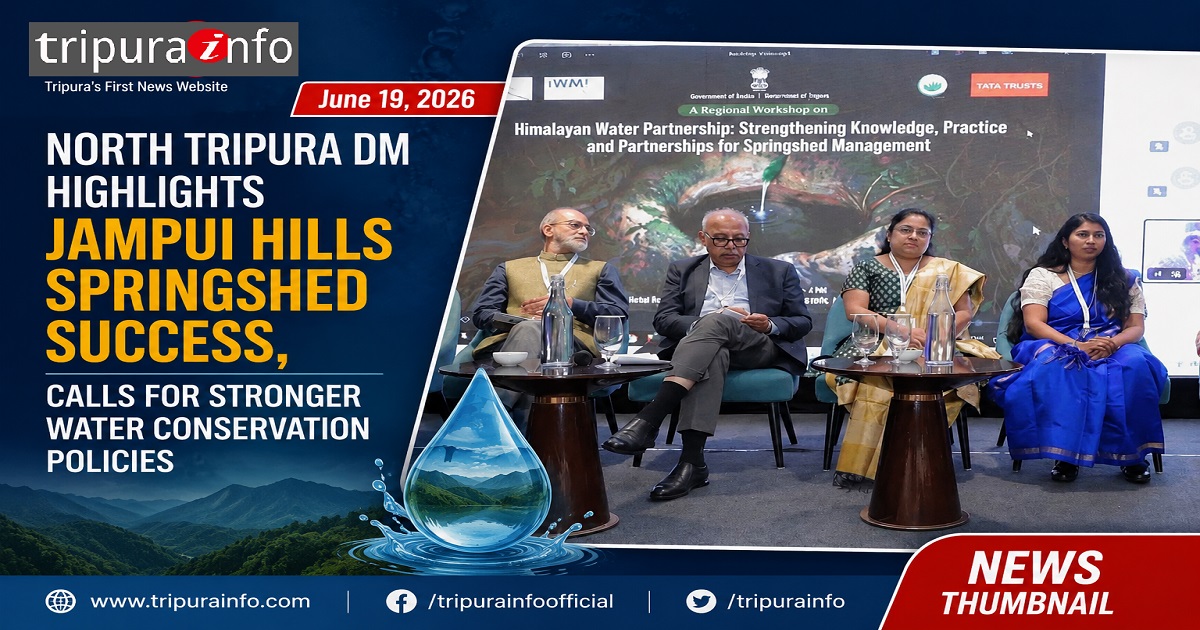 Stressing the urgent need for sustainable water resource management across the Himalayan and Northeastern regions, Ms. Chandni Chandran, IAS, District Magistrate and Collector of North Tripura, participated in a high-level panel discussion on “Role of Technology, Community in Springshed Management and the Need for an Integrated Policy Framework” during the Regional Workshop on Himalayan Water Partnership: Strengthening Knowledge, Practice and Partnerships for Springshed Management. The event was held in Guwahati, organized Tata Trust and CML in collaboration with the Government of Assam and Tripura.
The workshop brought together policymakers, administrators, researchers, experts and development practitioners to exchange ideas and experiences on conserving and rejuvenating springs, which remain a vital source of drinking water and livelihood support for millions living in mountainous regions.
During the discussion, Ms. Chandran shared key learnings from the Springshed Management Project in Jampui Hills, one of Tripura’s most ecologically significant hill regions. She informed participants that interventions had been undertaken in 36 springs to improve groundwater recharge and revive several springs that had either become degraded or were on the verge of drying up. The project demonstrated how scientific interventions combined with community participation can restore critical water sources and improve long-term water security.
Highlighting a growing environmental concern, the District Magistrate cited survey findings indicating that nearly 40 percent of springs in the hill regions of Northeast India have disappeared during the last five years. She warned that the rapid decline of natural springs poses a serious threat to water security, biodiversity and the livelihoods of hill communities.
She emphasized the urgent need for large-scale efforts to recharge aquifers, revive depleted springs and establish community-led monitoring mechanisms before irreversible damage occurs. According to her, local communities should be actively involved in mapping, monitoring and protecting springs, as they are the primary stakeholders and custodians of these natural resources.
Ms. Chandran also drew attention to the allocation pattern of water conservation funds under national programmes. She noted that 40 to 65 percent of MGNREGA funds earmarked for water conservation are currently directed towards districts classified as critical, largely located in states such as Punjab, Haryana and Rajasthan. While acknowledging the importance of conservation efforts in those regions, she pointed out that these areas are largely discharge zones of rivers and streams, whereas the Himalayan and Northeastern states function as crucial recharge zones.
She argued that unless conservation and recharge activities are strengthened in the upstream regions, downstream water availability cannot be sustainably improved. Accordingly, she recommended that water conservation initiatives be made mandatory across all districts rather than being limited to designated critical districts.
The District Magistrate further highlighted an innovative initiative from Koriya district in Chhattisgarh, where farmers were encouraged to dedicate five percent of their agricultural land for water conservation activities. She suggested that a similar model could be adopted nationwide and linked to agricultural subsidies and government support schemes, thereby promoting sustainable water management practices at the grassroots level.
The panel discussion underscored the importance of integrating modern technology, scientific research, traditional knowledge, community participation and policy support to ensure long-term water security. Participants agreed that stronger collaboration among governments, local communities, research institutions and development agencies would be essential to protect springs, restore fragile ecosystems and enhance climate resilience in mountain regions.
The workshop concluded with a collective call for strengthened partnerships, greater knowledge sharing and integrated policy interventions to address the growing challenges of water scarcity, climate change and ecosystem degradation across the Himalayan and Northeastern regions of India.
more news...