Huge consignment of banned Phensedyl cough syrup recovered from luxury apartment in the heart of Agartala, young woman aressted
By Our Correspondent
Agartala, June 19, 2026
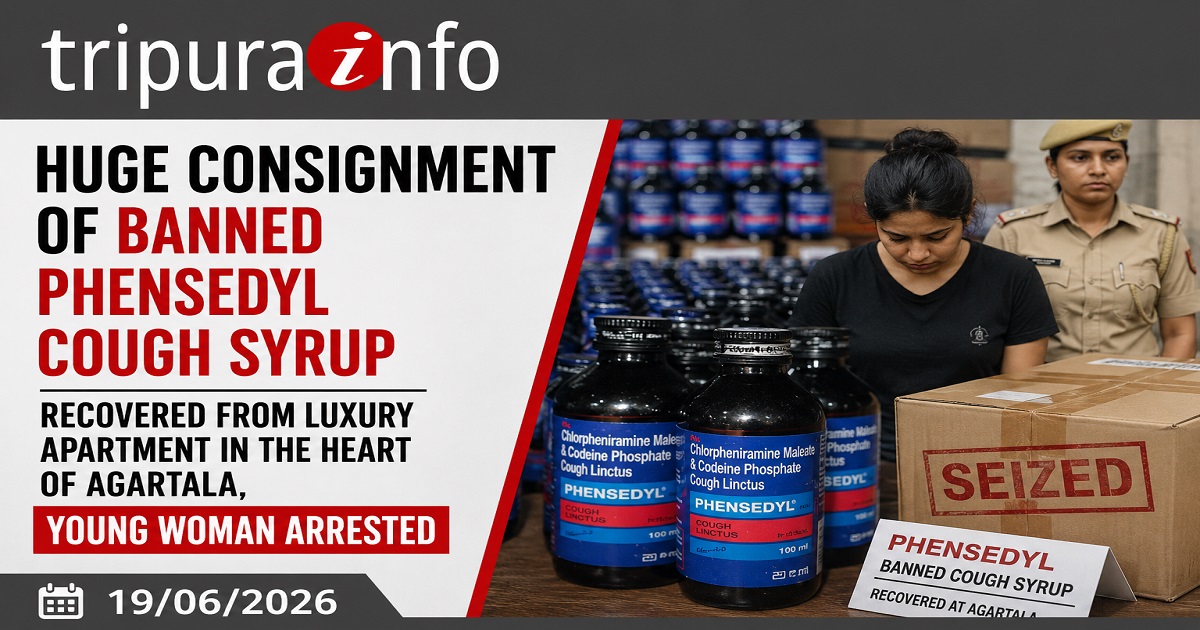 The recovery of a huge consignment of banned Phensedyl cough syrup from a luxury apartment in the heart of Agartala and the arrest of a young woman have once again raised serious concerns over the effectiveness of Tripura's anti-drug campaign and the growing reach of narcotics networks across the state.
Despite successive government campaigns and repeated assurances of building a "Drug-Free Tripura," the latest seizure has highlighted the continuing presence of organized drug trafficking even in some of the most prominent residential areas of the capital city.
According to police sources, a late-night raid conducted at Arundhati Apartment near the College Tilla area resulted in the seizure of 749 bottles of banned Phensedyl cough syrup. A young woman from Dhalai district was arrested in connection with the case. The operation was reportedly carried out based on specific intelligence inputs.
The incident has triggered fresh debate about the scale of the narcotics trade operating across Agartala and other parts of Tripura. Critics argue that while occasional seizures and arrests are being highlighted, the principal operators and kingpins behind the lucrative drug network continue to remain beyond the reach of law enforcement agencies.
Observers point out that drug trafficking has become increasingly visible in several localities of the capital, with allegations that illegal transactions are taking place openly in many neighbourhoods, particularly during evening and night hours. The situation recently came under public scrutiny when West Tripura District Magistrate Dr. Vishal Kumar, IAS during a surprise field visit at Agartala’s Battala area accompanied by Superintendent of Police Namit Pathak, IPS reportedly detected and acted against alleged drug-related activities.
The latest seizure has also brought attention to a worrying trend—the increasing involvement of women in drug trafficking operations. Security experts believe that organized traffickers are increasingly using women as carriers or intermediaries, assuming they may attract less suspicion during transportation and storage of contraband substances.
Questions are also being raised about intelligence gathering and surveillance mechanisms. Critics argue that the storage of such a large quantity of narcotics in a well-known apartment complex located near educational institutions indicates significant gaps in monitoring and enforcement. They contend that if such operations can function from high-profile locations, the scale of the underground network may be far larger than what occasional seizures reveal.
Social activists and concerned citizens have expressed alarm over the growing availability of narcotic substances among the youth. They warn that drug syndicates are employing increasingly sophisticated methods to expand their operations, posing a serious threat to public health, social stability and the future of young people in the state.
While the government and law enforcement agencies have repeatedly reiterated their commitment to eliminating the drug menace, many residents believe that lasting success will depend on dismantling the financial and organizational structures of the trafficking networks rather than merely arresting low-level carriers and distributors.
The latest operation has therefore renewed calls for intensified intelligence-based investigations, stronger surveillance, coordinated enforcement action and the identification of the alleged masterminds behind the drug trade. Until the roots of the narcotics network are effectively uprooted, many fear that the vision of a truly "Drug-Free Tripura" may remain an aspiration rather than a reality.
more news...