Surrendered Militants Assured After Meeting with CM, Another Group Threatens Fresh Highway and Rail Blockade on June 24
By Our Correspondent
Agartala, June 18, 2026
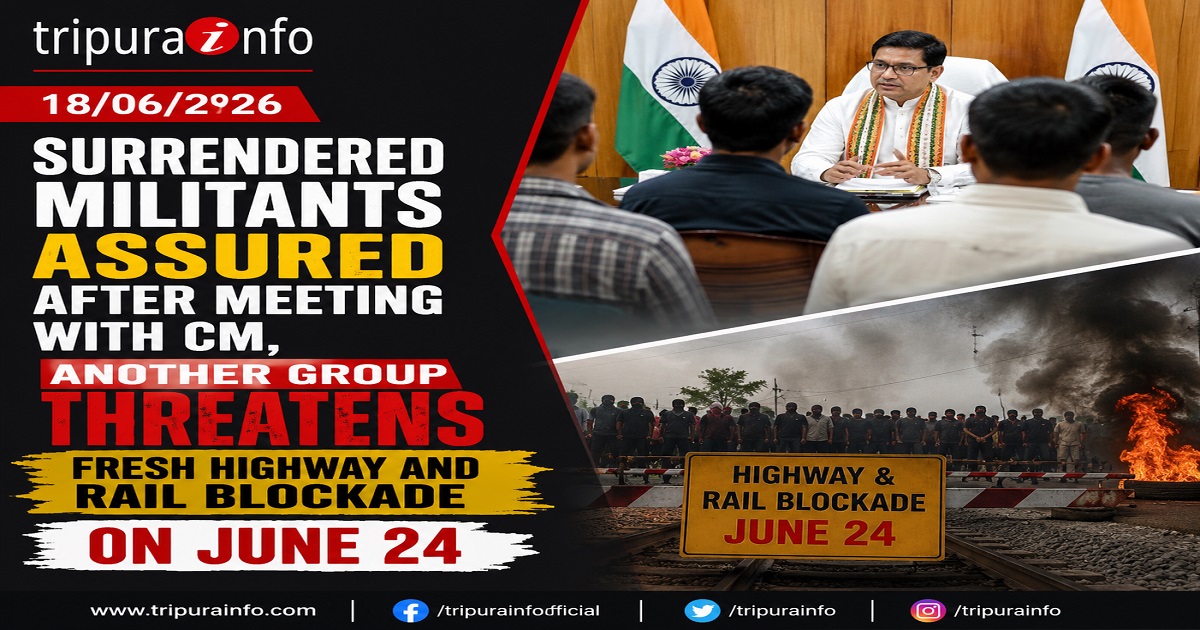 Relief appears to be in sight for one section of surrendered insurgents in Tripura after a high-level meeting with Chief Minister Professor (Dr) Manik Saha, even as another group of former militants has renewed its threat to launch a statewide National Highway and railway blockade on June 24, highlighting lingering rehabilitation issues in the state.
Representatives of several surrendered militant organizations met the Chief Minister at his official residence on Tuesday following the withdrawal of a previously announced 72-hour road blockade programme scheduled from June 12. The agitation had been suspended after the government assured the groups that their concerns would be heard at the highest level.
The meeting focused on a range of long-pending demands related to rehabilitation, welfare benefits, livelihood opportunities, and other issues affecting former insurgents who had laid down arms and returned to mainstream society.
Earlier, Tribal Welfare Minister Bikash Debbarma had met the agitators and conveyed the Chief Minister's willingness to engage in dialogue, paving the way for the latest discussions.
Representing the surrendered militant groups at the meeting were Prasenjit Debbarma, Parimal Debbarma, Alindra Debbarma, and Vidyadhar Tripura. Apart from the Chief Minister, the meeting was attended by Tribal Welfare Minister Bikash Debbarma, the Chief Secretary, Director General of Police, and senior officials from concerned departments.
Speaking to reporters after the meeting, Prasenjit Debbarma described the discussions as positive and constructive. He said the government had listened to their concerns seriously and assured them that their demands would be examined. Expressing satisfaction with the outcome, he voiced hope that effective steps would now be taken to resolve issues that have remained pending for years.
Political observers and administrative officials believe the dialogue could play an important role in easing tensions and creating a pathway toward a lasting solution for surrendered militants seeking rehabilitation and social integration.
However, while one chapter of unrest appears to be moving towards resolution, another is gathering momentum.
Tripura is once again bracing for a proposed blockade of National Highways and railway tracks on June 24, called by a separate group of surrendered former insurgents. The announcement has reignited debate over the state's rehabilitation policies and the challenges of addressing demands from various categories of surrendered militants.
Unlike recently surrendered insurgent groups that entered into formal rehabilitation agreements with the government, the organizations behind the proposed June 24 agitation reportedly do not have any officially recognized rehabilitation pact. Their members claim they surrendered individually to security forces, including the police, Assam Rifles, and Border Security Force (BSF), at different times, mostly more than a decade ago.
According to the agitators, despite giving up militancy and returning to civilian life, many of their demands regarding rehabilitation, financial assistance, employment opportunities, and welfare support have remained unresolved.
The issue gained prominence after the state government last year signed a major rehabilitation agreement with surrendered cadres of the National Liberation Front of Tripura (NLFT) and the All Tripura Tiger Force (ATTF). Under that settlement, around Rs. 250 crore was earmarked for development and welfare initiatives aimed at tribal communities and the rehabilitation of former militants.
Since then, several groups that claim they were excluded from rehabilitation packages have intensified their demands. Over recent months, the state has witnessed repeated threats of highway and railway blockades by surrendered militants seeking recognition and benefits similar to those provided under recent agreements.
Such protests have often caused widespread disruption, affecting transportation, trade, educational activities, healthcare access, and the movement of essential commodities across the state.
With the June 24 deadline approaching, attention is now focused on whether the government can engage with the protesting groups and prevent another round of disruptions. The administration is expected to closely monitor the situation while exploring avenues for dialogue to maintain peace and normalcy across Tripura.
more news...