Tripura’s Revenue Boom: Own Revenue Nearly Triples Since 2018, Increased from Rs.1,915.50 crore in 2017-18 to a projected Rs.4,470 crore in 2026-27
By Our Correspondent
Agartala, June 17, 2026
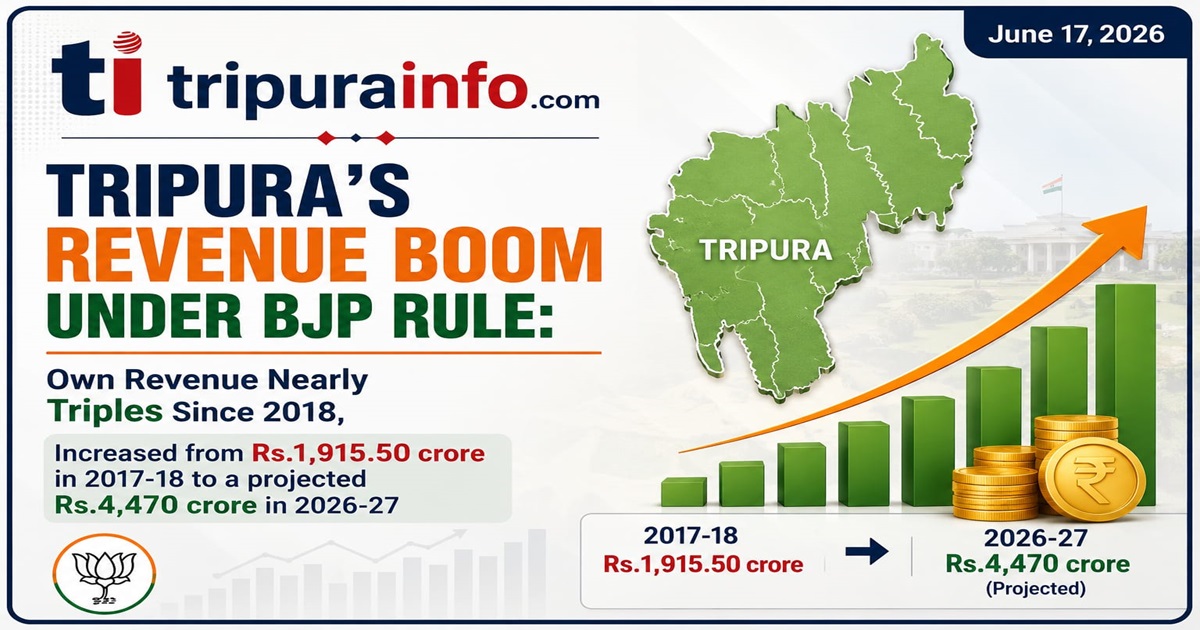 Tripura has recorded a remarkable rise in its own revenue generation over the past decade, particularly after the BJP-led government came to power in 2018. Official budget records show that the state's own revenue has increased from Rs.1,915.50 crore in 2017-18, the last financial year before the BJP assumed office, to a projected Rs.4,470 crore in 2026-27. The figures indicate that the state's internal revenue collection has more than doubled in less than a decade, reflecting a significant expansion of its tax base and stronger fiscal management.
The growth story has been driven primarily by a sharp increase in tax revenue. State Own Tax Revenue, which stood at Rs.1,422.02 crore in 2017-18, is projected to reach Rs.4,020 crore in 2026-27. This represents one of the fastest revenue expansions in Tripura's history and highlights the government's efforts to improve tax administration, strengthen compliance mechanisms and widen the scope of revenue collection.
Among all revenue sources, the Goods and Services Tax (GST) has emerged as the largest contributor to the state exchequer. GST collections have risen dramatically from Rs.479.71 crore in 2017-18 to an estimated Rs.1,933.84 crore in 2026-27. The implementation of GST, combined with digital monitoring and stricter compliance measures, has significantly increased the state's earnings from commercial activities and consumer spending.
Another major contributor to revenue growth has been the Road Development Cess. Prior to the BJP government, collections from this source were either negligible or non-existent. However, the cess generated Rs.27.75 crore in 2018-19 and is expected to contribute Rs.429.02 crore in 2026-27. Similarly, state excise revenue has grown steadily from Rs.54.38 crore in 2017-18 to Rs.178.20 crore in the current budget estimates. Revenue from vehicle taxes, registration fees and transport-related services has also witnessed substantial growth due to increasing vehicle ownership and enhanced enforcement.
The state's revenue from taxes on vehicles has increased from Rs.36.95 crore in 2017-18 to Rs.131.82 crore in 2026-27, while receipts from stamps and registration fees are projected to rise from Rs.40.16 crore to Rs.145 crore during the same period. VAT collections, mainly from petroleum products, continue to remain a significant source of revenue and are expected to generate around Rs.650 crore in 2026-27.
On the non-tax side, royalties from industries and petroleum sectors have shown considerable growth. Revenue from this segment has increased from single-digit figures a decade ago to an estimated Rs.181 crore in 2026-27. Departments such as Public Works, Forest and Wildlife, Fisheries, Housing and Animal Resources Development have also contributed to strengthening the state's own revenue base.
While the revenue growth reflects a stronger fiscal position for the government, it has also generated concerns among citizens, traders, transport operators and middle-class households who argue that the increasing tax burden is affecting their daily lives. Many consumers indirectly bear the impact of GST through higher prices of goods and services. Rising fuel costs, coupled with VAT and Road Development Cess, have increased transportation expenses, which in turn influence the prices of essential commodities. Vehicle owners have also faced higher costs through road taxes, registration fees and various transport-related charges.
Small businesses and traders often contend that stricter compliance requirements under GST and other taxation mechanisms have increased operational costs. Many argue that while revenue collection has improved substantially, ordinary citizens have not always experienced corresponding relief from inflation and rising living expenses.
Economic observers note that a balance must be maintained between revenue generation and public welfare. While states require adequate resources to fund infrastructure projects, healthcare, education and welfare programmes, excessive dependence on indirect taxes can disproportionately affect lower and middle-income groups because such taxes are ultimately paid by consumers regardless of income level.
Several economists believe that the government could consider reducing certain levies, particularly the Road Development Cess and selected fuel-related taxes, when fiscal conditions permit. A modest reduction in these taxes could help lower transportation costs, ease inflationary pressures and provide relief to households and businesses. Experts also suggest that expanding industrial activity, tourism, information technology investments and natural gas-based industries would generate additional revenue without placing further tax burdens on citizens.
more news...