Fresh Call for National Highway and Railway Blockade on June 24 Raises Questions Over Rehabilitation Demands and Governance in Tripura
By Our Correspondent
Agartala, June 17, 2026
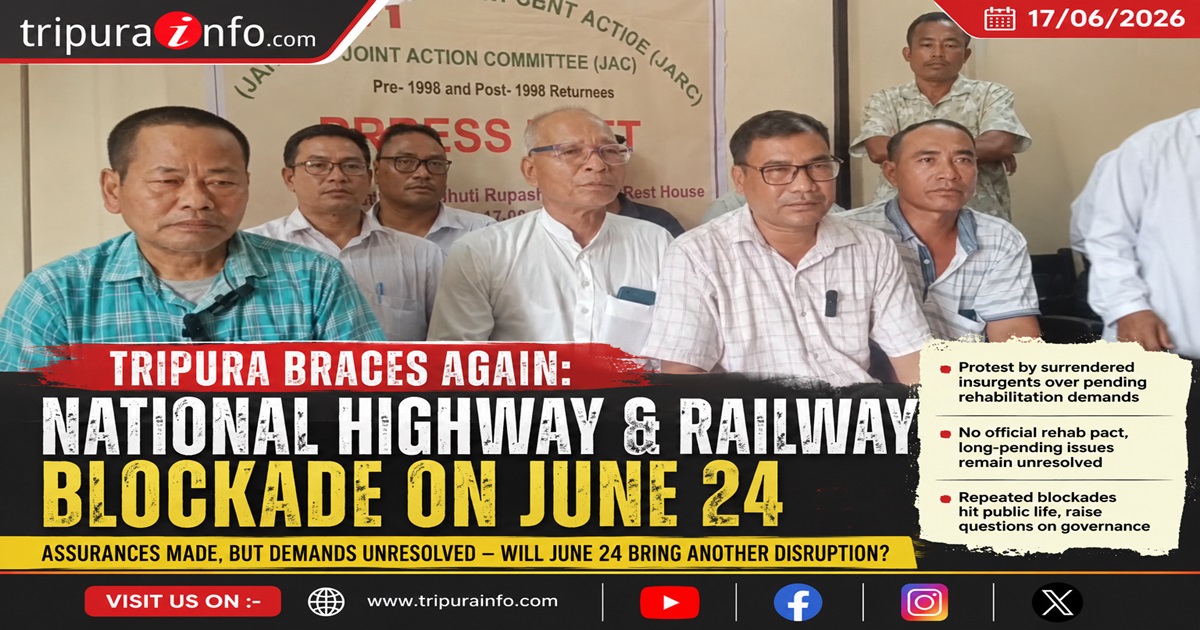 Tripura is once again bracing for a proposed blockade of National Highways and railway tracks on June 24, called by a group of surrendered former insurgents. The announcement has reignited debate over the state's rehabilitation policies, administrative response, and the recurring disruption of public life caused by such agitations.
Unlike some of the recently surrendered militant groups that entered into formal agreements with the government, the organizations behind the latest protest reportedly do not have any officially recognized rehabilitation pact. The groups claim that their members had surrendered individually to security forces, including the police, Assam Rifles, and Border Security Force (BSF), at different points in time, often more than a decade ago. Despite laying down arms and returning to civilian life, they allege that many of their long-pending demands remain unresolved.
The issue gained renewed attention following a rehabilitation agreement signed last year involving surrendered cadres of the National Liberation Front of Tripura (NLFT) and the All Tripura Tiger Force (ATTF). Under that agreement, approximately Rs 250 crore was earmarked for various welfare and development initiatives aimed at benefiting tribal communities and supporting rehabilitation efforts.
Since then, several groups claiming to have been left out of rehabilitation packages have intensified their demands. Over the past months, Tripura has witnessed repeated calls for highway and railway blockades by surrendered militants seeking recognition, financial assistance, livelihood opportunities, and other benefits. Each such protest has significantly affected daily life, disrupting transportation, trade, education, healthcare access, and the movement of essential goods.
Critics argue that the recurring nature of these agitations reflects deeper administrative shortcomings. They point out that government representatives, including ministers from the Tribal Welfare Department and even Chief Minister Dr. Manik Saha, have held discussions with protestors and offered assurances on multiple occasions. However, according to the agitating groups, many of those commitments have yet to materialize, leading to renewed protests every few months.
The situation has also triggered strong reactions among the public. Many citizens have expressed frustration over repeated disruptions to road and rail connectivity, questioning why the issue remains unresolved despite numerous rounds of dialogue. Public opinion remains divided, with some supporting the demands of surrendered militants who claim they were excluded from rehabilitation benefits, while others insist that no group should be allowed to repeatedly paralyze essential public infrastructure.
Observers note that railway blockades are particularly sensitive because Tripura's rail network serves as a critical lifeline connecting the state with the rest of India. Any disruption affects not only passengers but also the transportation of goods and supplies.
Political dimensions have also entered the debate, with allegations that certain political leaders are indirectly encouraging or supporting such movements. These claims, however, remain unverified and have not been officially substantiated.
The proposed June 24 blockade has once again placed the state government in a difficult position. Analysts believe the administration faces two clear options: either expedite a comprehensive resolution of the pending rehabilitation demands or adopt a firmer approach to prevent repeated disruptions of public life. Failure to address the issue decisively could lead to a continuation of the cycle of protests, negotiations, assurances, and fresh agitations.
As the deadline approaches, security agencies are expected to remain on alert while the government may seek further discussions with the agitating groups to avert another disruption of transport services. For ordinary citizens, however, the primary concern remains ensuring uninterrupted movement and a permanent solution to a problem that has resurfaced repeatedly over the past several years.
more news...