72-Hour Rail and Road Blockade Begins in Tripura, Public Anxiety Grows as Government Faces Questions Over Response
By Our Correspondent
Agartala, June 12, 2026
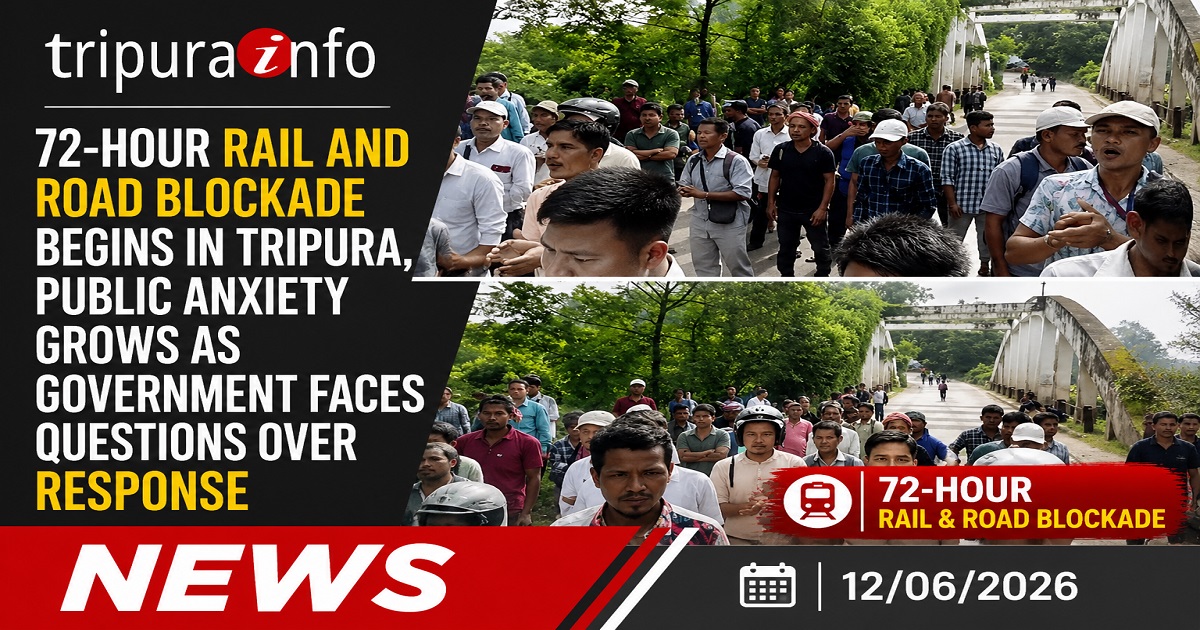 The 72-hour rail and road blockade called by surrendered militant groups has triggered a parallel debate across Tripura, with many questioning the necessity of such a disruptive agitation despite repeated assurances from both the Central and State Governments regarding the implementation of the Tiprasa Accord and a proposed development package worth approximately Rs.250 crore for tribal areas.
In recent weeks, leaders associated with the movement had publicly stated that Prime Minister Narendra Modi and Union Home Minister Amit Shah remain committed to fulfilling the promises made under the historic accord. Tribal Welfare Minister Bikash Debbarma also held discussions with representatives of the surrendered groups on the eve of the blockade and reportedly assured them that all demands falling within the jurisdiction of the State Government would be addressed.
Government sources indicated that while most of the demands are being actively considered, at least one major issue falls under the jurisdiction of the Union Home Ministry, limiting the State Government's ability to take immediate action. Despite these assurances and ongoing discussions, the surrendered groups internally backed by the Tipra Motha chose to proceed with the blockade, leading to widespread inconvenience for the general public.
The decision has prompted questions from various quarters. Critics argue that when governments have publicly committed themselves to implementing the accord and extending financial support for tribal development, there remains sufficient scope for dialogue and negotiation. They contend that a rail and road blockade disproportionately affects ordinary citizens, including students, patients, office-goers, daily wage earners, traders, railway passengers and air travelers.
Many citizens have also questioned why public life should be brought to a standstill when negotiations between the government and the protesters are still underway. The blockade has caused uncertainty regarding inter-district travel, disrupted transportation networks and generated anxiety among people who depend on uninterrupted movement for work, education and medical emergencies.
At the same time, leaders of the protesting groups maintain that assurances alone are not enough and that concrete implementation of commitments is required. According to them, the agitation is intended to ensure that promises made under the accord translate into visible action on the ground within a definite timeframe.
The contrasting positions have made the blockade not only a law-and-order issue but also a political test of confidence between the government and the indigenous communities. As the agitation enters its crucial phase, the key question being asked across Tripura is whether a blockade was necessary when assurances regarding the Tiprasa Accord and a Rs.250-crore development package had already been placed on the table.
According to reports received from different locations, one of the largest gatherings was witnessed near the Sadhupada Bridge area of Baramura Hills, where former surrendered cadres allegedly associated with the All Tripura Tiger Force (ATTF) and the National Liberation Front of Tripura (NLFT) assembled in support of the blockade. The situation has reportedly led to heightened tension in the Baramura region.
Vehicular movement on several important routes was disrupted from the early hours of the day. Traffic came to a standstill in affected areas, raising concerns among passengers, office-goers, students, and people requiring emergency travel.
Several allegations have also been raised regarding the role of the administration. Local residents claimed that instead of facilitating safe movement for commuters, police personnel were stopping vehicles and turning them back from blockade points. Some critics alleged that the authorities appeared to be enforcing movement restrictions rather than ensuring uninterrupted public transport. However, no official response has yet been issued regarding these allegations.
Questions have also been raised about the preparedness of the state administration ahead of the blockade. Critics claim that no significant preventive measures were announced on the previous day to ensure the smooth movement of long-distance train passengers, air travelers, students, office employees, and litigants who needed to reach courts and other institutions.
Reports further indicate that vehicular movement through the Hezamara–Khowai route has been suspended, affecting connectivity between districts. As a result, many residents remain uncertain about whether inter-district travel can be undertaken safely during the blockade period.
Political observers and members of the public have expressed concern over the absence of a detailed government statement regarding the situation. So far, there has been no official clarification regarding alternative travel arrangements, security measures, or the administration's strategy for maintaining normalcy during the blockade.
Government employees, teachers, students, and other daily commuters are reportedly facing confusion about attending offices, schools, and colleges. Many have sought clear instructions and assurances from the authorities regarding safety and transportation.
more news...