More Than 100 Cases, Multiple Complaints and Persistent Allegations Raise Questions Over Governance at Tripura University
By Our Correspondent
Agartala, June 7, 2026
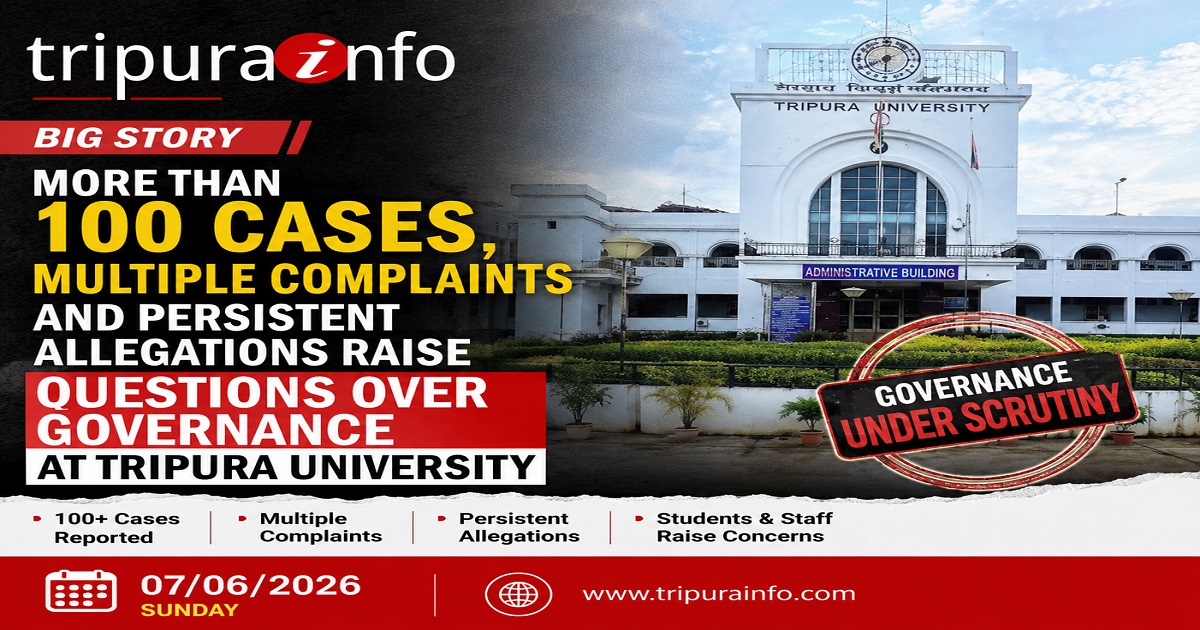 Tripura University (TU), once regarded as one of the most prestigious academic institutions in Northeast India, is facing mounting scrutiny amid a series of allegations relating to faculty appointments, recruitment irregularities, labour rights violations, academic misconduct and administrative failures. Critics, former employees, stakeholders and complainants have alleged that despite repeated complaints supported by documentary evidence, neither the university administration nor higher authorities have conducted comprehensive investigations into many of the allegations that have surfaced over the last several years.
According to various complainants and stakeholders, numerous representations have been submitted to university authorities, the Ministry of Education, the University Grants Commission (UGC), the Visitor's nominees and other constitutional authorities. However, they allege that meaningful action has rarely followed, forcing aggrieved individuals to seek relief through the courts.
Several stakeholders claim that more than one hundred cases involving Tripura University authorities, recruitment disputes, service matters, appointment controversies and administrative decisions have reached judicial forums over the years. Critics argue that the growing volume of litigation itself reflects deeper governance concerns within the institution.
Among the latest controversies is the appointment of an Assistant Professor in the Department of Tourism Administration. Petitioners challenging the appointment before the Tripura High Court have alleged that the university violated the essential eligibility conditions prescribed in its own recruitment advertisement dated January 6, 2025.
According to the allegations, the advertisement specifically required a Master's Degree in Tourism as an essential qualification. However, the selected candidate reportedly possessed a Post Graduate Diploma in Management (PGDM) rather than a Master's Degree in Tourism.
Critics point out that this appointment appears to contradict Tripura University's earlier stand in a 2019 recruitment dispute concerning the post of Registrar. In that case, a former Joint Registrar allegedly failed to secure relief from the High Court after the university maintained that a Master's Degree was an indispensable requirement and that equivalence claims could not override explicit recruitment rules.
Legal observers argue that the university's alleged change in interpretation raises questions regarding consistency, transparency and fairness in recruitment practices. The matter is presently under judicial scrutiny.
Additional allegations have also been raised regarding the counting of guest teaching experience and claims of favoritism and nepotism in the recruitment process. These allegations are also reportedly part of ongoing legal proceedings.
Another controversy concerns allegations regarding the educational qualifications of an Assistant Professor in the Department of Information Technology. A complaint submitted to the UGC alleges that the faculty member obtained an MTech degree from Karnataka State Open University (KSOU) during a period when the university's distance education programmes were allegedly not recognized by the UGC.
The complainant has requested verification of academic records and an inquiry into the subsequent Ph.D admission process at Tripura University. The UGC has forwarded the complaint to Tripura University for appropriate action and response. However, no final determination has yet been made by competent authorities regarding the allegations.
Another issue generating concern relates to approximately 80 casual workers reportedly engaged through outsourcing arrangements for nearly a decade.
Worker representatives allege that these employees receive extremely low wages and that deductions by the outsourced service provider further reduce their earnings. Labour rights activists have questioned whether all applicable labour laws and social security provisions are being properly implemented.
The matter has reportedly reached the office of the Regional Labour Commissioner (Central), Guwahati, following a complaint lodged by worker representative Debabrata Biswas. Labour activists have demanded a detailed investigation into wage practices, contractor arrangements and compliance with labour regulations.
According to employee representatives, many workers have spent years serving the institution without adequate job security, social benefits or wage protections.
Several stakeholders have also voiced concerns regarding examination administration and academic governance within the university.
Critics have alleged that controversies surrounding examination management, evaluation processes and administrative decision-making have damaged the institution's reputation in recent years. Some allegations relate to matters reportedly discussed in the Tripura Legislative Assembly concerning irregularities in examination systems connected to affiliated institutions.
No court or statutory authority has yet established culpability against any individual regarding these allegations. However, stakeholders continue to demand transparent inquiries into all reported incidents.
A section of university stakeholders has specifically criticised the functioning of the Controller of Examinations (In-Charge), Professor Chinmoy Roy.
Critics allege administrative failures, conflicts of interest and undue influence in various university matters. Allegations have also been made regarding recruitment decisions involving close relatives and the handling of academic affairs.
Those making the allegations have called for an independent departmental inquiry and have demanded that any investigation be conducted by authorities external to the university administration to ensure impartiality.
No official findings have been issued against Professor Roy regarding these allegations, and the matters remain subjects of public debate, complaints and legal proceedings.
Established in 1987 and elevated to the status of a Central University in 2007, Tripura University has played a pivotal role in higher education across the Northeast. For decades, the institution built a reputation for academic excellence and public service.
However, critics argue that recurring allegations involving recruitment, administration, examinations and governance have adversely affected public confidence in the institution.
Former students, teachers and civil society members increasingly argue that restoring trust will require transparent investigations, accountability mechanisms and institutional reforms.
more news...