Former IFS Officer and CWLW Calls for Independent Zoo Authority as Concerns Grow Over Wildlife Decline at Sepahijala
By Our Correspondent
Agartala, June 7, 2026
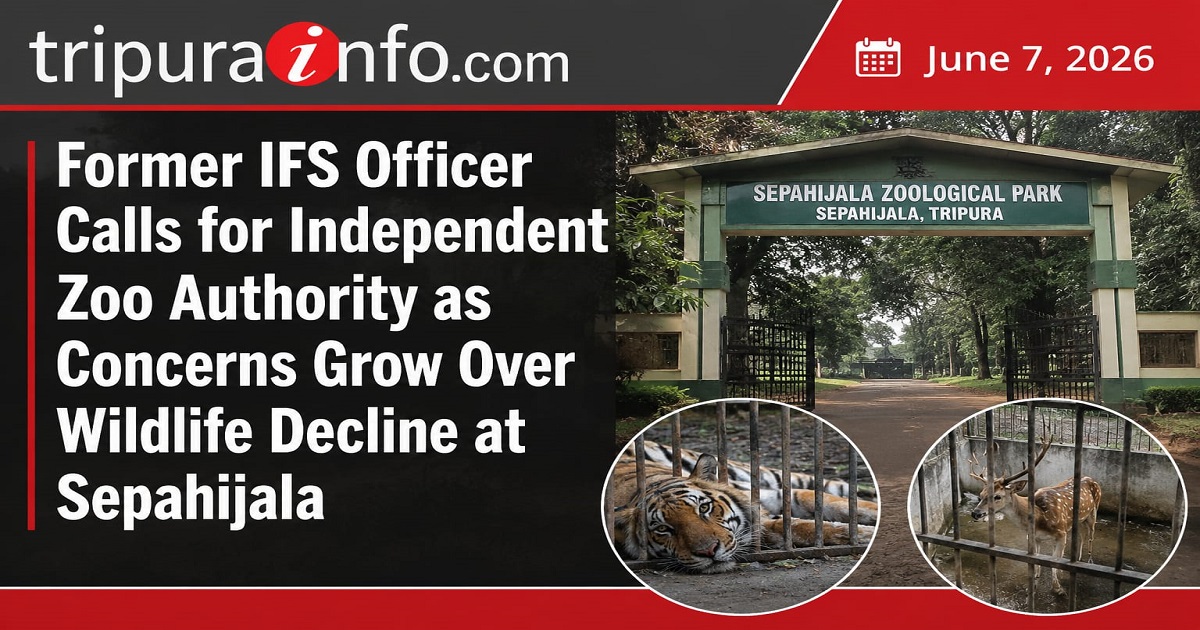 Amid growing concerns over declining wildlife populations and management challenges at Tripura's premier zoological institution, a former Indian Forest Service (IFS) officer has renewed his call for the creation of an independent Zoo Authority of Tripura, describing it as a crucial policy intervention that could transform zoo management, wildlife conservation and tourism development in the state.
The former officer, who previously served as Chief Wildlife Warden (CWLW), revealed that a detailed proposal for establishing such an authority had been prepared during his tenure and had reached an advanced stage of consideration. However, the proposal eventually stalled over questions regarding the financial sustainability of the authority from its inception.
According to him, Tripura's zoos require a professionally managed institutional framework capable of operating with scientific expertise, administrative autonomy and long-term planning. An independent Zoo Authority, he said, would be able to recruit technically qualified personnel, formulate its own operational guidelines in line with the standards of the Central Zoo Authority (CZA), and implement modern wildlife management practices.
The former CWLW noted that several states in India have already established autonomous zoo authorities which have significantly improved zoo administration while generating substantial revenue through tourism, visitor services and conservation-related activities.
He argued that expecting complete financial self-sufficiency from the very first day was unrealistic. Instead, he had proposed that the state government provide financial support for an initial period of three to five years, allowing the authority to develop infrastructure, improve visitor facilities, strengthen conservation programmes and establish sustainable revenue streams.
"Once the authority becomes operational and tourism potential is fully harnessed, it can gradually become self-sustaining without requiring regular government support," he observed.
The suggestion assumes greater significance at a time when questions are being raised about the condition of wildlife and management practices at Sepahijala Zoological Park, one of Tripura's most important wildlife destinations.
For decades, Sepahijala Zoological Park, located within the sprawling Sepahijala Wildlife Sanctuary, has served as a major centre for wildlife conservation, environmental education and eco-tourism. The sanctuary has attracted thousands of tourists, students, researchers and nature enthusiasts from across the region.
However, many wildlife enthusiasts, former employees and regular visitors recently have expressed concern over what they describe as a noticeable decline in the number of animals and birds within the zoo and surrounding sanctuary over the past two to three years.
According to people familiar with the sanctuary, the reduction is particularly visible among species such as monkeys and deer that once roamed freely throughout the forested landscape. Several long-time visitors claim that compared to the wildlife population visible only a few years ago, the number of animals now seen in many parts of the sanctuary appears to be substantially lower.
Visitors who have frequented Sepahijala for many years recall seeing large groups of monkeys across the sanctuary and deer grazing in various forest stretches.
Ironically, residents living around the sanctuary report that monkeys are now often seen in larger numbers in nearby villages and settlements than within parts of the protected area itself. Such observations have led to speculation that wildlife may be increasingly moving out of the sanctuary in search of food, water or safer habitats.
The reported decline has prompted questions regarding habitat management, food availability, human-wildlife interactions and the overall effectiveness of wildlife monitoring mechanisms. Conservationists believe that comprehensive scientific surveys would be necessary to accurately determine population trends and identify the causes behind any decline.
Adding to public concern are allegations of financial irregularities that have surfaced periodically in connection with zoo management and expenditure. Although inquiries have reportedly been conducted in the past, critics argue that greater transparency and stronger institutional oversight are necessary to restore public confidence.
Experts point out that an autonomous Zoo Authority could potentially address many of these challenges by introducing professional management systems, independent financial oversight, modern conservation planning, scientific animal census mechanisms and long-term tourism development strategies.
The former IFS officer believes that Tripura possesses significant untapped potential in wildlife tourism. Through improved visitor experiences, conservation education programmes, eco-tourism initiatives and strategic partnerships, the state's zoological institutions could emerge as major attractions while simultaneously strengthening wildlife conservation efforts.
He further suggested that the proposal for the Zoo Authority may still exist in government records and could be revived for fresh consideration. Expressing his willingness to contribute, he stated that he would feel honoured to assist officially if the state government decides to revisit the idea.
As Tripura seeks to balance conservation objectives with tourism development, the proposal for an independent Zoo Authority is once again drawing attention as a possible long-term solution for ensuring scientific management, financial sustainability and enhanced protection of the state's wildlife resources. Many observers believe that the future of institutions such as Sepahijala Zoological Park may depend on bold policy reforms capable of addressing both conservation challenges and administrative shortcomings.
more news...