Power Utility Faces Public Backlash as Consumers Allege ‘Hidden Tariff Hike’, Questions Raised Over Lack of Public Awareness Campaign
By Our Correspondent
Agartala, June 5, 2026
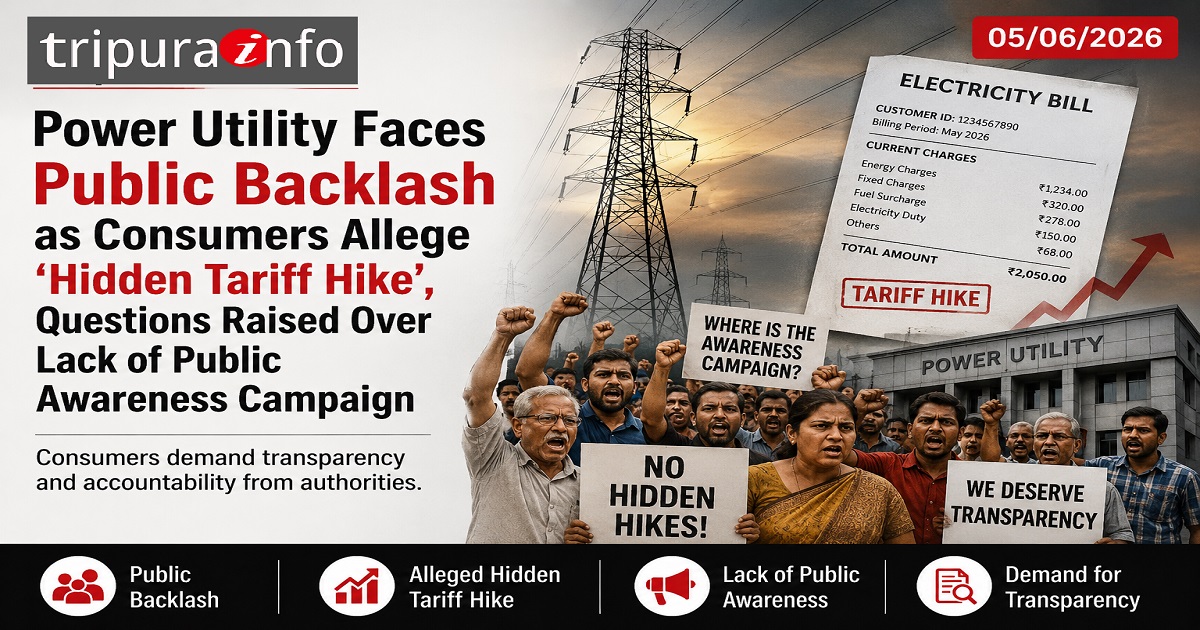 Growing public resentment against the state power utility has exposed a major communication gap between electricity regulators and consumers. While the Tripura Electricity Regulatory Commission (TERC) recently approved an increase in electricity tariffs, including revisions in fixed and energy charges, consumers allege that they were never adequately informed about the implications of the hike. As a result, the electricity corporation is now facing widespread criticism and accusations of overbilling.
The controversy erupted after consumers across the state noticed a sharp rise in their monthly electricity bills. Many claim that fixed and fuel charges have increased disproportionately compared to their actual electricity consumption, creating a perception that the utility corporation is arbitrarily inflating bills.
Several consumers who examined their latest bills found that even when energy consumption remained almost unchanged, the overall bill amount rose significantly due to higher fixed and fuel-related charges. This has led to growing suspicion regarding the billing system and triggered allegations of digital manipulation and daylight robbery.
Tariff Hike Approved, But Were Consumers Informed?
According to TERC’s tariff order for FY 2026-27, the Commission approved rationalisation of fixed charges and increases in energy charges across various consumer categories. The regulator stated that the revision was necessary to bridge the revenue gap of the utility and bring Tripura’s tariff structure closer to national and regional benchmarks. The tariff order also continued the system of charging fixed charges based on connected load (kW) rather than per connection.
However, consumers argue that although TERC approved the revised tariff structure, neither the regulator nor the power utility undertook any large-scale awareness campaign to explain how the new charges would affect household bills.
Many consumers say they came to know about the increase only after receiving inflated bills. There were no extensive public meetings, awareness drives, consumer education programmes, or detailed explanations accompanying the SMS notifications sent to customers.
The situation has been compounded by the increasing reliance on online payment systems. Most consumers receive an SMS mentioning the amount due and pay it immediately without checking the detailed breakup of charges.
With people preoccupied by rising living costs, family responsibilities and professional commitments, few have the time or patience to carefully examine every component of their electricity bills. Consequently, changes in fixed charges, fuel adjustments and other tariff-related revisions often remain unnoticed until consumers compare bills over several months.
Consumer activists argue that this lack of transparency has created confusion and mistrust among the public.
Complaints have also surfaced regarding the format of printed bills. Consumers allege that the thermal-paper slips issued by meter readers contain information in a format that is difficult to read. While the total payable amount is clearly visible, detailed calculations and charge components are often difficult for ordinary consumers to decipher.
Critics say this has further weakened consumer awareness and prevented many households from understanding how their bills are being calculated.
Although the tariff revision originated from a regulatory decision, public anger is largely being directed at the power utility corporation, which serves as the primary interface with consumers. Many believe that the corporation should have proactively informed consumers about the revised tariff structure and its impact on monthly bills.
Consumer groups maintain that if awareness campaigns had been conducted before implementation of the revised tariff, much of the current confusion and resentment could have been avoided.
Experts and consumer rights advocates are now calling for greater transparency in the electricity sector. They argue that every tariff revision should be accompanied by extensive public awareness programmes, detailed bill explanations, consumer outreach initiatives and simplified billing formats.
Without such measures, they warn, distrust between consumers and the power utility will continue to grow, even when tariff revisions have been legally approved by the regulator.
For now, the electricity corporation finds itself facing mounting public dissatisfaction—not merely because tariffs have increased, but because many consumers feel they were never properly informed about why their bills have gone up and how the revised tariff structure actually works.
According to the official press note issued by the Tripura Electricity Regulatory Commission (TERC) on 4 May 2026, the tariff revision was introduced after examining TSECL’s petitions for truing-up, annual performance review and tariff determination. The Commission noted that TSECL had sought recovery of a revenue gap of Rs.1,709 crore and proposed a regulatory surcharge along with a doubling of fixed charges. However, TERC rejected the surcharge proposal and instead opted for a rationalisation of fixed and energy charges to gradually recover the approved revenue gap while aligning Tripura’s tariff structure with neighbouring states and national benchmarks. The Commission approved an increase of 15 paise per unit for domestic consumers in lower consumption slabs, 20 paise per unit for higher domestic slabs, irrigation, public water works, public lighting and special utility categories, and 35 paise per unit for most other consumer categories. The system of billing fixed charges on the basis of connected load (kW) rather than per connection was also continued. The regulator stated that these measures were intended to avoid a sudden tariff shock while ensuring the financial sustainability of the power utility.
The tariff order also retained several concessions and consumer-oriented provisions. TERC continued a 10 per cent rebate on energy charges for homestays in remote areas, registered women self-help groups engaged in commercial and industrial activities in remote locations, hospitals in remote areas, and mobile towers serving remote regions. A similar 10 per cent rebate was continued for IT and ITES industries. The Commission also retained the Green Tariff option at Rs.0.75 per unit for consumers opting for green power and continued the Time-of-Day (ToD) tariff framework, under which electricity consumed during solar hours is charged at a discounted rate while peak-hour consumption attracts higher rates.
more news...