Tripura Witnesses Unprecedented Growth in Health and Education Infrastructure Since 2018: CM Manik Saha
By Our Correspondent
Agartala, June 3, 2026
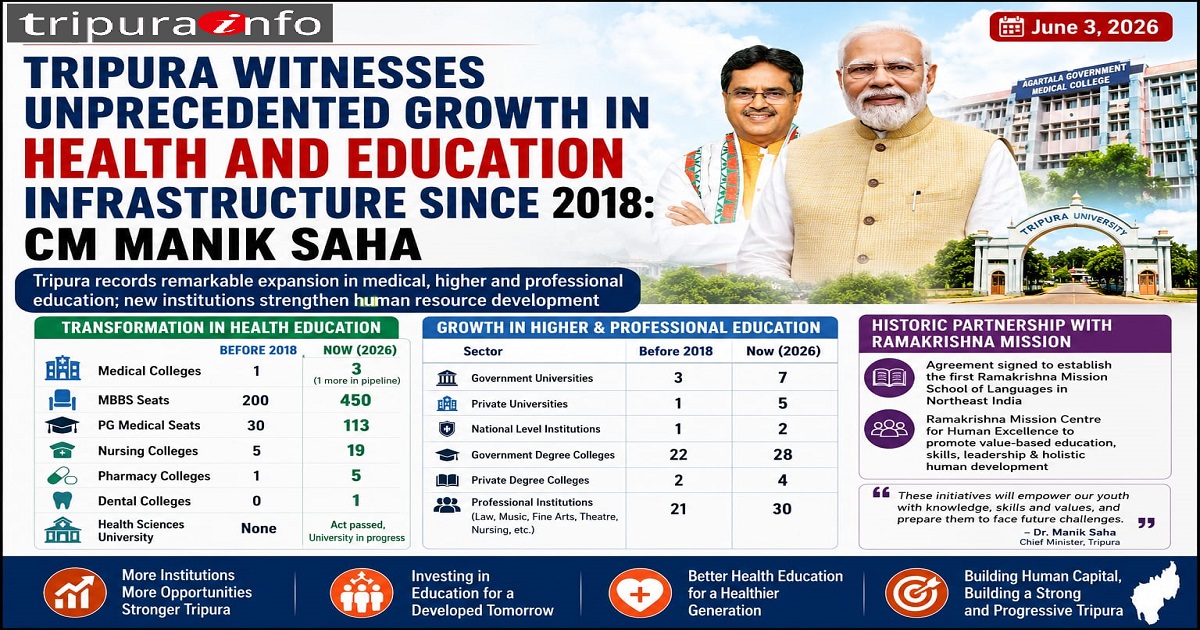 Tripura has achieved remarkable progress in the sectors of health and education since 2018, transforming the state's institutional landscape and creating new opportunities for students and healthcare professionals. This claim was made by Chief Minister Dr. Manik Saha, who highlighted the government's achievements through a series of detailed social media posts showcasing the expansion of health education, higher education and professional learning infrastructure across the state.
Dr. Saha said that under the leadership of Prime Minister Narendra Modi, Tripura has entered a new era of educational and healthcare development, with substantial investments in infrastructure, institutional capacity and human resource development.
According to data shared by the Chief Minister, Tripura's health education sector has undergone a significant transformation during the past seven years.
Before 2018, the state had only one major medical college functioning with limited intake capacity. Today, the number of medical colleges has increased to three, while plans are underway for the establishment of one additional medical college, one Ayurvedic college and one Homoeopathic college.
The number of MBBS seats has increased dramatically from 200 before 2018 to 450 at present. Similarly, postgraduate medical seats have risen from 30 to 113, significantly enhancing opportunities for higher medical education within the state.
The nursing education sector has witnessed one of the highest rates of expansion. The number of nursing colleges has increased from five before 2018 to nineteen at present, helping to address the growing demand for trained nursing professionals.
Likewise, pharmacy education has expanded from a single pharmacy college to five institutions. Tripura has also established its first dental college, a facility that did not exist before 2018.
Another major development has been the creation of a dedicated forensic sciences university. While Tripura previously lacked any specialized forensic sciences university, the Tripura forensic Sciences University Act has now been passed by the State Assembly, paving the way for a comprehensive forensic education framework.
The Chief Minister described these developments as a historic leap forward in creating a modern healthcare education ecosystem capable of producing doctors, nurses, pharmacists and healthcare specialists for future generations.
Dr. Saha also highlighted the expansion of general, technical and professional education institutions across Tripura.
Government universities in the state have increased from three before 2018 to seven at present. This expansion includes the establishment and upgrading of several institutions aimed at broadening access to higher education.
Private universities have grown from one to five, reflecting increased participation from the private sector in higher education.
National-level educational institutions have doubled from one to two, strengthening Tripura's academic profile within the Northeast region.
Government degree colleges have increased from twenty-two to twenty-eight, while private degree colleges have expanded from two to four.
The state has also witnessed a substantial rise in professional educational institutions, including law, music, fine arts, theatre and nursing-related institutions. Their number has increased from twenty-one before 2018 to thirty currently.
The Chief Minister noted that these institutions are playing an important role in improving employability, professional skills and career opportunities for young people.
In another major development, the Tripura Government and Ramakrishna Mission have signed an agreement to establish the first Ramakrishna Mission School of Languages in Northeast India along with a Ramakrishna Mission Centre for Human Excellence.
According to Dr. Saha, the initiative will focus on language education, skill enhancement, value-based learning and leadership development.
He praised the Ramakrishna Mission's longstanding contribution to education and social development in Tripura and said the new institutions would provide students with modern skills, ethical values and global competencies necessary for the future.
The Chief Minister described the initiative as a landmark step that would contribute significantly to youth empowerment and human resource development.
The state government believes that strengthening educational infrastructure and expanding healthcare education are essential for building a skilled workforce capable of meeting future challenges.
Dr. Saha stated that the expansion of universities, colleges, professional institutions and healthcare education facilities is helping Tripura create a strong knowledge-based economy while improving access to quality education across urban and rural areas.
He emphasized that these reforms are not merely about increasing the number of institutions but about creating a comprehensive ecosystem that promotes innovation, professional excellence and social development.
According to the Chief Minister, the achievements recorded since 2018 demonstrate the state's commitment to investing in human capital. He maintained that the simultaneous growth of health education and higher education infrastructure is laying the foundation for long-term economic and social progress.
With increased educational opportunities, expanded professional training facilities and a growing healthcare education network, Tripura is positioning itself as an emerging educational and healthcare hub in the Northeast, Dr. Saha asserted.
The government believes that these initiatives will play a crucial role in shaping a skilled, educated and healthy generation capable of contributing to the state's continued development in the coming decades.
more news...