TIPRA Motha Under Pressure as ADC Governance Delays Persist, MLA Ranjit Debbarma Demands Implementation of Historic Tripartite Accords
By Our Correspondent
Agartala, June 3, 2026
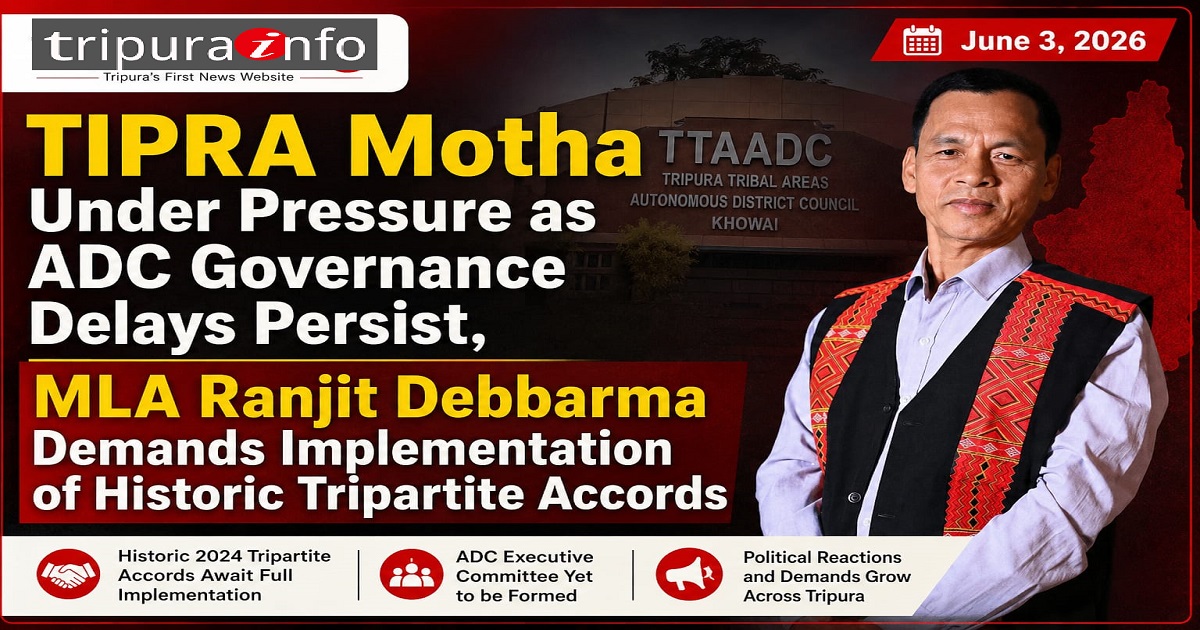 Nearly one and half months after assuming power in the Tripura Tribal Areas Autonomous District Council (TTAADC), the ruling TIPRA Motha-led administration is facing growing criticism over its failure to constitute a full Executive Committee, leading to concerns that governance and development activities across the ADC areas have come to a virtual standstill.
At the same time, senior TIPRA Motha leader and Ramchandraghat MLA, Ranjit Debbarma, has intensified pressure on both the Central and State Governments over the alleged delay in implementing the historic tripartite agreements signed in 2024. His recent social media posts have triggered significant political discussion across the state.
In a strongly-worded statement on social media, Ranjit Debbarma highlighted the two landmark tripartite agreements signed on September 4, 2024, between the Government of India, the Government of Tripura, and the two former insurgent groups, National Liberation Front of Tripura (NLFT) and All Tripura Tiger Force (ATTF).
According to the MLA, one of the central commitments of these agreements was the protection and recognition of the land and political rights of the Tiprasa people. He expressed disappointment that despite the passage of considerable time since the signing of the accords, there has been little visible progress regarding the implementation of key provisions, particularly those contained in Clauses 24 and 25, which reportedly deal with sensitive and significant demands related to indigenous rights.
Debbarma stated that after recently holding a review meeting with members of the surrendered insurgent groups, he felt compelled to urge both the Central and State Governments to expedite the implementation of all provisions of the agreements.
Although a Joint Working Group was established to oversee the execution of various agreements and memorandums of understanding, the MLA argued that its meetings have yet to produce any tangible outcomes on the ground.
In a pointed remark that has generated considerable political speculation, Debbarma questioned on social media: “What should be done to ensure the speedy implementation of these agreements and understandings between the Centre and the State Government? What exactly does ‘democratic struggle’ mean?”
Political observers view the statement as a signal of growing frustration within sections of TIPRA Motha regarding the pace of implementation of commitments made under the tripartite accords.
The controversy comes amid increasing criticism of the TIPRA Motha-led administration in the TTAADC. Despite securing a resounding mandate in the council elections and taking office nearly one and a half months ago, the administration has so far appointed only the Chief Executive Member (CEM) and two Executive Members, while the full Executive Committee remains unconstituted.
Political analysts suggest that uncertainty within the leadership regarding the distribution of executive portfolios may be contributing to the delay. As a result, several administrative and developmental initiatives reportedly remain pending.
The absence of a fully functional Executive Committee has raised concerns among various political and social organizations, which argue that the delay is adversely affecting governance and public welfare programmes across ADC areas.
The Tripura Rajya Ganamukti Parishad (GMP) has emerged as one of the strongest critics of the current situation.
Addressing a press conference in Agartala after a meeting of the party's central committee, GMP leader Radhacharan Debbarma alleged that the failure to constitute the Executive Committee has hampered development works and delayed projects aimed at benefiting the people.
He expressed particular concern about remote and border areas such as Gandacherra, Chhamanu, Bhandarima and Thalchhara, where many shifting cultivator (jhumia) families are reportedly facing severe livelihood challenges due to a lack of employment opportunities.
According to GMP, many residents are being forced to seek agricultural work near border areas and adopt alternative means of survival. The organization demanded immediate employment generation through MGNREGA and other rural development schemes.
The GMP also alleged that residents across several ADC areas continue to suffer from inadequate electricity supply, poor drinking water facilities, and deteriorating road infrastructure.
The organization warned that if effective measures are not taken before the onset of the monsoon season, it may launch a larger public movement to press for solutions.
Radhacharan Debbarma further argued that more than a month has passed since the swearing-in of TIPRA Motha's 24 elected council members, yet the absence of an Executive Committee remains a matter of serious concern. Without formal approval from the committee, several important public-interest projects cannot be initiated or implemented, he claimed.
The GMP also raised questions regarding certain appointments allegedly made in the ADC without formal government approval and sought clarification on why those individuals continue to remain in their positions.
Additionally, the organization opposed recent demands raised by the Janajati Suraksha Manch in connection with a judgment of the Andhra Pradesh High Court. GMP maintained that reservations for Scheduled Tribes and Scheduled Castes are determined by constitutional provisions and socio-economic considerations rather than religious identity.
GMP co-secretary Pranab Debbarma alleged that ethnic sentiments were exploited during the ADC election campaign to influence tribal voters. He also announced that the organization would intensify its political campaign against both the ruling Bharatiya Janata Party (BJP) and TIPRA Motha Party ahead of the forthcoming Village Committee elections.
As demands for the implementation of the 2024 tripartite agreements grow louder and the formation of a full Executive Committee remains pending, TIPRA Motha finds itself under increasing scrutiny. While party leaders continue to press the Centre and the State Government on indigenous rights and constitutional commitments, critics argue that administrative delays within the ADC itself are undermining governance and slowing development across tribal areas.
With political pressure mounting from both within and outside the party, the coming weeks are expected to be crucial for the future direction of the TTAADC administration and the implementation of the historic agreements that many indigenous communities see as vital to their aspirations.
more news...