Tripura Launches FIGS Digital Platform to Revolutionize Forest Governance, 300 Mobile Devices Distributed for Real-Time Monitoring
By Our Correspondent
Agartala, May 30, 2026
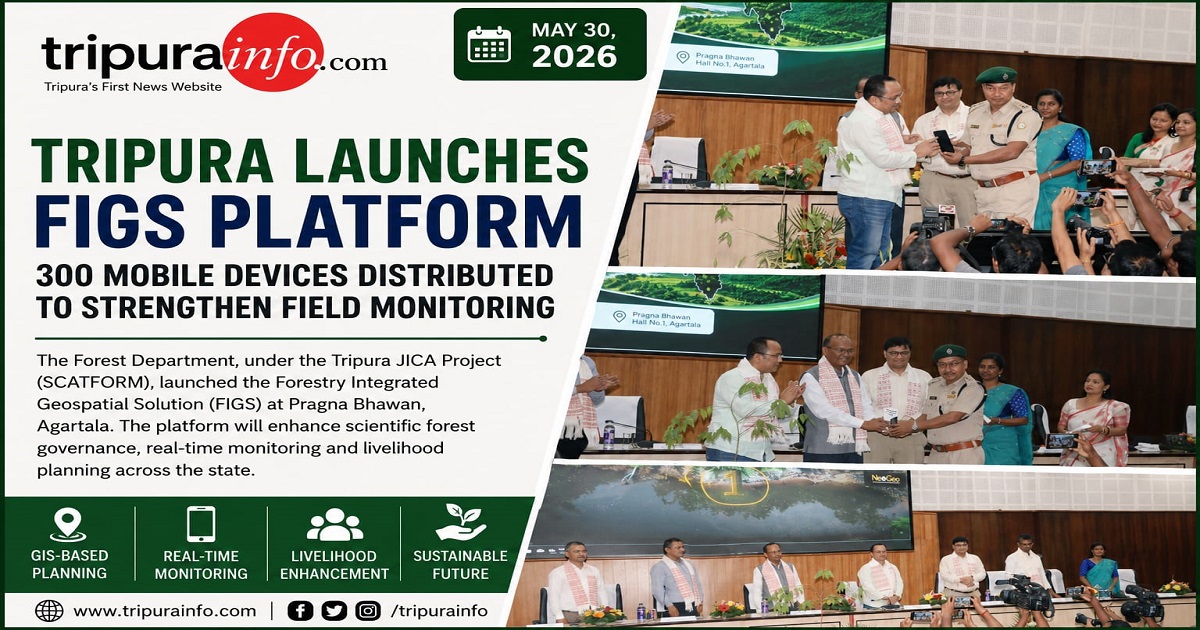 In a landmark initiative aimed at transforming forest governance through technology-driven solutions, the Forest Department of the Government of Tripura, under the Tripura JICA Project (SCATFORM), on Saturday launched the Forestry Integrated Geospatial Solution (FIGS), an advanced GIS and MIS-enabled digital platform designed to strengthen scientific forest management, natural resource governance and livelihood planning across the state.
The platform was formally launched at Pragna Bhawan by Forests, Science and Technology Minister Animesh Debbarma in the presence of Principal Secretary (Forests) and Principal Chief Conservator of Forests & Head of Forest Force RK Samal, IFS senior officials of the Forest Department, representatives of the Tripura JICA Project and other stakeholders. The event also witnessed the distribution of 300 mobile devices to project officials and field staff, the felicitation of outstanding performers in FIGS data updation and the release of four major publications documenting the achievements and impact of the SCATFORM project.
Addressing the gathering, Minister Animesh Debbarma emphasized that technology and nature should not be viewed as opposing forces but as complementary tools for sustainable development. He said there was a time when discussions on forests were limited to trees, rivers, wildlife and natural landscapes while technology was associated only with machines and computers. However, he noted that the future demands a new perspective where technology becomes a powerful instrument for conservation and environmental protection.
The Minister highlighted how modern technologies are increasingly helping governments and conservation agencies monitor forests more effectively. He said satellite-based systems can detect forest fires, mobile applications can geo-tag plantations, digital dashboards can monitor water conservation structures, drones can survey inaccessible terrains and GIS-based analysis can identify ecologically vulnerable areas. According to him, technology is not replacing nature but helping society understand, manage and protect natural resources more efficiently.
Debbarma further observed that the future of conservation would not be defined by a choice between nature and technology but by nature protected through technology and technology guided by nature. Referring to initiatives such as the Forest Fire Monitoring and Alert System of the Forest Survey of India and geospatial applications under ISRO’s Bhuvan platform, he said forestry management across the country is becoming increasingly digital, map-based and real-time. He stressed that Tripura should not remain a follower in this transformation but should emerge as a leader in adopting innovative technologies for conservation and development.
Speaking about his personal connection with forests, the Minister said forests are not merely an administrative responsibility but an integral part of Tripura’s identity, culture and heritage. He noted that generations of communities have lived in close association with forests and natural resources and emphasized that sustainable development can only be achieved when technological advancement remains rooted in ecological values and community aspirations. He reaffirmed the government's commitment to promoting initiatives that combine conservation, livelihood enhancement and technological innovation.
The newly launched FIGS platform has been developed as a comprehensive geospatial solution for site suitability assessment, project planning, asset creation, monitoring and livelihood management. The platform integrates GIS-based mapping, remote sensing, mobile geo-tagging, field-level data collection, dashboards, approval mechanisms, statistical analysis and report generation. It is expected to facilitate evidence-based planning and real-time monitoring of forestry and livelihood interventions across the state. Developed on a secure and scalable open-source architecture, FIGS represents a significant shift from conventional reporting systems to a transparent, data-driven and spatially intelligent governance framework.
Highlighting the importance of the platform for livelihood planning, Debbarma pointed out that nearly 70 per cent of Tripura's geographical area is under forest cover and that a large number of forest-dependent communities derive their livelihoods from natural resources. He said different regions possess different resource potentials and therefore require location-specific livelihood interventions. While some areas may be suitable for fisheries because of water availability, others may offer opportunities in livestock development, agroforestry, bamboo-based enterprises or eco-tourism. Through FIGS, planners and field officials will be able to identify suitable livelihood opportunities based on geography, resource availability and community needs, ensuring that development interventions are based on accurate data and ground realities rather than assumptions.
As part of the programme, the Forest Department distributed 300 mobile devices to project officials and frontline staff to strengthen field-level data collection and monitoring. The devices will enable real-time capture and updating of information related to plantations, nurseries, water conservation structures, livelihood assets and other project interventions. Officials believe that the initiative will significantly improve the quality, accuracy and timeliness of field data collection and reporting. Awards were also presented to the best-performing districts, subdivisions, forest ranges, officers, Community Organisers and Livelihood Coordinators for their achievements in data collection and updation under the FIGS platform.
During the event, four important publications were released, including A Glimpse of Tripura SCATFORM Project – District-wise Achievements & Impact, Micro-Biodiversity Heritage Sites of Tripura – Community Conserved Ecological Landscapes under SCATFORM, Forestry Integrated Geospatial Solution-Tripura (FIGS) – A Comprehensive Guidebook and Success Stories under Tripura Sustainable Catchment Forest Management Society. The publications document the project's achievements in forest restoration, watershed development, biodiversity conservation, women-led livelihood initiatives, community participation and digital innovation.
The programme also included the felicitation of Santanu Chakraborty, President of Neo Geo Info Tech Ltd., in recognition of his contribution to the development and successful implementation of the FIGS platform under the Tripura JICA Project.
The launch of FIGS marks a major milestone in Tripura’s efforts to modernize forest governance and strengthen sustainable natural resource management through advanced technology. By integrating geospatial intelligence, real-time field data and digital monitoring systems, the platform is expected to enhance transparency, accountability and decision-making while supporting ecological conservation, climate resilience and livelihood security for forest-dependent communities across the state.
more news...