CBSE's Revolutionary Education Reforms Raise Implementation Concerns in Tripura Amid Teacher, Infrastructure and Textbook Shortages
By Our Correspondent
Agartala, May 29, 2026
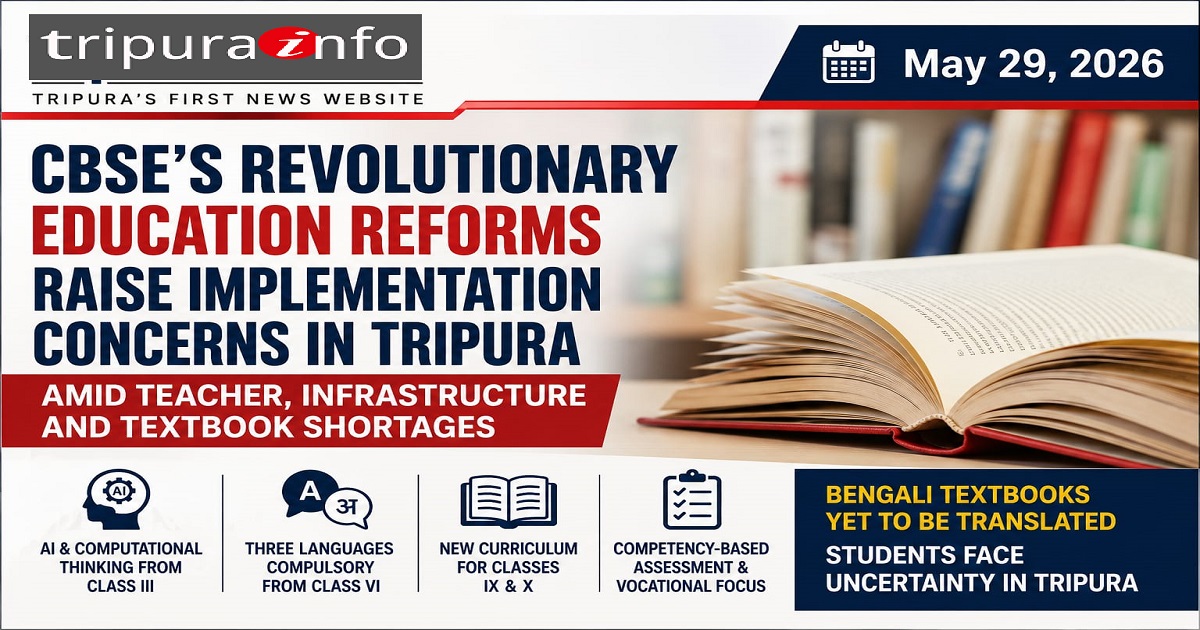 India's school education system is set to undergo one of its most significant transformations in recent decades as the Central Board of Secondary Education (CBSE) prepares to implement a series of major reforms from the 2026-27 academic session under the framework of the National Education Policy (NEP) 2020 and the National Curriculum Framework for School Education (NCFSE) 2023. The reforms include the introduction of Artificial Intelligence (AI) and Computational Thinking (CT) from Class III, compulsory three-language learning from Class VI, sweeping curriculum changes in Classes IX and X, competency-based assessments, and a stronger focus on vocational education.
While education experts have described the reforms as a landmark step toward preparing students for a technology-driven future, serious questions are being raised about their practical implementation in states such as Tripura, where shortages of trained teachers, digital infrastructure, and educational resources continue to pose major challenges. Concerns have also emerged over delays in translating and publishing textbooks in Bengali, leaving many students under Tripura Board of secondary education uncertain about how the new curriculum will be implemented.
According to education officials, the Tripura Board of Secondary Education (TBSE) has yet to fully prepare for the transition to the new educational framework. Many schools across the state continue to face difficulties in accessing modern digital facilities, computer laboratories, internet connectivity, and adequately trained teachers capable of teaching emerging subjects such as Artificial Intelligence and Computational Thinking. In several government schools, the distribution of textbooks in Bengali for the current academic year has reportedly not been completed, adding to concerns about the state's readiness for the ambitious reforms.
Under CBSE Academic Circular No. Acad-15/2026 issued on April 1, 2026, Computational Thinking and Artificial Intelligence will be introduced for students from Classes III to VIII. The initiative aims to develop logical reasoning, problem-solving skills, algorithmic thinking, pattern recognition, digital literacy, and ethical use of technology from an early age. CBSE believes that such skills will be essential for students to succeed in an increasingly technology-oriented world.
The reforms will extend further into secondary education, with Computational Thinking and Artificial Intelligence modules becoming mandatory components of the curriculum for Classes IX and X. CBSE has announced plans to make these subjects fully compulsory from the 2027-28 academic session. The move is expected to provide students with practical exposure to AI, data analysis, and digital technologies at the secondary level.
Significant structural changes are also being introduced in Classes IX and X. Mathematics will be offered at both Basic and Standard levels, while Science education will provide opportunities for students to study either General Science or Advanced Science. The new system is designed to allow students greater flexibility in selecting subjects based on their interests, abilities, and future career goals.
The revised curriculum will also incorporate vocational education, skill-based learning, arts education, physical education and well-being, and a new subject titled "Individuals in Society." According to the new Class IX curriculum framework, ten curricular areas have been identified: Language-I, Language-II, Language-III, Mathematics, Science, Social Science, Individuals in Society, Vocational Education, Arts Education, and Physical Education and Well-being. In Class X, "Individuals in Society" will be replaced by Environmental Education.
CBSE's new language policy has attracted particular attention. Through Academic Circular No. Acad-17/2026 issued on April 9, 2026, the board directed schools to implement the R1-R2-R3 language framework. As a result, the study of a third language will become compulsory from Class VI onward. Schools will be required to inform CBSE about the third language they choose to offer, and students will be expected to continue studying that language through Classes IX and X. The policy is intended to promote multilingual education, respect for cultural diversity, and national integration.
A key feature of the new system is the shift away from rote learning toward competency-based assessment. CBSE has emphasized that students will be evaluated not only on their ability to memorize information but also on conceptual understanding, analytical thinking, creativity, inquiry skills, and real-world problem-solving abilities. Project-based learning, research activities, seminars, and experiential learning will play a much larger role in classroom instruction.
The assessment pattern is also being redesigned. In Class IX, students will undergo annual examinations along with internal assessments, and performance will be graded using categories such as A1, A2, B1, B2, C1, C2, and D. While the Class X board examination will continue, a larger proportion of questions will focus on competencies, application of knowledge, and conceptual understanding.
CBSE has further stated that new NCERT textbooks are being developed in alignment with NCFSE 2023 and NEP 2020. These books will place greater emphasis on India's knowledge systems, interdisciplinary learning, cultural heritage, experiential education, and technology-enabled learning. The new textbooks for Class IX was expected to be published by March 2026. But till now no books is available in Bengali. However, concerns remain in Tripura regarding the timely translation and availability of Bengali-language textbooks, with education stakeholders warning that delays could place students at a disadvantage.
Vocational education has been given special importance under the reforms. Students will gain exposure to fields such as Information Technology, healthcare services, retail management, and other employment-oriented skills. Policymakers believe this will help students develop job-ready competencies from the school level itself.
To facilitate implementation, CBSE has directed schools to conduct teacher training programmes, organize parent awareness campaigns, hold special Parent-Teacher Meetings (PTMs), and make necessary preparations for the rollout of the revised curriculum. Dedicated webinars and orientation sessions are also planned to familiarize stakeholders with the new educational framework. But no such efforts is being seen till date in Tripura.
more news...