Gauhati High Court Acts Against Mizoram University Registrar Amid Growing Questions Over Silence on Alleged Irregularities in Tripura University
By Our Correspondent
Agartala, May 28, 2026
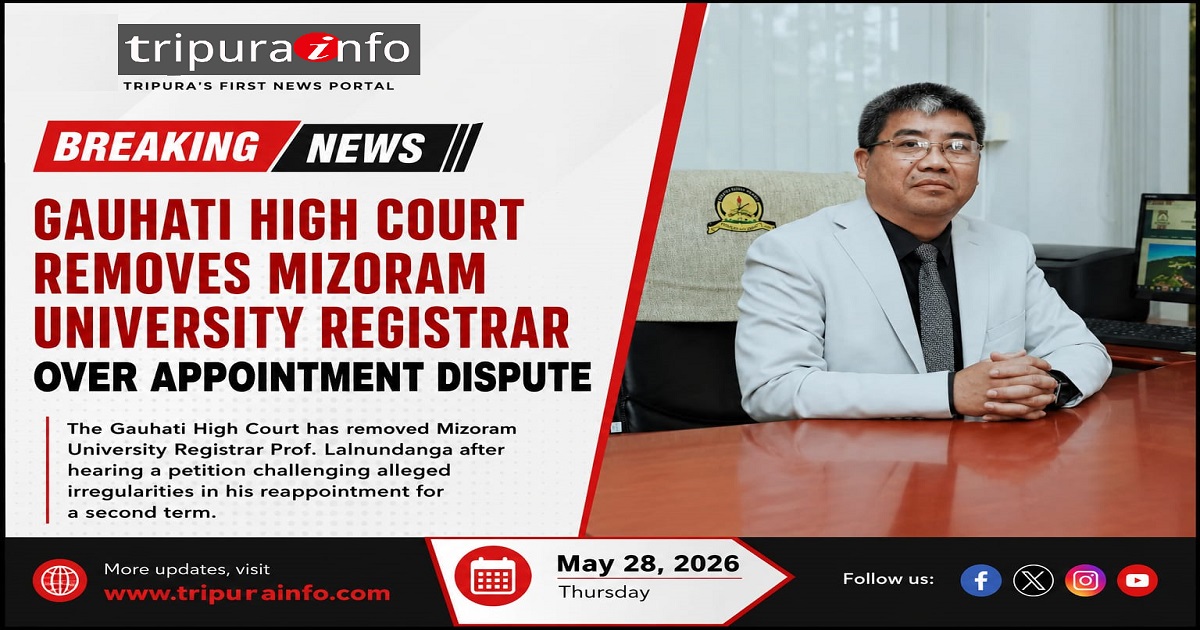 At a time when serious allegations of corruption and administrative irregularities in Tripura University continue to dominate public discourse in the state, the recent intervention by the Gauhati High Court in Mizoram University has once again brought the issue of accountability in higher educational institutions into sharp focus.
The Gauhati High Court recently removed Mizoram University Registrar Prof. Lalnundanga after hearing a petition challenging alleged irregularities in his reappointment for a second term. The development has sparked widespread discussions in academic and intellectual circles across the Northeast, particularly in Tripura, where multiple allegations involving Tripura University have remained unresolved for years despite repeated public outcry.
Established in 1987 after a prolonged democratic movement and years of public demand, Tripura University emerged as a symbol of the aspirations of the people of Tripura. It was not merely the achievement of a particular political ideology or student organization; rather, it represented the collective dreams of an entire state seeking academic advancement and intellectual identity.
For two decades, from 1987 until July 1, 2007, Tripura University functioned as the state’s only university and steadily worked to establish itself on the national academic map. The institution entered a new phase on July 2, 2007, when it was upgraded to a Central University, raising hopes and expectations among students, parents, scholars, and citizens of Tripura.
Over the years, several distinguished academicians served as Vice-Chancellors and contributed significantly to the institution’s growth. Student movements and protests did emerge periodically over administrative and academic issues, but successive administrations generally addressed them through dialogue and institutional measures.
However, during the last several years, allegations of widespread corruption, irregularities, favoritism, and administrative failure have increasingly overshadowed the university’s academic reputation. Various newspapers, news websites, electronic media platforms, and public forums in Tripura have repeatedly highlighted concerns regarding the functioning of the institution.
One of the most embarrassing episodes in the university’s history emerged when a video allegedly showing a former Vice-Chancellor accepting bribes surfaced publicly, creating shockwaves across the state and severely damaging the image of the institution. Even after that controversy, expectations remained that the university would initiate strong corrective measures to restore public confidence.
Further allegations surfaced regarding examination-related irregularities involving students of Tripura Medical College, which is affiliated with Tripura University. The issue reportedly became so serious that even the Chief Minister of Tripura referred to the matter inside the Legislative Assembly. Allegations that students could allegedly pass examinations in exchange for monetary bribes raised disturbing questions about the integrity of the academic system.
Public criticism has particularly intensified regarding the functioning of the Controller of Examinations (CoE). Questions are now being raised about accountability, administrative oversight, and the failure to protect the academic credibility of the institution.
For the first time in the history of Tripura University, student protests reportedly escalated to the extent that academic robes of the Vice-Chancellor were publicly burned by agitating student groups. Many intellectuals and citizens described the incident as not merely an insult to an individual office-bearer but an affront to the dignity of the entire state and its premier educational institution.
Allegations have also circulated within academic circles regarding irregularities connected to appointments and Ph.D.-related procedures involving influential individuals within the university administration. Some of these matters are reportedly under judicial consideration before the High Court.
Despite the seriousness of these allegations, critics claim that there has been little visible intervention from key constitutional and institutional bodies, including the Tripura High Court, Tripura Human Rights Commission, Tripura Lokayukta, and higher education authorities at both the state and central levels.
The contrast between the swift judicial intervention in Mizoram University and the prolonged silence surrounding controversies in Tripura University has now become a matter of public debate across the state.
Academicians, former students, and concerned citizens are increasingly demanding transparent inquiries, administrative accountability, and institutional reforms to restore the lost credibility of Tripura University. Many believe that unless decisive corrective action is taken immediately, the institution risks further erosion of its academic standards and public trust.
As Tripura University approaches four decades of existence, the institution stands at a critical crossroads, between reclaiming its historic legacy and slipping deeper into controversy and institutional decline.
more news...