Despite Shortage Trained Manpower, Tripura Govt Pushes Digital Governance to the Next Level with NextGen IFMS after HRMS Rollout
By Our Correspondent
Agartala, May 27, 2026
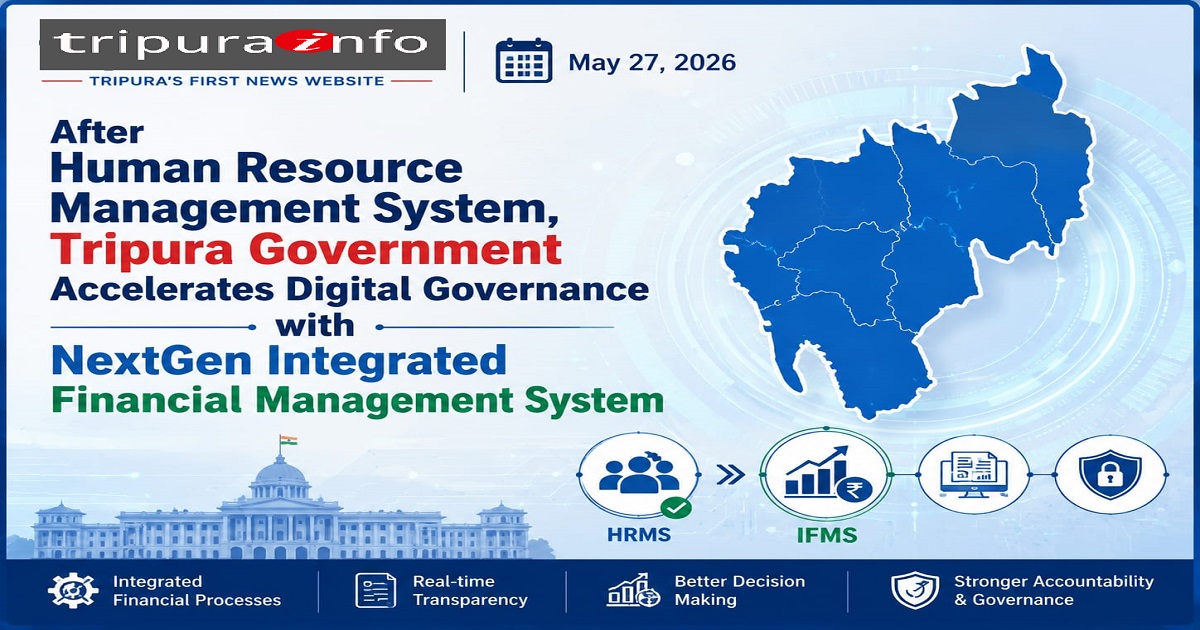 In a major step towards building a transparent, accountable and technology-driven administration, the Government of Tripura under the leadership of Chief Minister Dr Manik Saha is implementing two ambitious digital governance platforms, the NextGen Integrated Financial Management System (IFMS) and the NextGen Human Resource Management System (HRMS), despite the challenge of inadequate trained and experienced manpower across several government departments.
The twin initiatives are expected to transform financial administration and employee management across the state by introducing complete digitization, automation and real-time monitoring in government operations. Developed in collaboration with National Informatics Centre, the projects are being regarded as among the most advanced governance reforms undertaken by the Tripura Government in recent years.
However, officials and experts believe that the successful implementation of these sophisticated digital systems will require large-scale training, technical capacity-building and continuous administrative support, particularly in departments where skilled digital manpower remains limited.
The Finance Department is now preparing for the rollout of the NextGen IFMS with several advanced features, including e-Billing, e-Voucher, e-Sanction, Aadhaar-enabled payment systems and integration with the Works Accounting Management Information System (WAMIS) as well as the e-Procurement platform. A high-level review meeting on the implementation roadmap has already been conducted under the chairmanship of Finance Minister Pranajit Singha Roy.
Officials said the e-Billing mechanism will ensure complete electronic submission of bills to the Treasury, reducing paperwork, minimizing delays and improving efficiency in fund processing. Similarly, the e-Sanction system will digitally connect administrative sanctions with approved budget allocations, strengthening fiscal discipline and preventing unauthorized expenditure.
The Aadhaar-enabled payment framework is expected to significantly enhance transparency, accountability and financial inclusion. Government benefits including scholarships, subsidies and welfare assistance will be transferred directly into beneficiaries’ bank accounts, reducing leakages and eliminating fake or duplicate beneficiaries.
The system will also support rural citizens through Micro-ATMs and banking correspondents, allowing beneficiaries to withdraw funds using fingerprint authentication without requiring debit cards, PINs or passwords. Officials believe the mechanism will strengthen transaction tracking and ensure greater accountability in fund disbursement.
The integration of WAMIS with IFMS is being viewed as a major technological breakthrough for infrastructure-related departments. The platform will digitally manage project estimate preparation, generation of bid documents, online tendering, issuance of work orders, project monitoring, electronic Measurement Books (MB), treasury claim submissions and forwarding of accounts to the Accountant General (A&E).
Although WAMIS is currently operational in selected offices, the Government plans to expand the platform across all Public Works and Forest Department offices in phases. Officials believe the expansion will improve efficiency, accelerate project implementation and ensure faster payments to contractors by reducing delays in bill verification and processing.
At the same time, departments are facing difficulties due to shortage of adequately trained technical personnel, especially in rural and field-level offices. As a result, the Government has started emphasizing intensive training and capacity-building programmes for engineers, treasury officials and departmental staff to ensure smooth implementation of the new digital systems.
Alongside financial reforms, the State Government has also developed the NextGen Human Resource Management System (HRMS) to modernize employee administration and strengthen governance through digital transformation. The platform has been developed by finance department in collaboration with NIC and is being described as one of the most advanced employee management systems introduced by any state government in India.
The centralized digital ecosystem manages the complete lifecycle of government employees, from recruitment to retirement covering 68 Directorates and more than 1,694 government offices across Tripura.
The system currently includes dedicated modules for Employee Availability, Attendance Management, Payroll Processing, Pay Fixation, Crucial Information Correction and Pension Proposal Management, which is under development. These integrated modules ensure strict compliance with government rules while validating legitimate claims for House Rent Allowance (HRA) and Medical Allowance (MA).
Several advanced modules are expected to be introduced soon, including the highly anticipated Service Book Module, which will function as the permanent digital repository of employees’ official records. The module will include two integrated sections, a Digital Service Book for real-time digital entries and updates, and a Physical Service Book Repository for secure storage of scanned historical records.
The upcoming Leave Management Module is also expected to fully automate leave applications, approvals and tracking, thereby eliminating manual paperwork and significantly improving administrative efficiency.
Officials said the software has been designed with a strict rule-based validation mechanism to protect public funds and prevent irregularities. Employee-specific allowances are automatically validated by the system before approval by Drawing and Disbursing Officers (DDOs), ensuring adherence to government norms and financial rules.
To maintain data integrity, the platform mandates verification and matching of PAN details, bank account information and unique employee identification numbers across databases. In sensitive cases, such as inclusion of a disabled child in family records, the system requires mandatory digital uploads including Disability Certificate, UID Number, Family Declaration and Government Approval Document.
A highly secure electronic signature (e-sign) framework has also been integrated into the platform. Once employee records are digitally validated and signed, they cannot be modified without formal authorization. Any reversal of an e-sign requires a secure proposal through the e-office system along with approval routed through the concerned Departmental Secretary, thereby ensuring maximum accountability and oversight.
The system also enables Heads of Departments to access real-time departmental data related to employee strength, transfers, pay fixation and personnel management.
One of the most significant objectives of the NextGen HRMS is to ensure that digital service books and pension proposals are processed immediately on the day of an employee’s retirement. Officials believe this will drastically reduce delays and enable pension finalization within the shortest possible time after retirement.
Despite challenges related to limited trained manpower and rapid technological transition, the combined implementation of the NextGen IFMS and HRMS reflects the Tripura Government’s broader vision of transparent administration, efficient public service delivery and modern digital governance powered by advanced technological reforms.
more news...