Questions Raised Over Police Action Against Consenting Adult Couples in Tripura Despite Court Directives
By Our Correspondent
Agartala, May 23, 2026
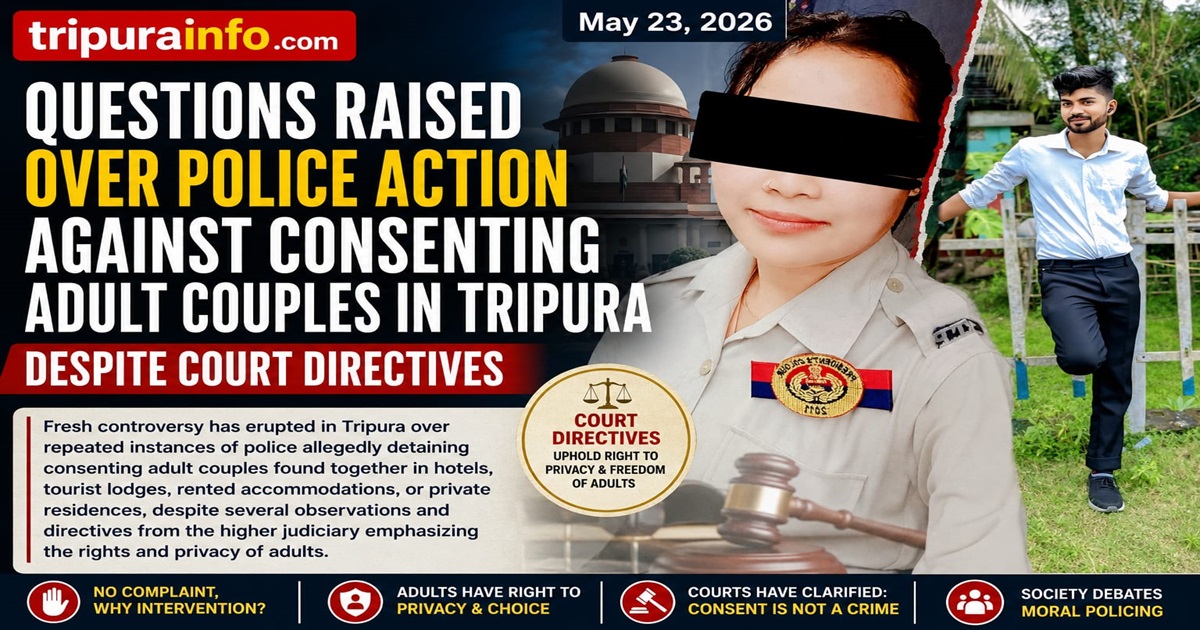 Fresh controversy has erupted in Tripura over repeated instances of police allegedly detaining consenting adult couples found together in hotels, tourist lodges, rented accommodations, or private residences, despite several observations and directives from the higher judiciary emphasizing the rights and privacy of adults.
Over the past several months, multiple incidents have reportedly taken place across the state where police personnel intervened after finding unmarried or pre-marital couples together and allegedly took them to police stations for questioning. In several cases, sources claimed that the couples were adults and that no complaints had been filed either by family members or by any of the individuals involved.
The issue has triggered widespread debate on social media, with many citizens questioning what they describe as moral policing by law enforcement agencies in a democratic society governed by constitutional rights and judicial precedents.
The latest controversy surfaced on Thursday night at the police station complex in Kanchanpur under North Tripura district.
According to local sources, at around 10:30 PM, some women residing inside the police station complex allegedly detained a young man after suspecting his presence inside the residential quarters of a woman constable. The matter was subsequently reported to Kanchanpur Police Station.
Later, Second Officer-in-Charge Pritimoy Chakma and Sub-Inspector Arjun Majumdar, accompanied by police personnel and TSR jawans, reportedly conducted a search operation in the room of woman constable Sebika Chakma.
Sources claimed that a youth identified as Sujon Debnath from Teliamura was found inside the room.
When journalists reportedly approached the police station seeking clarification, no official statement was issued by the authorities.
Civil society members and social media users have increasingly raised concerns over what they perceive as excessive police intervention in the personal lives of consenting adults.
In some earlier reported cases, even couples who were reportedly engaged and preparing for formal marriage ceremonies were allegedly taken from tourist lodges or accommodations by police personnel for questioning. Critics argue that when both individuals are adults and no complaint has been lodged, such intervention may amount to unnecessary harassment and violation of personal liberty.
Many observers have pointed out that Indian courts, including the Supreme Court and various High Courts, including Tripura High Court have repeatedly upheld the constitutional right of adults to choose their partners and live together consensually.
The debate has gained further relevance following a recent judgment of the Tripura High Court, where the court acquitted a man previously convicted in a rape case, observing that a consensual relationship within a subsisting marriage cannot constitute rape under Section 375 of the Indian Penal Code.
A division bench comprising Justice Dr T Amarnath Goud and Justice S Datta Purkayastha set aside the conviction and 10-year sentence imposed by a Belonia court on Sukanta Murasing.
The case originated from an FIR filed in 2022 in which the complainant alleged that the accused had raped her in 2017 and later promised marriage. The two subsequently married in 2018 and also executed a notarised declaration. However, disputes later arose after the accused allegedly declined to conduct a formal social marriage ceremony.
While hearing the appeal, the High Court noted that the complainant herself admitted to being in a long-standing romantic relationship with the accused and acknowledged that their marriage still subsisted. The bench further observed that she voluntarily continued the relationship and lived with the appellant as husband and wife.
The court stated that consensual relationship within marriage cannot be treated as rape and held that the prosecution failed to establish the charge beyond reasonable doubt. The court subsequently ordered the immediate release of the appellant unless required in any other case.
Legal observers believe the recurring controversies in Tripura once again bring into focus the balance between policing and constitutional freedoms.
The Supreme Court of India has, in multiple judgments over the years, recognised the right of consenting adults to cohabit without interference. Courts have also repeatedly emphasized the right to privacy, personal liberty, and freedom of choice under Article 21 of the Constitution.
Against this backdrop, the recent incidents in Tripura are likely to further intensify public discussion over whether police authorities should intervene in consensual relationships involving adults in the absence of any criminal complaint or allegation of coercion.
As of now, no formal statement has been issued by the police administration regarding the latest Kanchanpur incident.
more news...