Court-Ordered Transfer of Betel Nut Plantation in Unakoti Sparks Debate Over Private Lending Practices
By Our Correspondent
Agartala, May 21, 2026
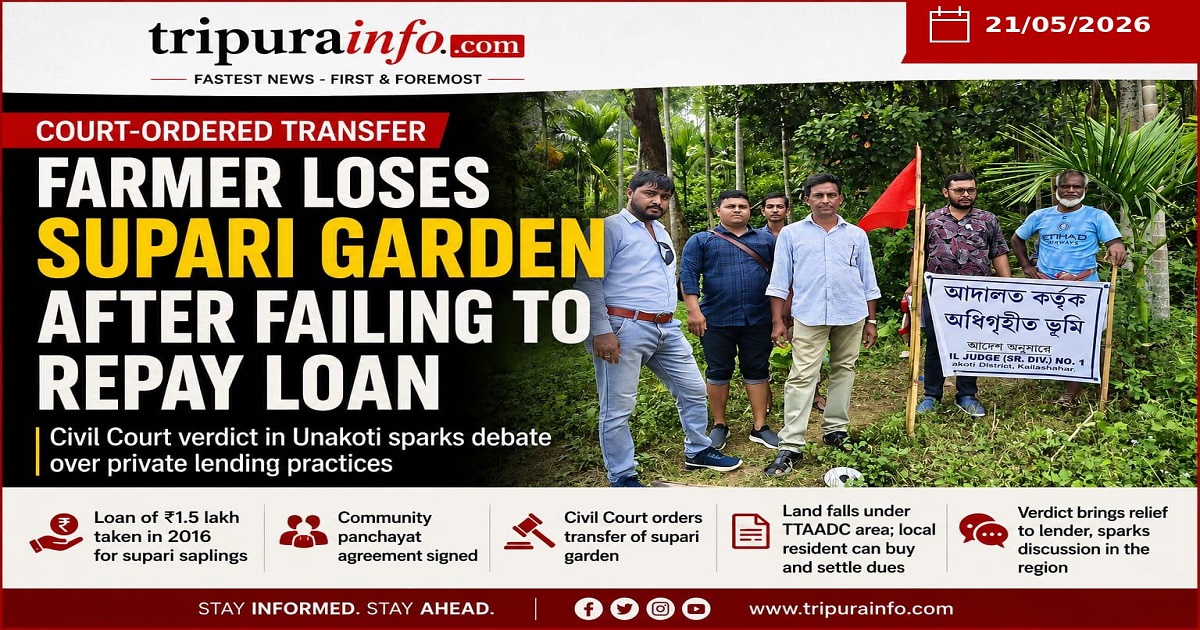 A recent civil court verdict in Tripura’s Unakoti district has triggered intense public discussion over private money lending practices and the growing vulnerability of small farmers trapped in debt. The case revolves around a farmer who allegedly failed to repay a loan of nearly Rs 1.5 lakh taken for agricultural purposes, eventually leading to the court-directed transfer of a valuable betel nut plantation.
According to reports, the incident took place in the Tilabazar area of Unakoti district. After a prolonged legal battle, the Civil Court of Unakoti ordered the transfer of possession of a supari (betel nut) garden to local resident Faizul Bari Ahmed. The development has now become a major topic of discussion across the region, with many questioning the social and economic implications of such disputes involving private lenders and financially distressed farmers.
Sources said that in 2016, Renga Darlong had reportedly taken approximately Rs 1.5 lakh from Faizul Bari Ahmed in connection with the supply of betel nut saplings. However, despite repeated requests and reminders, the amount was allegedly not repaid within the agreed period.
As the dispute deepened, Faizul Bari Ahmed reportedly approached the local Chatlang Social Panchayat seeking intervention. Following this, a community arbitration meeting was organized in the presence of both parties and several local elders and respected residents.
During the settlement meeting, both sides reportedly signed an agreement stating that if the borrowed money was not repaid within a stipulated timeframe, Renga Darlong would transfer ownership of his supari garden to Faizul Bari Ahmed. The agreement was witnessed and signed by several prominent local persons and community representatives.
Despite the settlement, the borrower allegedly failed to repay the outstanding amount even by 2024. Subsequently, Faizul Bari Ahmed filed a civil suit before the court. After extensive hearings and legal proceedings, the Civil Court ultimately ruled in favour of the lender and ordered that possession of the plantation be handed over to him.
Acting on the court’s directive, government officials recently visited the site, installed an official government signboard on the land, and formally transferred possession of the plantation to Faizul Bari Ahmed.
However, the case has also highlighted a significant legal complication. Since the land falls within the jurisdiction of the Tripura Tribal Areas Autonomous District Council (TTAADC), existing laws restrict the transfer and registration of tribal land in the name of non-tribal individuals from outside the notified area.
Taking this legal provision into account, the court reportedly directed that any eligible local resident from the area may purchase the land and settle the dues payable to Faizul Bari Ahmed through the court process.
While Faizul Bari Ahmed has expressed relief over the conclusion of the long-pending dispute, the incident has sparked wider debate in the area regarding private lending, informal financial agreements, the economic struggles of farmers, and the social consequences of debt-related litigation in rural Tripura.
Local residents and observers are now discussing whether stronger institutional financial support systems for farmers could help prevent such situations in the future, especially in economically vulnerable rural and tribal areas.
more news...