Fuel-Saving Directive Triggers Administrative Slowdown in Tripura, Ministers’ Symbolic Gestures Go Viral, But Public Offices Face Operational Challenges
By Our Correspondent
Agartala, May 20, 2026
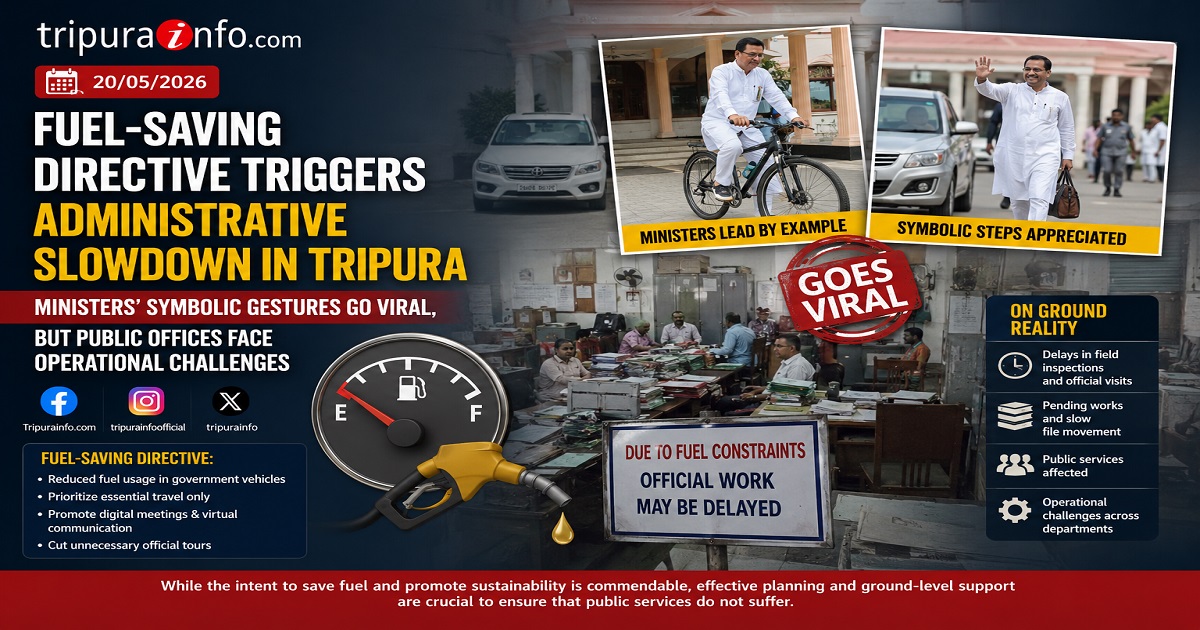 Tripura’s decision to enforce a 50 percent attendance roster in government offices following Prime Minister Narendra Modi’s appeal for fuel conservation has triggered widespread administrative disruption across the state over the past week. While ministers and senior officials have publicly demonstrated support for the campaign through symbolic gestures, common citizens are increasingly facing difficulties in accessing government services.
Responding to the Prime Minister’s call for fuel savings, Chief Minister Dr. Manik Saha directed all state government departments to function with only 50 percent staff attendance. He also reportedly reduced the number of vehicles in his official convoy. Following the Chief Minister’s example, several ministers reduced escort vehicles and staged public demonstrations promoting fuel conservation.
Photographs and videos of ministers and public representatives travelling to offices on motorcycles, bicycles, trains and auto-rickshaws quickly went viral on social media. The District Magistrate of Gomati district drew attention after cycling to office, while several elected representatives called journalists to highlight their decision to commute by bike or scooter.
However, beyond the publicity surrounding these symbolic measures, serious concerns are emerging regarding the functioning of government departments.
Administrative Work Slows Down
Under the new roster system, Group C and Group D employees in government departments and governmentcontrolled agencies were instructed to attend offices on a 50 percent rotational basis. The order also applies to irregular employees. Most departments implemented the directive immediately.
In the Tripura Tribal Areas Autonomous District Council (TTAADC), authorities adopted a modified arrangement, asking employees to attend office three days a week while working from home on remaining days.
But officials and citizens alike claim that the sudden reduction in workforce has significantly slowed administrative functioning. Many departments in Tripura are already suffering from acute staff shortages. With half the employees remaining absent under the roster system, routine file movement, public services, and office coordination have reportedly become sluggish.
Several citizens visiting offices for official work have complained of delays, longer waiting periods, and difficulty in accessing key services.
Interestingly, the state’s Food Minister has publicly maintained that there is no shortage of petrol or diesel in Tripura. Yet drivers and transport operators allege that many petrol pumps across the state have displayed “No Petrol” or “No Diesel” signboards over recent days.
As a result, many vehicle owners claim they are being forced to purchase fuel from black market operators at inflated prices. This contradiction between official assurances and ground realities has added to public confusion and frustration.
Questions Raised Over Practicality of the Move
Critics argue that while the fuel-saving initiative may have been launched with good intentions, its implementation has overlooked the practical impact on governance and public services. They point out that symbolic photo opportunities by ministers and DM cannot compensate for the inconvenience now being faced by ordinary citizens.
Questions are also being raised over whether the state administration conducted any proper assessment before implementing the 50 percent attendance policy, especially when many departments are already operating with limited manpower.
Observers believe that unless the roster system is reviewed or fuel supply concerns are resolved quickly, administrative efficiency may continue to decline, directly affecting public service delivery across Tripura.
more news...