Court Denies Anticipatory Bail in Rahul Kishore Roy Death Case, Questions Raised Over Police Investigation
By Our Correspondent
Agartala, May 14, 2026
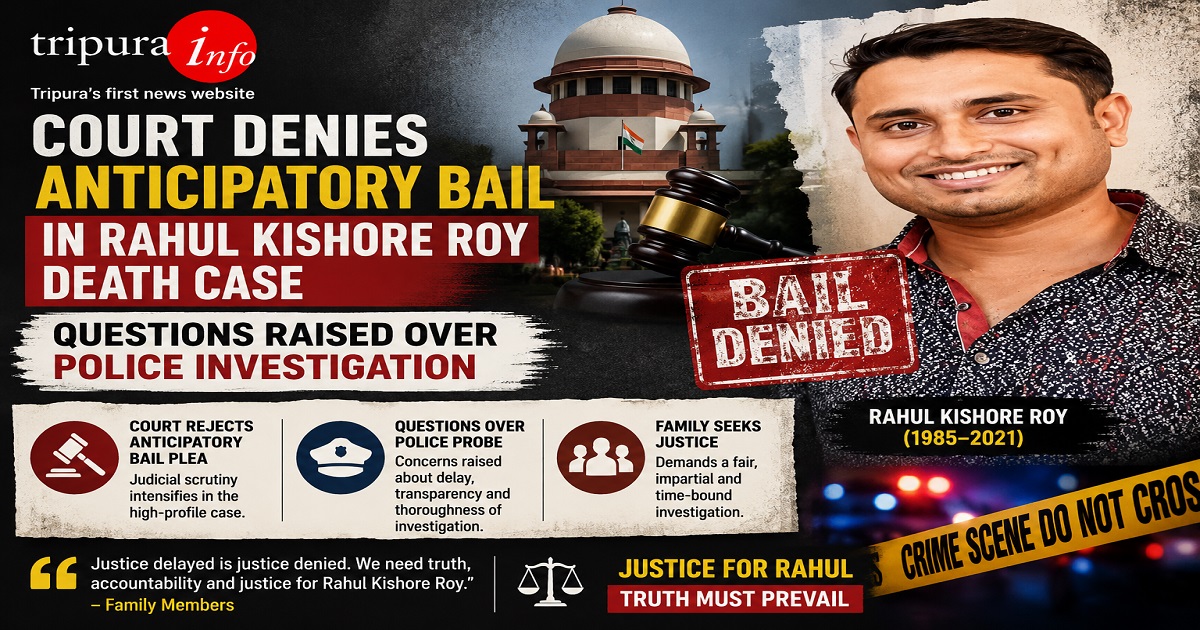 The mysterious death of BJPs prominent Dharmanagar youth leader Rahul Kishore Roy has taken a dramatic new turn after a court in North Tripura rejected the anticipatory bail pleas of all the three accused. As per the wife of the deceased newly elected MLA Jahar Chakraborty and his wife Barnali Goswami also involved in this suicide case. The court’s strong observations and the continuing delay in arrests have intensified public scrutiny over the police investigation and triggered fresh political controversy across the state.
According to court proceedings held yesterday in the North Tripura District and Sessions Court, the anticipatory bail applications of the accused were rejected after the court found the allegations to be serious and the investigation to be at a sensitive preliminary stage. However, despite the cancellation of legal protection, none of the accused have been arrested so far, raising serious questions about the role and neutrality of the investigating agency.
The court made it clear that, considering the gravity of the allegations and the prima facie materials placed before it, granting anticipatory bail at this stage would not be appropriate. Legal observers believe the ruling reflects the judiciary’s concern over both the nature of the incident and the possibility of influencing the investigation.
During the hearing, lawyers representing the accused repeatedly questioned the manner in which the investigation has been conducted. They argued that although the prosecution claimed Rahul Kishore Roy had submitted a complaint to the police before his death, the original complaint document was never produced before the court. Instead, only a preliminary official report was submitted.
This became a major point of discussion during the hearing. The court reportedly sought clarification as to why the complete written complaint, if it indeed existed, was not brought before the judiciary. The defense further highlighted several alleged inconsistencies in the investigation process.
Questions were also raised regarding the recording of statements from the victim’s family members. Despite the seriousness of the matter, the family’s detailed statements were allegedly not fully documented during the initial stage of the probe. The defense additionally claimed that family members had not clearly named the accused in their early interactions with the media, and that the FIR was submitted later in typed format.
Although the defense attempted to use these points to weaken the prosecution’s case, the court did not accept the arguments in favor of anticipatory bail. The judge reportedly observed that in a situation involving shock and grief, the fact that someone else typed the FIR does not automatically undermine the credibility of the allegations.
The court instead focused on the sequence of events described in the complaint. According to the allegations, on the day election results were declared, the accused allegedly went to Rahul Kishore Roy’s residence, created unrest, abused family members, and physically assaulted them. It was also alleged that Rahul’s pregnant wife was assaulted during the incident.
Furthermore, the complaint states that later that night, the accused again visited the house and allegedly threatened the family with dire consequences. Within hours of these events, Rahul Kishore Roy was found hanging under mysterious circumstances.
The court considered this chain of events to be highly significant while rejecting the anticipatory bail pleas. It also observed that the investigation is still in its early phase and that several important witness statements and evidentiary procedures are yet to be completed. Granting anticipatory bail at such a stage, the court felt, could potentially influence witnesses and hamper the collection of evidence.
Another key issue discussed during the hearing was the use of media video footage by the defense. Lawyers for the accused reportedly presented television clips to argue that the victim’s family did not initially mention the names of the accused. However, the court declined to treat partial media footage as conclusive evidence.
The judge observed that selective video clips broadcast by news channels cannot be accepted as the ultimate truth without proper verification. The authenticity, context, and full content of such footage, the court noted, must be examined through a proper investigation.
Perhaps the most significant observation made by the court was regarding the explanation given by the accused for visiting Rahul’s house. The defense claimed they had merely gone there to share election victory celebrations.” However, the court questioned why such a tragic incident occurred within hours of that visit if the intention had been purely celebratory.
This observation has been widely interpreted as a sign that the judiciary is unwilling to treat the incident as a routine political dispute or post-election excitement.
As public attention continues to grow around the case, the role of the police investigation is increasingly coming under criticism. While the court has taken a strict stand by refusing anticipatory bail, the absence of arrests despite serious allegations has fueled suspicion and political debate.
The Rahul Kishore Roy death case has now evolved into one of the most discussed and politically sensitive incidents in Tripura, with mounting demands for a transparent, impartial, and comprehensive investigation.
more news...