Tripura’s Financial Framework Under Review: Experts Propose Strategic Reforms for Sustainable Growth
By Our Correspondent
Agartala, April 9, 2026
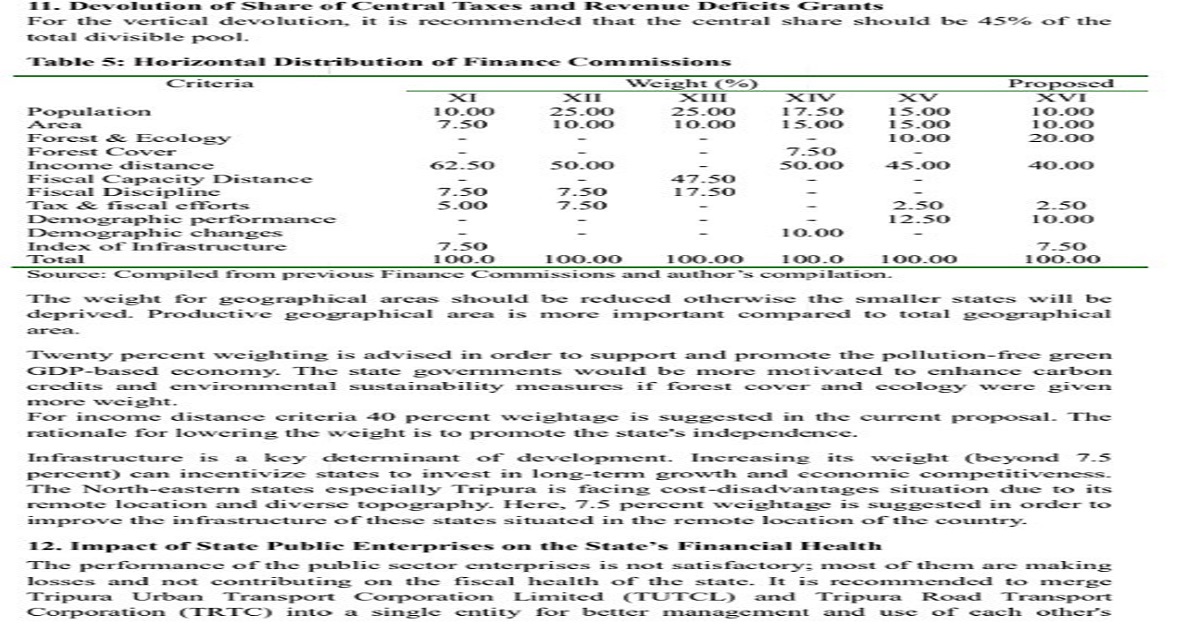 A comprehensive evaluation of Tripura’s financial framework, conducted by the Department of Economics at Tripura University under the guidance of Professor Subhrabaran Das, has put forward a series of key policy recommendations aimed at ensuring long-term fiscal sustainability and inclusive economic growth. The study, supported by the upcoming Sixteenth Finance Commission, highlights both strengths and areas requiring urgent reform.The report appreciates the proposed horizontal devolution formula, which allocates 45 percent of the divisible pool of central taxes to states. This reflects a continued commitment to fiscal decentralization and equitable distribution. Notably, the inclusion of environmental parameters, with forest and ecology receiving a significant 20 percent weight, is expected to benefit northeastern states like Tripura, where forest resources are integral to both the economy and ecological balance.
However, the study raises concerns over the 10 percent weight assigned to geographical area. Experts argue that this criterion may disadvantage smaller states such as Tripura and recommend shifting focus toward productive geographical area to ensure a more balanced and fair allocation mechanism. The income distance criterion, which carries a 40 percent weight, has been deemed appropriate but requires careful calibration to gradually encourage fiscal self-reliance among states.Infrastructure development emerges as a major concern in the report. With only 7.5 percent weight currently assigned to the infrastructure index, the study suggests increasing this share, emphasizing that states like Tripura face higher infrastructure costs due to difficult terrain and connectivity limitations. Strengthening infrastructure is viewed as critical for enhancing economic competitiveness and improving regional integration.
The performance of State Public Sector Enterprises (SPSEs) in Tripura also comes under scrutiny. Several entities continue to incur losses, placing a burden on the state’s finances. To address this, the study recommends structural reforms, including the merger of Tripura Urban Transport Corporation Limited (TUTCL) with Tripura Road Transport Corporation (TRTC) to improve operational efficiency and optimize resource utilization.In the industrial sector, the report encourages the Tripura Handloom and Handicrafts Development Corporation Limited (THHDCL) to expand its national footprint through e-commerce platforms and stronger distribution networks. At the same time, the financially unviable Tripura Jute Mills Limited (TJML) has been recommended for closure, with provisions to rehabilitate its workforce within other public sector units under the Directorate of Industries & Commerce. The study further proposes transferring TJML’s assets to the Tripura Industrial Development Corporation Limited (TIDCL) for more productive use.
The research was carried out by a team comprising Professor Subhrabaran Das (Head of Department), Research Associate Kiran Bhowmik (PhD Scholar), and Research Assistant Srijan Debnath.Overall, the report presents a balanced and forward-looking roadmap focused on strengthening fiscal discipline, promoting environmental sustainability, and enhancing institutional efficiency. The recommendations are expected to play a significant role in shaping policy decisions, ensuring resilient and inclusive economic growth for Tripura in the coming years.
more news...