Kokborok Script Row Turns Political as Tribal Congress Leader Targets Pradyot Kishore and His Sister BJP MP’s Family Legacy
By Our Correspondent
Agartala, January 31, 2026
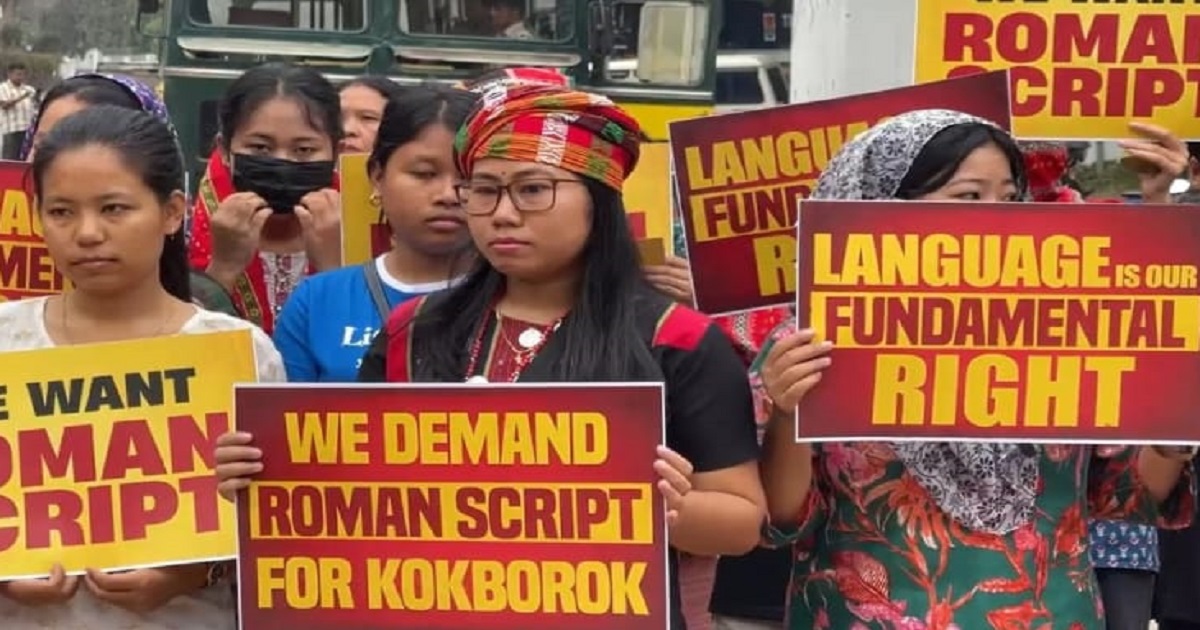 The long-simmering Kokborok language controversy in Tripura has taken a sharp political turn, with Tripura Pradesh Adivasi Congress Chairman Shabda Kumar Jamatia launching a scathing attack on Tipra Motha founder Pradyot Kishore Debbarma and his Sister BJP MP Kriti Singh by invoking family lineage and language identity, further intensifying the already volatile debate over script and cultural representation.
Speaking at a political gathering, Jamatia alleged that the Pradyot Kishore Debbarma and his sister BJP MP Kriti Singh herself unable to speak Kokborok, questioning the sincerity of the ruling party’s claims about protecting indigenous identity. “Whose fault is this?” Jamatia asked, arguing that the erosion of Kokborok usage among tribal families is the result of historical and political decisions, not a natural social change.
He pointedly blamed past rulers for abandoning Kokborok as an official language during the royal era, stating that if Kokborok had been institutionalised then, the present crisis would not have emerged. Instead, Bengali was adopted and gradually became dominant across Tripura. “Today Bengali is spoken everywhere, in markets, villages, and even in indigenous households. Children grow up speaking Bengali first, not Kokborok,” he said, adding that this linguistic shift is now being weaponised politically.
Notably, Jamatia’s remarks come amid an escalating Kokborok script controversy that has shaken Tripura’s political landscape in January 2026. Chief Minister Manik Saha has firmly rejected demands to adopt the Roman script for Kokborok, maintaining that the use of foreign scripts could endanger indigenous cultural identity. The state government continues to back the Bengali script, a stance that has widened cracks within the ruling alliance.
The issue has particularly strained relations between the BJP and its ally TIPRA Motha, especially ahead of the crucial TTAADC elections. TIPRA Motha has consistently supported the Roman script, aligning with the sentiments of large sections of indigenous students and intellectuals.
The controversy spilled onto the streets during the 48th Kokborok Language Day on January 19, when student organisations including the Twipra Students Federation and the Tipra Indigenous Students' Federation disrupted official programmes, demanding immediate recognition of the Roman script. Protesters argue that the Roman script better represents Kokborok phonetics and is more practical for modern education.
Anger intensified after reports surfaced that students, particularly in CBSE-affiliated schools, were effectively compelled to use the Bengali script for Kokborok, triggering widespread resentment among indigenous communities.
Reportedly, the Kokborok script dispute is not new. For over five decades, successive governments have failed to reach a consensus between the Bengali and Roman scripts, leaving generations of students caught between policy shifts and political posturing. What was once an academic and cultural debate has now evolved into a high-voltage political issue, with identity, history, and electoral calculations deeply intertwined.
As political leaders trade accusations and student protests continue, the Kokborok controversy stands as a stark reminder that unresolved cultural questions, when mixed with power politics, can deepen social fault lines rather than heal them.
more news...