Tripura University Legal Cell Order Raises Questions Over Authority of Probationary Professor to Sign Court Documents
By Our Correspondent
Agartala, January 23, 2026
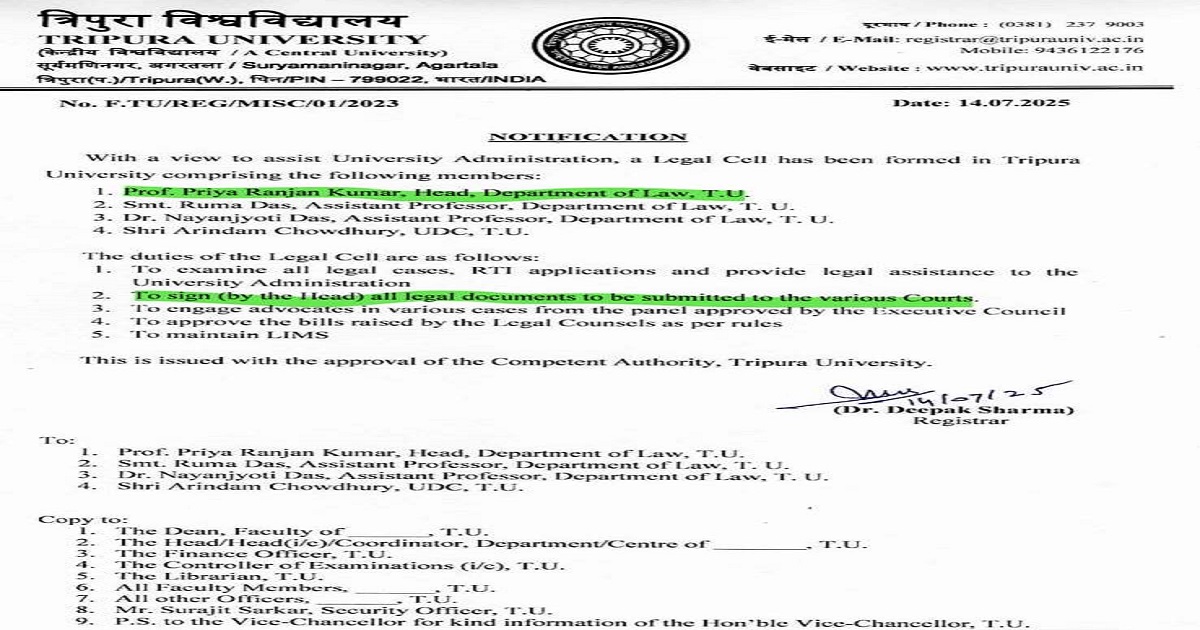 An office order issued by Tripura University on July 14, 2025, forming a Legal Cell and authorising a probationary faculty member to sign legal documents submitted before courts has triggered serious questions over administrative propriety, legality, and adherence to Government of India service rules.
As per the notification issued by the then Registrar of Tripura University, Dr Deepak Sharma, a Legal Cell was constituted to assist the University Administration. The Legal Cell was headed by Dr Priya Ranjan Kumar, Professor and Head, Department of Law, Tripura University. Among the duties assigned, the order specifically authorised the Head of the Legal Cell to sign all legal documents to be submitted before various courts of law, in addition to other responsibilities related to legal cases, RTI matters, engagement of advocates, and maintenance of legal records.
However, it has been pointed out that Dr Priya Ranjan Kumar, at the time of issuance of the order and even as of date, is reportedly under probation. As per the established service rules of the Department of Personnel and Training (DoPT), Government of India, a probationer is ordinarily not entrusted with sensitive statutory or quasi-judicial responsibilities, including signing of affidavits or legal documents to be filed before courts.
This has led to a critical question being raised in academic and administrative circles: why was a probationary officer entrusted with such a high-stakes responsibility involving submissions before the High Court of Tripura and other courts of law?
Critics argue that the decision becomes even more puzzling given the availability of several permanent teaching and non-teaching officers within Tripura University who are of comparable or equivalent rank to that of the Registrar. They question why such officials were bypassed in favour of a probationer for signing affidavits and other legal documents carrying significant legal consequences.
To illustrate the gravity of the issue, observers draw a parallel with banking norms, noting that even financial institutions are often reluctant to extend loans or assign major financial authority to individuals on probation. Against this backdrop, assigning a probationer the responsibility of representing the University through sworn affidavits before courts is being described as highly irregular.
More serious legal concerns have now emerged regarding the validity of affidavits already signed and submitted by Dr Priya Ranjan Kumar to the High Court of Tripura and other judicial forums. Legal experts suggest that if the signatory lacked the requisite authority under service rules, such affidavits could be challenged on grounds of legal sanctity, potentially rendering them void or legally untenable.
There are also allegations that the decision may have been taken to shield higher officials from future legal or administrative accountability. These allegations, though yet to be independently verified, have intensified demands for a thorough inquiry into the circumstances under which the Legal Cell was constituted and powers were delegated.
Legal observers caution that if affidavits are found to be invalid due to improper authorisation, it could amount to wastage of valuable judicial time and may invite serious observations from the courts.
In light of these developments, there is growing demand for clarification from Tripura University authorities and, if necessary, intervention by competent authorities to examine whether the Legal Cell’s functioning complied with DoPT norms, University statutes, and principles of administrative law.
more news...