Holy Cross Convent School in Dharmanagar Says No to Religious Rituals on Campus, Citing Constitutional Secularism
By Our Correspondent
Agartala, January 22, 2026
 The authorities of Holy Cross Convent School in Dharmanagar have categorically stated that no religious programme or ritual, including Saraswati puja, will be organised within the school premises. The school management has clarified that the decision is rooted firmly in the constitutional principle of secularism and the legal framework governing educational institutions.
According to the school authorities, the very opening spirit of the Indian Constitution declares India to be a secular state. While it is true that many Christian missionary-run schools in Tripura traditionally organise programmes on the occasion of Christmas to mark the birth of Jesus Christ, the management believes that extending the same logic to allow Saraswati Puja or any other religious ritual inside a missionary-run school becomes a complex and sensitive issue when examined strictly from a constitutional perspective.
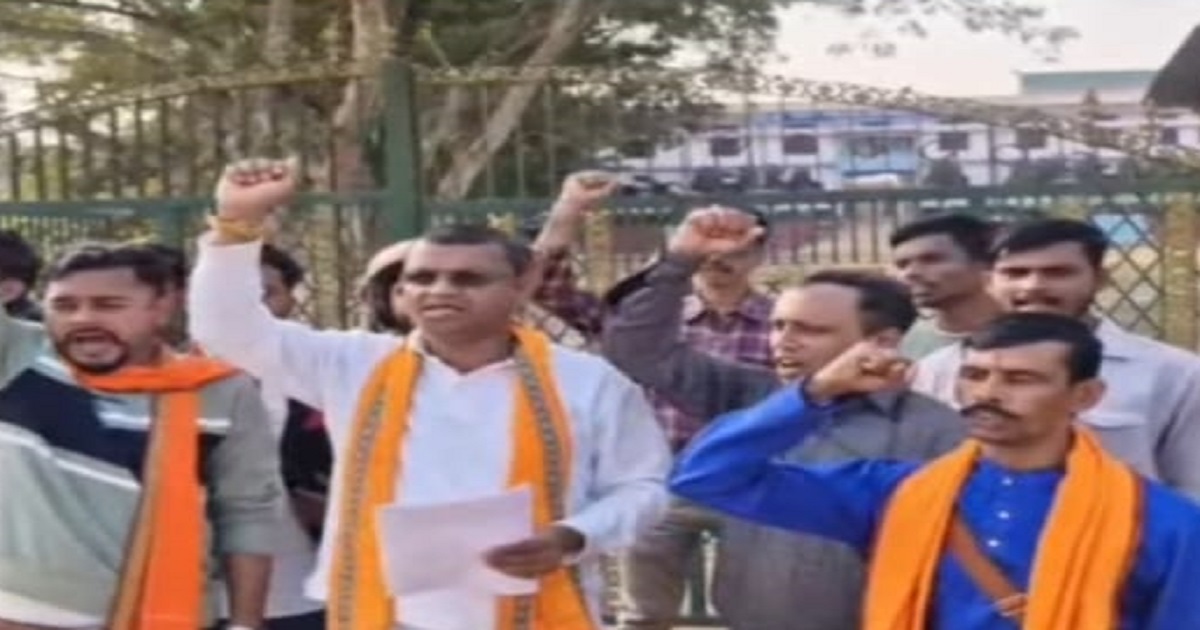
The debate gained prominence after demands were raised by certain organisations, including the Vishwa Hindu Parishad, seeking permission to organise Saraswati Puja in Christian missionary-run schools to be held tomorrow. While such demands may appear reasonable at a surface level in the name of equality, their actual implementation raises serious constitutional and legal questions. This complexity has now come into sharp focus through the decision taken by the Dharmanagar based missionary school.
It is also a well-established fact that Saraswati Puja has been organised for decades in most government and government-aided schools across Tripura. However, constitutional experts point out that Article 28 of the Constitution clearly prohibits imparting religious instruction or conducting religious worship in government or government-aided educational institutions. Whether it is Saraswati Puja, Nabi Divas, or the celebration of Jesus Christ’s birthday, all are religious observances and therefore lack constitutional validity within such institutions.
Legal scholars further argue that the practice of inviting priests of a particular caste to conduct rituals in schools may also conflict with Article 17 of the Constitution, which abolishes untouchability and prohibits discrimination rooted in caste practices. From this viewpoint, institutionalised religious rituals in schools stand at odds with constitutional morality.
Moreover, Article 38 directs the State to secure a social order based on justice, equality, and human dignity, while Article 51A emphasises the fundamental duty of citizens to promote scientific temper, humanism, and a rational outlook. Organising religious ceremonies in educational institutions, especially those funded or aided by the State, is seen as contradicting these core constitutional values.
Despite the clarity of constitutional provisions and legal interpretations, a pressing question continues to surface: why has the administration failed to take a definitive and uniform stand on this issue? The decision by Holy Cross Convent School has once again brought the matter to the forefront, exposing the administrative hesitation in enforcing constitutional principles consistently across educational institutions in Tripura.
more news...