NEET-PG 2025 Cut-Off Shock: NBEMS Lowers Eligibility to Zero Percentile, Raising Serious Concerns Over Medical Standards
By Our Correspondent
Agartala, January 14, 2026
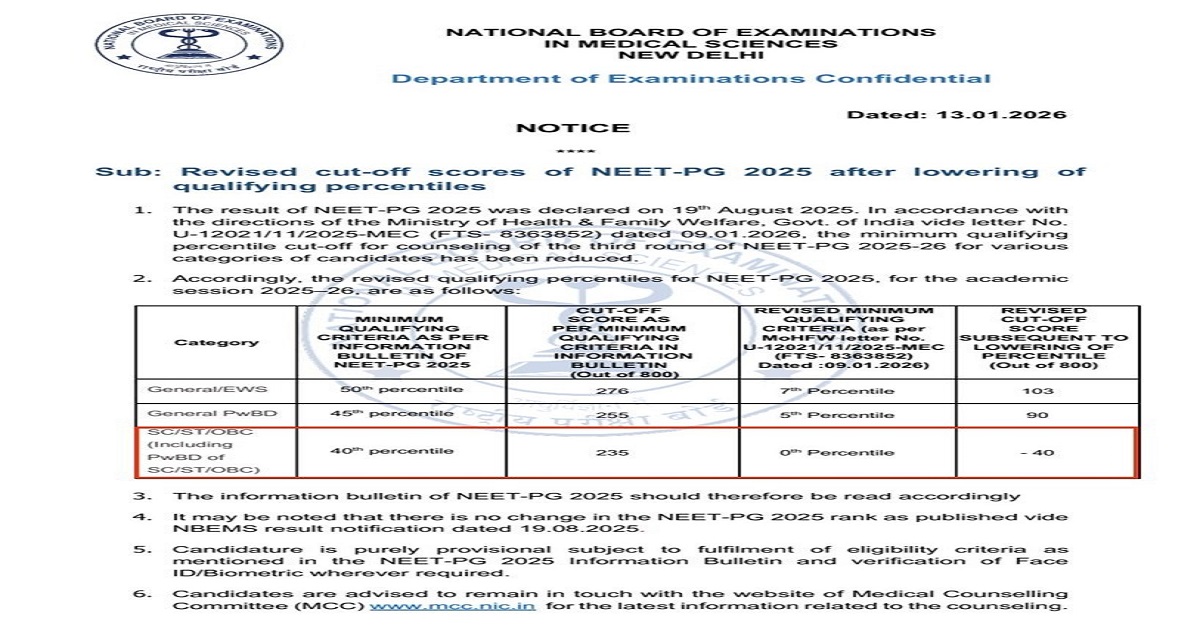 The National Board of Examinations in Medical Sciences (NBEMS) has issued a controversial notification revising the qualifying cut-off scores for NEET-PG 2025, dramatically lowering the eligibility criteria across categories, including a zero percentile cut-off for SC, ST and OBC candidates. The decision, taken following directions from the Ministry of Health and Family Welfare, has triggered intense debate among doctors, medical educators and the public over patient safety and the future of postgraduate medical education in India.
As per the notice dated January 13, 2026, the revised qualifying criteria apply to counselling for the third round of NEET-PG 2025–26. The most startling change is for the SC, ST and OBC category, where the qualifying percentile has been reduced from 40th percentile to zero percentile. In terms of marks, this translates to a revised cut-off score of minus 40 out of 800, a figure that has shocked even senior members of the medical fraternity.
For General and EWS candidates, the qualifying percentile has been lowered from the 50th to the 7th percentile, with the cut-off score dropping from 276 to 103. For General PwD candidates, the cut-off has been reduced from the 45th to the 5th percentile, bringing the score down from 255 to 90. NBEMS has clarified that while eligibility criteria have changed, NEET-PG 2025 ranks remain unchanged.
The notification has reignited an uncomfortable but necessary debate: what does minimum competence mean in a profession where human lives are at stake? Medical experts argue that postgraduate medical education is not merely about filling seats but about ensuring that future specialists meet a basic academic and clinical threshold.
One senior doctor of Agartala Government Medical College remarked that imagining a surgeon or physician qualifying for a postgraduate seat despite failing to score even zero marks raises disturbing questions. The concern is not about any community or category, but about the erosion of standards in a field where mistakes can be fatal. Critics say that lowering cut-offs to such an extent risks producing specialists who lack foundational knowledge, thereby undermining public trust in the healthcare system.
Public reaction has been equally sharp. Many have questioned whether policymakers would be comfortable being treated by a specialist who entered postgraduate training with negative marks. Others argue that instead of repeatedly lowering standards, the government should invest in improving undergraduate medical education, faculty strength and training infrastructure so that more candidates can qualify on merit.
As the controversy deepens, one question dominates the discussion: Can a country striving to become a global healthcare leader afford to compromise on the competence of its doctors? The answer may shape not just medical education policy, but the future safety and confidence of millions of patients across India.
more news...