Nameplate Controversy and Administrative Concerns Raise Questions at Tripura University
By Our Correspondent
Agartala, January 13, 2026
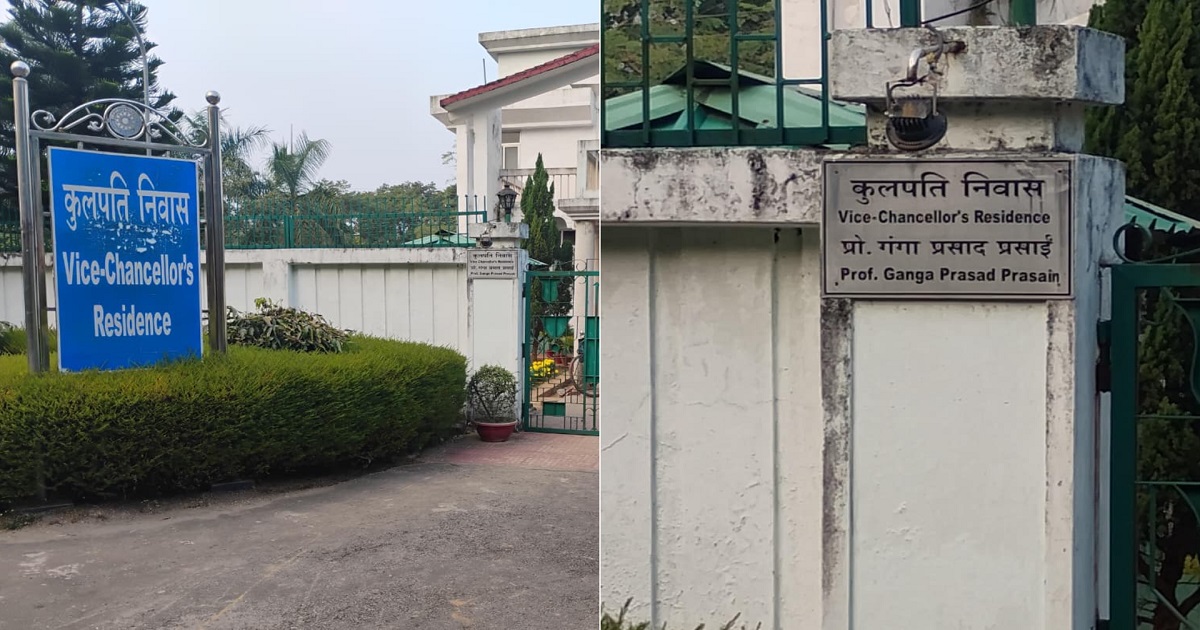 Tripura University, a Central University, has recently found itself at the center of discussion due to a series of administrative and governance-related issues that have drawn the attention of students, research scholars, and academic observers. One of the most visible matters involves the official nameplate of the former Vice-Chancellor, Prof. Ganga Prashad Prasain, which reportedly remains displayed in front of the Vice-Chancellor’s official residence on the university campus even after the completion of his tenure.
According to sources, Prof. Prasain vacated his position and left the university following the end of his term. However, the continued presence of his nameplate has raised questions among the university community. Comparisons are being drawn with an earlier instance involving former Vice-Chancellor Prof. V. L. Dharukar, whose nameplate was reportedly removed prior to his departure. Observers are expressing curiosity over why similar administrative practices were not followed in both cases, despite the circumstances being largely comparable.
The issue has also brought broader concerns about the current administrative climate at Tripura University, which is presently under the leadership of Prof. Shyamal Das. University officials have informally indicated that the in-charge Vice-Chancellor is often addressed as “Dada,” a practice that many students and research scholars find inappropriate in a formal academic setting. They argue that such informal modes of address may undermine institutional decorum and the professional environment expected within a Central University.
In recent academic developments, Tripura University—known for its relatively strong communication systems and infrastructure compared to several other institutions in the region—has reportedly witnessed a decline in applications for PhD admissions. Sources suggest that concerns over the university’s reputation and internal administrative matters may have influenced prospective research scholars’ decisions.
Another major issue highlighted by stakeholders is the frequent intervention of local influences in administrative and developmental matters. While the university is said to have several competent and dedicated faculty members, there are allegations that they do not receive adequate institutional support from the administration to contribute effectively to the university’s growth. Critics argue that excessive local interference, often by individuals without sufficient understanding of academic and administrative processes, hampers long-term development.
Many within the academic community emphasize that while political intervention is not necessarily the core problem, strong regulation, transparent monitoring, and adherence to institutional norms are essential. Without these, they warn, the university may struggle to achieve its academic and developmental goals.
As discussions continue, students, faculty, and observers alike hope that timely corrective measures will be taken to restore confidence and uphold the academic stature of Tripura University.
more news...