In Memory of Tripura’s First IAS Officer, Late Ramesh Chandra Ray
Dr. Bholanath Saha
October 6, 2026
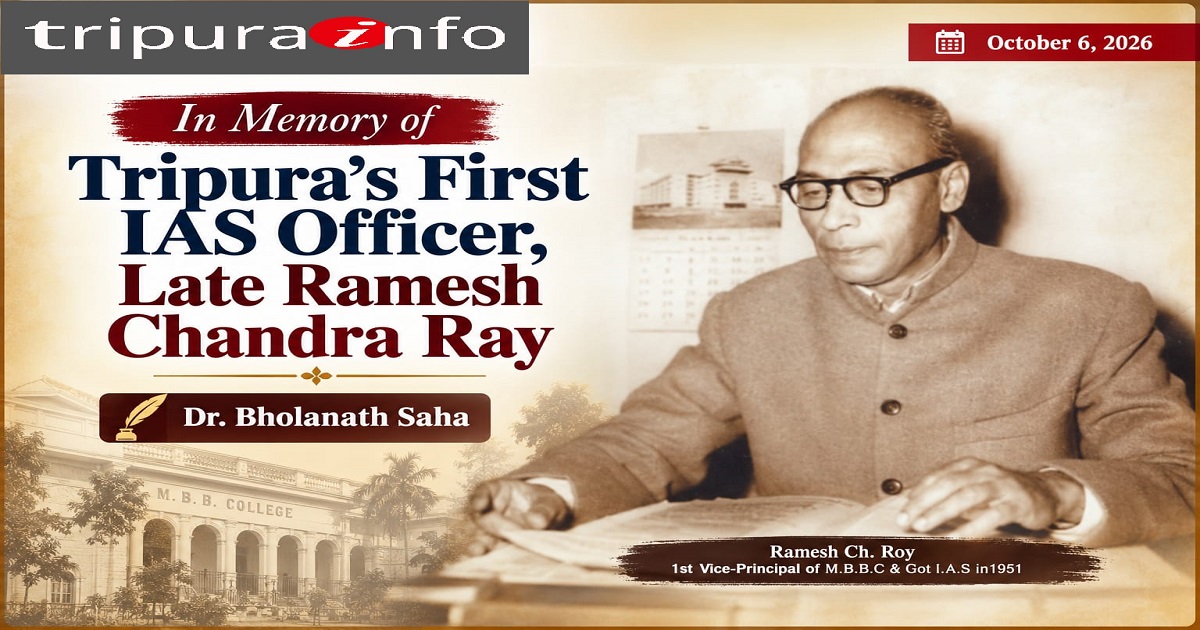 Today, many talented and intelligent young men and women from Tripura have cleared the IAS examination and brought fame and honour to our state. Among them, Mr Balbant Kishore Debburma 1985, Mr Sirdhatha Kishore Debburma 1987 batch, Smt. Tanushree Debbarma in 2006, Shri Debapriya Bardhan in 2012, and Shri Dhiman Chakma in 2021 have made their mark at the national level. About 75 years ago, Shri Ramesh Chandra Ray became the first person from Tripura to be selected for the IAS. This year, 2026, marks 75 years since his selection to the IAS and also 40 years since his death. On these two memorable occasions, I offer this tribute to his memory.
The Indian Administrative Service (IAS) was formed in 1946 as the successor to the Indian Civil Service (ICS) of the British period. After Independence, special recruitment arrangements were also made to meet the shortage of administrative officers. At that time, candidates were also selected from among university and college teachers.
Ramesh Chandra Ray, the Vice-Principal and Professor of English Literature at M.B.B. College, the only college then established in the state, applied under this opportunity. After some time, he was called for an interview by the Union Public Service Commission (UPSC), and in 1951 he was selected for the Madhya Pradesh Cadre.
As soon as this good news reached the college, there was great happiness among everyone. The entire college community warmly congratulated him for achieving this rare distinction as the first person from Tripura to be selected for the IAS.
Shri Ray was selected for the IAS, but his appointment letter did not arrive. He became very worried. After a long wait, he finally received the appointment letter in a partly burnt envelope.
On making inquiries, it was found that an aircraft accident had taken place near Agartala airport in 1951. His valuable appointment letter was on that very aircraft which met with the accident. By that time, however, the prescribed date for joining the service had already passed.
During this difficult situation, with the help of the then Principal, Dr. Jogendra Kumar Choudhury, and others, contact was made with the Ministry of Home Affairs in Delhi, and his joining deadline was extended.
Then another obstacle arose—the medical fitness test. The Agartala Medical Board declared him medically unfit. With no other option, he went to Kolkata and met Dr. Bidhan Chandra Roy. The famous doctor examined him and issued a certificate declaring him physically fit for service.
After communicating with Delhi, he finally joined his new service in Madhya Pradesh on January 12, 1952.
During his career, he worked with great honesty and dedication. He eventually retired from service as the Chief Secretary of the Government of Madhya Pradesh.
Professor Ray was born at Pattan village in Brahmanbaria, which was then in East Bengal. He completed his B.A. from Comilla Victoria College under Calcutta University and later obtained his M.A. in English.
After Partition, he came to Agartala in 1947. On November 20, 1947, he joined M.B.B. College as Vice-Principal and Professor of English Literature, with a pay scale of Rs. 250-10-300.
He was a highly respected scholar of English literature. He was nearly six feet tall, fair in complexion, and usually wore a dhoti and kurta. He had a serious and dignified personality.
Students from the Science, Commerce and Arts streams were also eager to attend his English Literature classes and listen to his lectures. When there was no space inside the classroom, students would gather in the corridor to listen to him.
I came to know about this from one of his students, the late Shri Chittaranjan Bhattacharjee, who was the first Chief Engineer of the state’s Electricity Department.
When Ramesh Chandra Ray first came to Agartala, he stayed with his family at our own house in Banamalipur. He was my mother’s maternal uncle.
Later, while serving in Madhya Pradesh, he purchased a house in the Dum Dum area of Kolkata. He named the house ‘Sharat Tara’, after his father, Sarat Chandra Ray.
During the late 1960s and the 1970s, whenever we travelled from Agartala to Kolkata, this house was a special shelter for our family. After his retirement, Grandfather lived in this house with his family.
The drawing room of the house was decorated with framed photographs and many memories from his professional life. There were photographs of him with India’s first President, Dr. Rajendra Prasad, Prime Minister Jawaharlal Nehru and many other important personalities of that time.
There was also a small room on the roof of the house where Grandfather often spent time in meditation.
Today, that house is no more. Grandfather is no more, and Grandmother is no more either.
Grandfather passed away at this Dum Dum house on January 7, 1986, at the age of 78.
Among his two sons and three daughters, his youngest son, Shri Ranjan Ray, a retired officer of the Indian Ordnance Factory Service, is now 81 years old and lives with his son in Bengaluru.
Today, everything connected with Grandfather exists only in our memories—only memories.
After retirement, Grandfather came to Agartala only once, and that too for a short period. During that visit, he stayed at the house of his cousin, Dr. Brajendra Poddar, at Bardowali, and also at our house in Banamalipur.
Dr. Brajendra Poddar was the father of Shri R.C. Poddar, a well-known retired TCS officer of the state.
During his stay in Agartala, Grandfather paid courtesy visits to the homes of Principal Sushanta Choudhury and other professors and accepted their invitations.
He was a follower of Thakur Ramakrishna Paramahamsa. He wrote two books in English on the philosophy and teachings of Ramakrishna and Sarada Devi. Both books were published by Oxford University Press.
Acknowledgement
First of all, I would like to express my gratitude to the Registrar of Maharaja Bir Bikram University, the knowledge-loving Dr. Sumanta Chakraborty.
He discovered a rare and valuable book titled ‘A Dream College’ from a pile of neglected books in the library of M.B.B. College. Although the book was damaged and difficult to read, it contained valuable information.
The book was written in 1952 by J.K. Choudhury, the second Principal of M.B.B. College.
Dr. Chakraborty took great care to preserve and recover the book. With the support of Maharaja Bir Bikram University and the state government, a new edition of the book was published in 2022.
This book provided much information about Shri Ramesh Chandra Ray.
One can only wonder how many valuable old books in our country have been destroyed over the years, and who knows how much precious information has been lost with them.
Another notable example of the recovery of an ancient manuscript is Kautilya’s ‘Arthashastra’.
The work was identified in 1905 by scholar and librarian Rudrapatna Shamasastry from a Sanskrit palm-leaf manuscript preserved in the Oriental Library of Mysore.
He published the Sanskrit text in 1909 and its English translation in 1915. As a result, the work received wide recognition among scholars across the world.
Secondly, many previously unknown details about respected Ramesh Chandra Ray can be found in the book ‘Jiban Khatar Prati Patay’ written by Achintya Kumar Ray, a professor of M.B.B. College.
আরও পড়ুন...