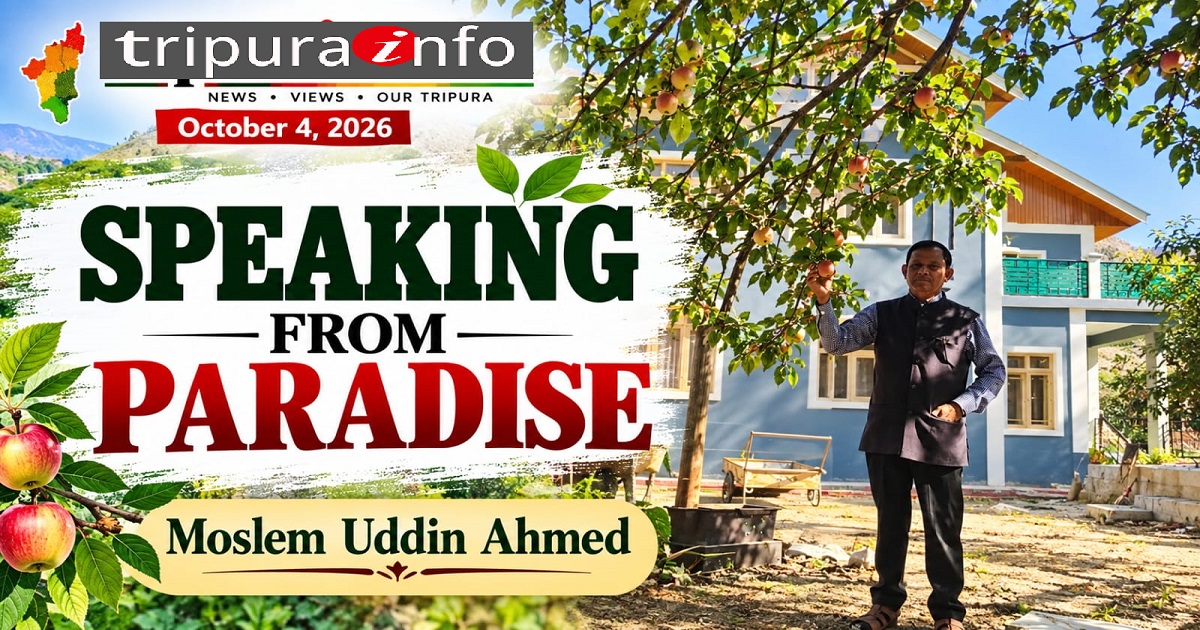
SPEAKING FROM PARADISE
Moslem Uddin Ahmed
October 4, 2026
 “The hills wear a robe of white,
Silent beneath the endless sky;
No tree, no path, no trace of life
Only snow, and mountains reaching high.”
At times, nature becomes so overwhelmingly beautiful that words seem inadequate to describe what the eyes behold and the heart experiences. There are landscapes before which one does not merely look—one stands humbled, astonished, and silently grateful to the Creator.
It was three-thirty in the morning. The world around us was still wrapped in profound silence, immersed in the tranquil stillness before dawn. Having carefully packed all his clothes and other necessities, Zulfiqar, accompanied by his son-in-law Asif Batul, boarded a hired car booked through Uber and set off directly for Terminal 1 of Delhi Indira Gandhi International Airport.
Passing through the peaceful, traffic-free streets of the early morning, the car reached the airport almost before one could realize it.
The clock showed 6:40 a.m. when the Air India Express aircraft left the runway at Delhi and took wing for Srinagar.
Crossing what seemed like a river of clouds—the Alakananda of the sky—the aircraft gently touched down on the runway of Srinagar Airport at around 8:00 a.m. At that very moment, an indescribable feeling of delight stirred quietly in everyone's heart. His companions on this unforgettable journey were Asif Batul, Dr. Hasan, and his younger sister Masuma Begum, who had recently graduated in science from the University of Delhi.
No sooner had Zulfiqar arrived at Srinagar Airport than his mobile phone seemed to become completely mute and lifeless. There was no network signal whatsoever.It was as though the phone had suddenly ceased to function. Yet his fellow travellers were happily talking to their loved ones without any difficulty.All of Zulfiqar's companions were residents of Kargil,belonging to the region of the former state of Jammu and Kashmir.
Zulfiqar had not known that if one entered the Kashmir Valley with a prepaid SIM card only issued in another Indian state, mobile connectivity could cease to function. Seeing him in this awkward predicament,Dr. Hasan reassured him: “There is nothing to worry about. Just get a new postpaid SIM card from the airport, and everything will be fine.” Accordingly, they went to a counter inside the airport and obtained a new SIM card. But even after half an hour, as instructed by the agency, the connection did not return. Following the agency staff's advice, the SIM card was removed from the phone and inserted again.As if by some magical spell, the network sprang back to life on the mobile screen in an instant. The previously silent phone had suddenly become alive again.The joy of being able to reconnect with his loved ones brought a smile of relief to Zulfiqar's face.With evident delight, he said to Hasan,
“Oh Hasan, look! The mobile is working again! No more worries. Now I can talk to everyone.”
The weather in Srinagar was wonderfully pleasant.Lazy clouds drifted across the sky. A gentle, cool breeze brushed against the body, while the sunlight remained bright, warm and vibrant. At that moment Dr. Hasan suggested,“It would be good to have some breakfast before we begin the journey.”Following his suggestion, they parked the car near Srinagar's famous Clock Tower and began looking for a good place to eat. Just then Masuma said,“Why don't we take a group photograph in front of the Clock Tower? It would make a wonderful memory” Everyone liked the idea. Together they took a group photograph as well as several individual pictures, preserving those beautiful moments in the camera.
After breakfast at a nearby restaurant, and before embarking on the long mountainous journey toward Kargil, they went and sat for a while beside the famous Dal Lake. Before them was nothing but water.
Gentle waves rippled across the lake as tourists from different parts of India and from abroad moved about in speedboats and traditional boats. The shikaras seemed to glide slowly across the water like graceful swans. In the distance, the mountains appeared hazy and blue.All around them lay an almost otherworldly silence.
For a while, nobody spoke. Everyone simply gazed, spellbound, at the still expanse of water. Zulfiqar thought to himself: ‘If only this moment could be preserved forever on the canvas of time!’ As the magnificent beauty of Dal Lake unfolded before his eyes, a strange serenity filled his heart. The shikaras floating peacefully upon the water, the distant bluish mountains, and the shadows of clouds drifting across the sky—all combined to create the impression that he was no longer standing in the real world, but had somehow entered a realm of dreams.
For the years he had heard people speak of the beauty of Kashmir. Yet he realized that seeing such beauty with one's own eyes was an experience of an entirely different depth.For some time he remained speechless, simply looking.It seemed to him that in the presence of such incomparable beauty, human language becomes helpless.From the depths of his heart, an involuntary thought arose:“O God, had I not witnessed it with my own eyes, I could never have imagined that the beauty of Your creation could be so profound, so enchanting.”
Eventually, they tore themselves away from the spell of Dal Lake and resumed their journey toward Kargil with renewed enthusiasm. Their driver was called “pilot,” as they affectionately called him-was an extremely decent and well-mannered teacher.
Throughout the journey, he kept telling them fascinating facts about the history and culture of Kashmir and Ladakh, along with many lesser-known stories connected with the places they were passing. As Zulfiqar listened to the teacher's stories about Kashmir, the pages of his own old memories seemed to unfold before his eyes, one after another.
Although many springs of life had passed, Zulfiqar had never managed to visit Kashmir because of various unforeseen circumstances. Twice he had made elaborate plans, only to cancel the journey at the very last moment.The first time, he could not travel to Kashmir because his daughter Rezowana had an urgent medical seminar.Zulfiqar's heart could not accept the idea of visiting this “Paradise on Earth” alone, leaving his beloved daughter behind. So he cancelled the Kashmir journey and travelled to Bangladesh instead.
The second attempt also failed for various reasons.Thus his dream of seeing Kashmir—the earthly paradise—with his own eyes remained unfulfilled. But what an extraordinary play of the Merciful One!
The very daughter because of whom he had once been unable to travel to Kashmir was eventually married into a family from Kargil, the mountainous region adjoining Kashmir.
And yet, in another irony of destiny, even today Zulfiqar was travelling toward his daughter's in-laws' home in Kargil, now part of the Union Territory of Ladakh through Srinagar, without Rezowana accompanying him. Once, his journey to Kashmir had been halted because of his daughter. Now, because of that very daughter's life story, he was travelling toward Kargil. The mysterious workings of destiny seemed clearer than ever.The emptiness of being without his daughter and the overwhelming excitement of seeing this heavenly land with his own eyes for the first time,two completely opposite emotions met deep within Zulfiqar's heart.
There was a trace of sadness hidden somewhere within the joy, and yet, even within that sadness, there was a strange sense of fulfilment. The car continued along the winding mountain roads toward Kargil. From a distance, the breathtaking beauty of the historic Mughal Garden appeared beside the highway leading toward Kargil. Such beauty could not simply be passed by.Zulfiqar felt that they had to stop.The car came to a halt. Everyone got out and stepped inside the garden. And in an instant, it seemed as though they had entered another world—a magical, dreamlike world.
The lush greenery all around, the profusion of colourful flowers, and the harmonious arrangement of the landscape made Zulfiqar feel as though this were perhaps a tiny reflection of Paradise upon the earth. He had never seen the true form of Paradise with his own eyes, of course.To him, it had always remained an otherworldly realm of imagination, faith and dreams.Yet the extraordinary beauty of this garden seemed to bring a tiny shadow of that unseen Paradise into the earthly world.
Before the boundless beauty of nature created by the Most Merciful Allah, they stood silently for a while, almost speechless.A clear stream flowed through the garden with a gentle, murmuring sound. Elegant fountains sparkled nearby, surrounded by countless flowers from different parts of the world. Together they created something like a living fairy tale.
Zulfiqar had heard about the beauty of the Mughal Garden from many people throughout his life and had read about it in books. But that day he realized once again that hearing about beauty and seeing it with one's own eyes are not the same thing.With Masuma's wholehearted help, many of those ethereal moments were captured on camera.
The colourful tulips swaying before their eyes, the flowers of countless familiar and unfamiliar varieties, and their extraordinary arrangements—each scene appeared like a painting created by the hand of nature itself. The camera captured some moments.But something far greater remained captured in the heart. Perhaps it was because of Kashmir's picture,perfect mountains and the extraordinary beauty of its historic Mughal Gardens that Kashmir came to be known as the “Paradise on Earth.”
As the car continued forward, the face of nature around them began to change.The green forests, trees and vibrant landscape that had enchanted their eyes gradually gave way to an entirely different world.
A gigantic mountain now stood before them.Cut through the heart of that mountain was the approximately 6.5-kilometre-long Sonamarg Tunnel,an astonishing achievement of modern engineering and technology. Slowly, our car entered deep inside the mountain.All around us was the darkness of rock. Ahead lay only a narrow path of light.It felt as though we were travelling through the very body of the mountain, entering some extraordinary and mysterious world.There was a time when crossing these steep mountain slopes and winding roads took hours and hours. Today, tunnels have made travel through these difficult terrains much easier and faster.
It was an extraordinary meeting of the grandeur of nature with human science, technology, intelligence and creativity. As the car sped through the long tunnel, it seemed that this was more than merely a road. It was a remarkable example of modern technology making human life easier and more dynamic. No matter how vast nature may be, human knowledge, technology and creativity can carve new pathways through its very heart.
When we emerged from the tunnel and returned to daylight, it felt as though the car itself were gradually entering an empire of clouds. We were now travelling toward the Zojila Pahars(hills) of Kashmir.
Enormous mountains rose on both sides of the road, treeless, rocky and rugged, yet extraordinarily beautiful. From a distance, they looked as though some artist had shaped one mountain after another out of earth and stone and lifted them toward the sky.The higher the car climbed, the more it seemed that the sky was within reach. Patches of snow from the previous winter still remained on the mountain peaks. White snow, drifting clouds and grey mountains blended together to create an extraordinary painting of nature.
Between two mountains, a clear stream rushed through the cleft of the rocks. In the profound silence around us, the sound of its restless current created a mysterious melody. At such a great altitude, the shortage of oxygen caused some difficulty in breathing.Yet in the presence of such beauty, even that discomfort seemed insignificant. Here and there, a little green grass clung to the mountain slopes. A tiny tree appeared in another place. Far away, a bird flew across the sky.Even in this harsh landscape, life was announcing its presence.
Looking at Zojila, one could imagine that some artist had just finished painting mountain after mountain and walked away, leaving the colours still wet. Indeed, to witness the wonders of God's creation, one needs not merely eyes, but a heart capable of being moved by wonder.
After emerging from the immense rocky mountains into the open light, Zulfiqar found mountains on both sides of the road. Looking at these barren, rugged mountains, a question suddenly arose in his mind.
Why had the Most Merciful Creator brought such immense quantities of earth, stone and sand into the world and created such enormous, rugged mountains? Why, on one side of the earth, is there an endless expanse of water, while on the other stand mountain ranges reaching toward the sky? Why do rivers rush through some places while mountains remain silent for ages in others?
He had no simple answers to these questions. Yet at that moment he felt that no matter how vast human knowledge becomes, it remains so limited before the mysteries of creation. Of course, these were merely his personal reflections, not scientific conclusions. But that day he deeply understood how unfamiliar forms of nature encountered during a journey can confront a person with questions of the most profound kind.
The farther the car travelled into Kargil, the more overwhelmed Zulfiqar became by what he saw outside the window.The towering mountains on either side seemed determined to touch the sky. When he looked toward the distant snow-covered peaks, it seemed as though some invisible magician had lovingly wrapped them in pure white blankets of cotton.
And yet, hidden behind that breathtaking beauty was something primordial and frightening. Loose rocks and layers of soil hanging precariously from the steep mountain slopes repeatedly created the terrifying thought: What if a gigantic boulder suddenly came crashing down upon the car?If such a thing really happened, the moving vehicle of steel and everyone inside it could disappear into dust within moments.
Amid this thrilling journey, Zulfiqar suddenly called out to the driver:“Masterji, please stop the car here for a moment!” The car stopped. His eyes fell upon a lively, wild mountain river.Its crystal-clear water rushed freely through the cleft of the mountains.Flowing over smooth rocks of strange and varied shapes, the river created such a beautiful scene that Zulfiqar could no longer restrain himself.He got out and walked down to the river bank. Standing upon a rock, he posed for a photograph. There were many tourists along the river. Some were taking photographs, some were enjoying picnics, and others were laughing and chatting with friends and family.
Yet amid all that liveliness, a profound thought arose in Zulfiqar's heart:
“O my God! Today my heart is restless with wonder. What a magnificent artist You are! With how many colours, with what exquisite strokes of Your brush, You have adorned this earth! For whom is this vast arrangement? This unveiled beauty of nature, these flawless sculptures of stone, these distant snow-covered peaks is all this merely for the satisfaction of human eyes? Or does some deeper mystery of Your creation lie hidden behind it all?”
Still thinking about the beauty of nature and the greatness of the Creator, they resumed their journey. A little farther along the road, they saw four pedestrians. One of them was wearing khaki clothing. They were walking along the mountain road, climbing the steep terrain on foot. Seeing them, Zulfiqar felt a sudden surge of respect and patriotism.He immediately told the driver: “Brother, please stop the car.” As soon as the car stopped, he opened the door, stepped out, folded his hands respectfully and greeted them.
He introduced himself and exchanged greetings before beginning a conversation. Politely, he asked: “Are you the brave soldiers who guard our country's borders?” A tired but proud smile appeared on one of their faces. “Yes,” he replied. “We are soldiers of the country.”One of them spoke with emotion: “The country comes first and said,“We have homes and families too. We have beloved children. We also wish to spend festivals with our families and travel somewhere with the people we love. “But the great responsibility of protecting the country rests upon our shoulders. Even when we wish to go home, we cannot always rush back to our loved ones.
“These freezing, inaccessible mountains are our workplace and have been our home for long periods of time. Every moment here is uncertain. At any time, an enemy's bullet may extinguish a life.“Yet for the security of our country, we must continue to perform our duty.“When duty calls, there can be no room for personal attachments.”
Another soldier added:“There is no count of how many of our soldiers sacrifice their lives for the country every year. “Since you are travelling toward Kargil, we have one request to you all. On your way, at Dras, there is the Kargil War Memorial, built in the memory of our brave soldiers. “Please may make sure to visit that sacred place and pay your respects to those who gave their lives for our beloved country.”
After shaking hands with those brave sons of the nation, everyone returned to the car and continued the journey. But something had changed. The landscape outside was the same, yet a new feeling had arisen within the travellers themselves-a deep sense of patriotism, profound respect and gratitude toward those unseen heroes who silently guard the nation's borders.
At last, the car stopped before the Kargil War Memorial at Dras. It was around 4:30 in the afternoon. As the day was already moving toward evening, there was some uncertainty in everyone's mind about whether they would still be permitted to enter the memorial. Dr. Hasan approached a soldier on duty at the gate and asked: “Can we still go inside?”
The soldier welcomed them warmly.
“Yes, certainly. Please come in.”
Before entering, visitors were required to register their names and addresses at a designated counter.
Zulfiqar duly went forward and entered his details.
When everything was complete, the soldier on duty said:“Sir, our guide is standing ahead. He will explain the history of this memorial and tell you about its various features in detail. Please go inside with him.” The moment they entered the memorial grounds, it felt as though they had stepped into another world. The silence all around, the solemn presence of the mountains and the atmosphere filled with the memories of fallen soldiers immediately weighed heavily upon their hearts.
Through the guide's words, they heard many stories of courage, bravery and sacrifice from the Kargil War. The stories of the soldiers who had been awarded the Param Vir Chakra, in particular, touched them deeply.
The Amar Jawan Jyoti—the eternal flame burning within the memorial grounds—seemed to embody that sacrifice. Looking at the flame, Zulfiqar felt that it was not merely fire. It was a symbol of the immortal memory of countless brave men who had sacrificed their lives for the country. With profound respect, they walked through the various sections of the memorial. There was a museum displaying photographs, documents and memorabilia related to the Kargil War, preserving the history of the sacrifices made by the brave soldiers.
Further ahead stood a magnificent Victory Tower. The memory of all those brave soldiers who had sacrificed their lives defending the sovereignty of this difficult terrain has been immortalized there.Standing in that environment, Zulfiqar and everyone accompanying him became deeply emotional. It seemed as though every stone of this land told the story of some hero's sacrifice. The silence of the mountains seemed to speak: ‘How many priceless lives have merged into this soil in defence of the nation's freedom and sovereignty of our country’
With heartfelt respect and salutations to the immortal martyrs, they returned to the car. Evening shadows were slowly descending over the mountains.
A piercingly cold wind was blowing, while the white mantle of snow seemed to spread gradually across the space between the mountains. The moon shone through the snowy veil, casting a soft light upon the road.
It was a breathtaking sight. Under that gentle moonlight, the car once again set off toward Kargil town. Eventually, Zulfiqar, together with Asif Batul, Dr. Hasan, Masuma, Masterji and the others, reached Kargil.
Small settlements have grown up along the banks of the Suru River in Kargil. Since it was not winter, there was not much water in the river at that time. Higher upstream, at Sankoo, a hydroelectric power station has been built across the Suru River, and water released from there also joins the river. It was there that Zulfiqar met Mohammad Ali. He was a physical education teacher by profession and a resident of the area. His conversation with Mohammad Ali changed Zulfiqar's understanding of the mountains considerably. Until then, he had thought of these mountains mainly as barren, rocky and infertile.
Mohammad Ali introduced him to another side of their character. In reality, by the grace of God, this harsh mountain environment itself is a great blessing for the people who live here. During summer, when the snow accumulated on the mountains begins to melt, the water descends through channels and small streams.
Through water-collection and distribution systems developed with government assistance, this water reaches people's homes. As a result, drinking water and water for daily use remain available throughout the year. It almost seems as though nature itself has arranged a free supply of mineral water for the people of these mountains!
And here again lies another remarkable manifestation of God's design. For several months of the year, the vast mountains, meadows, trees and roads of Kargil remain covered beneath a blanket of snow.
The entire region becomes like an enormous white ocean.
But this kingdom of snow does not last forever. During the harshest winter, when the whole of Kargil lies beneath snow, people become largely confined to their homes.
For elderly people in particular, this period can be extremely difficult.
If someone passes away during this time, even digging a grave can become a formidable task. Finding people willing and able to dig a grave through snow-covered, frozen ground is extremely difficult. Today, in some places, JCB machines have made the task somewhat easier, but even then the extreme cold and frozen earth mean that the process can take considerable time. Yet for the final farewell of a loved one, people must somehow undertake even this difficult task. Zulfiqar felt that even amid such harshness, the people here survive with extraordinary patience and courage.
The snow-covered mountains are harsh, and the lives of the people living among them are equally demanding. Yet within that very hardship lies a profound determination to survive. When the snow begins to melt in April and May, the white blanket gradually retreats.
Once again, the old, bare and rugged face of the mountains emerges.The vegetation buried beneath the snow initially appears almost lifeless. But after some time, new leaves begin to emerge from those seemingly dead branches, followed by flowers and fruit. Before long, the rugged mountainsides become filled with greenery and the pulse of new life. Nature seems to conquer its own death every year and sing a song of renewal.
Zulfiqar felt that, indeed, God has not completely deprived any human being. While people living in the plains may sometimes depend on distant markets for delicious fruit, this remote mountainous region produces apples, walnuts, apricots and many other valuable fruits. The taste and fragrance of fruit freshly picked from the tree are impossible to understand unless one has experienced them. The local people told them that by the time these fruits travel long distances to reach the markets, some of their freshness and flavour inevitably diminish.
Meanwhile, large trucks were arriving from Srinagar and other areas carrying construction materials. New houses were gradually being built, and as a result the value of land was also increasing. Yet greenery remains limited because of the harsh natural environment. Still, the people have not given up. Through their own efforts and with government assistance, they are gradually trying to make the mountains greener.
After the long silence of winter, the awakening of spring and summer seems to breathe new life into the people living at the foot of the mountains as well. The silent mountains come alive with human laughter, activity, conversation and the sounds of everyday life.
Zulfiqar felt that this was not merely a change of seasons. It was as though nature itself were narrating an eternal story of life, death and rebirth. Even among rocky mountains, snow and desert-like barrenness, there are hidden sources of water, fruit, crops, beauty and countless means of human survival.
Zulfiqar began to look at the nature. Just as the possibility of spring lies hidden beneath the snow, so too has the Great Creator concealed livelihood, beauty and the possibility of life within the naked, rocky heart of these mountains.
At that moment he felt: Kargil is not merely a land marked by the history of war; it is also a living story of nature's wonders, human struggle and the infinite power of the Creator.
As people travel farther and farther along the roads of the earth, they discover again and again that the Creator's creation is truly without limits. The mysteries and wonders of His creation are so vast that the human mind, with all its limitations, can never completely comprehend them.
Kargil — the 25th September 2026 -Ladakh
আরও পড়ুন...