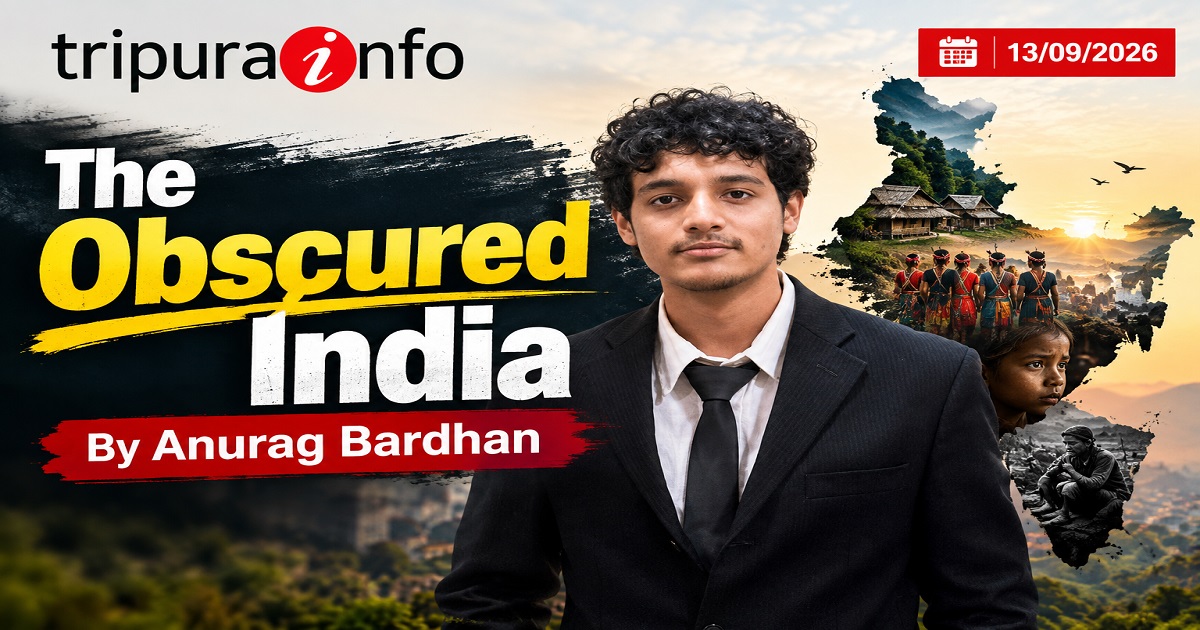
The Obscured India
Anurag Bardhan
September 13, 2026
 The Preamble to the Constitution of India states that our country, India, is a secular republic. But, for a moment, if we actually try comparing the real-life situation to the Constitution’s ideal—we would actually begin seeing some major contrasts. The extremists have delved so deeply into the trenches of religion that humanity is what is getting buried deep somewhere. Our majestically diverse India was always an open entrance for people from each and every community. But the hatred for particular communities worked like a slow poison which got injected into the veins of people gradually. The patriotism of people is weighed according to the community they come from. The Partition of 1947 was largely driven by communal differences, but among all the majorities who chose their frontier according to their communal conveniences, there were also many minorities who showed loyalty towards their motherland, India, and had chosen this side of the frontier. If freedom fighters like “Netaji” Subhas Chandra Bose and Bal Gangadhar Tilak had shed their sweat and blood for the independence of our country, then people like Asfaqulla Khan and “Maulana” Abul Kalam Azad had also contributed equally. They could also have shown their communal differences and resisted fighting against the British together. But their cohesion and unity were really very commendable. While people should praise such revolutionaries and learn their ideologies, a fraction of people show pride in showing off their particular community and claiming the freedom fighters as their own. There’s nothing wrong in showing pride by claiming freedom fighters, but the most saddening part is that people do not really claim them as personalities from their own nation India, but they claim them according to their communal beliefs. At present, communal hatred towards each other has risen very dominantly. It all started from a very small group of people, and gradually it grew out so much that even dedicated organisations were set up with such agendas. Summing things up—if such negative emotions can spread gradually, then love and unity among different communities can be spread even faster. We all should contribute to promoting cohesion between all different communities. Little hopes are still alive; we can still restore the beautiful unity among people from different communities—which was widely visible in India long ago. I recently came across a post that showed a child dressed up as Lord Krishna with his mother, who was wearing a burqa—this is the beauty of our diverse nation, India. More such incidents appearing on social media would really consolidate the ‘unity in diversity’ of India very well. (Class- X, Bhavan’s Tripura Vidyamandir)
(The editor of tripurainfo.com warmly invites students and aspiring writers to share their thoughts, ideas, and creativity through articles. Understanding that every great writer starts somewhere, tripurainfo.com is committed to providing a platform where young minds can express themselves without fear of judgment.
This initiative is not about perfection but about encouragement, growth, and giving voice to new perspectives. We believe that by supporting young talents today, we are shaping the storytellers, journalists, and thought leaders of tomorrow.
So, if you have a story to tell or an idea to share, don’t hesitate—send in your articles. Let your words inspire others, and let tripurainfo.com be the stage where your voice is heard!)
আরও পড়ুন...