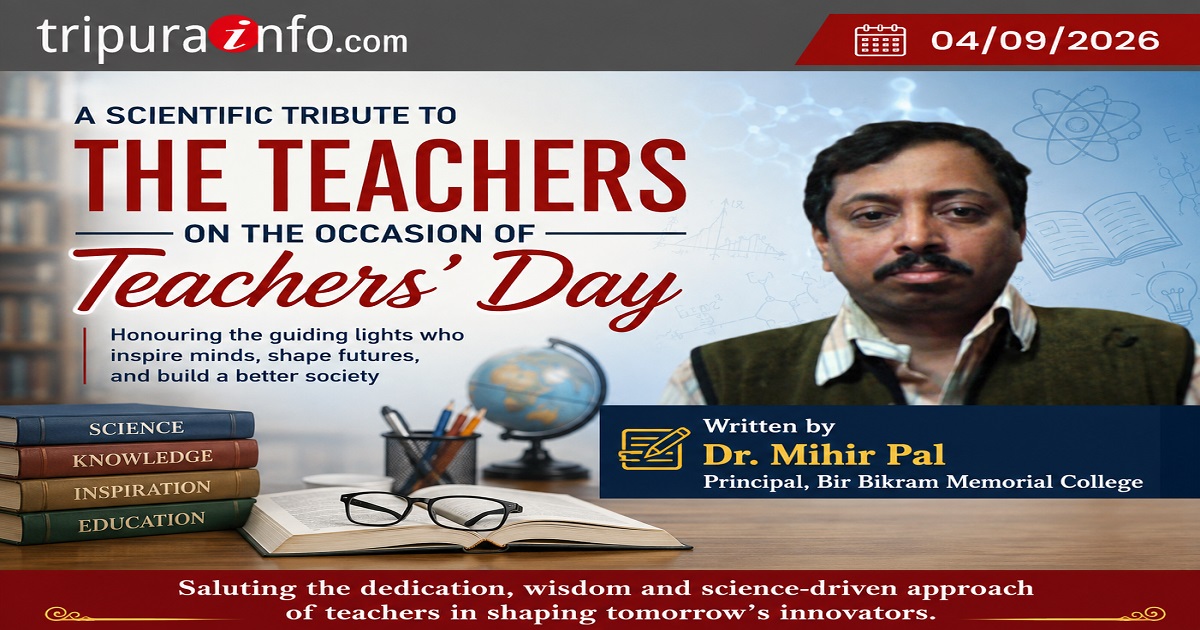
A scientific tribute to the teachers on the occasion of Teachers’ Day
Dr. Mihir Pal, Principal, BBM College
September 4, 2026
 On this Teachers’ Day, let us look at the teacher not merely as a person who delivers knowledge, but as a fundamental force in the universe of human civilization. On this day, I bow with profound respect to all our teachers—the architects of knowledge, the cultivators of human values, and the silent forces behind every intellectual and social transformation.
Science teaches us that life begins with a cell, but the greatness of human life begins with learning. In Biology, a cell carries within its DNA the information necessary to grow, adapt, and sustain life. Yet, in the journey of a human being, it is the teacher who helps transform information into understanding, knowledge into wisdom, and potential into achievement.
A teacher is, in many ways, the DNA of a learning community. Just as DNA carries the blueprint of life from one generation to another, teachers transmit knowledge, values, curiosity, and experience from one generation of learners to the next. Their influence may not always be immediately visible, but like genetic information, it continues to express itself throughout the lives of their students. Biology also teaches us the extraordinary principle of adaptation. Organisms survive and evolve because they respond intelligently to changing environments. A great teacher performs a similar function. In a rapidly changing world, teachers do not merely provide answers; they teach students how to adapt, how to question, how to think, and how to discover.
Physics tells us that nothing happens without an interaction. A particle changes its state when it interacts with another particle; a body changes its motion under the influence of a force. In much the same way, a student’s life changes when it encounters a teacher. A teacher is that invisible force which may not always be seen, but whose effect remains measurable—in the confidence of a student, in the direction of a career, in the courage to question, and ultimately in the character of a human being.
Science begins with light. Light travels across enormous distances, carrying information from distant stars and galaxies to our eyes. Without light, the universe would remain largely unknown to us. A teacher is the light of the intellectual universe. A teacher does not merely give information; a teacher makes the unknown visible. Just as a beam of light reveals the path before us, a teacher illuminates the path of a student through the darkness of doubt, confusion, and uncertainty. The classroom, therefore, is not merely a room with walls and desks. It is a laboratory of illumination, where ignorance gradually transforms into understanding.
Physics teaches us that energy cannot be created or destroyed; it can only be transformed from one form into another. Perhaps the greatest example of this law exists in education. A teacher transforms curiosity into knowledge, knowledge into wisdom, wisdom into confidence, and confidence into action. The energy of a teacher's words may become the research of a scientist, the compassion of a doctor, the integrity of an administrator, the creativity of an artist, or the vision of a future leader. The teacher may never witness the final form of that energy. Yet the transformation continues.
Newton taught us that every mass attracts every other mass. But there is another kind of attraction that Physics cannot measure with a gravitational constant—the attraction between a great teacher and a searching mind. A teacher's personality, discipline, integrity, and intellectual curiosity create a kind of educational gravity. Students are drawn towards excellence because they see excellence embodied in their teachers. And just as gravity keeps planets in their orbits, the values imparted by teachers often keep young lives on the right trajectory.
Einstein taught us that time is not absolute. But every teacher knows another truth about time:
One meaningful moment in a classroom can change an entire lifetime. A sentence spoken by a teacher today may remain in a student's memory for decades.
A simple encouragement—
"You can do it."
A thoughtful question—
"Why do you think so?"
Or a gentle correction—
"Try again."
-may become a turning point in someone's life. Thus, the true influence of a teacher cannot be measured in minutes or hours. Its timescale is a lifetime. Quantum mechanics teaches us that nature at its deepest level is full of uncertainty, probability, and possibilities. A young student's mind is remarkably similar. At the beginning, there are countless possible futures—a vast spectrum of probabilities. The teacher does not determine the future of the student. Rather, the teacher helps the student discover the possibilities hidden within themselves.
A question asked in the classroom may trigger a new thought.
A new thought may generate curiosity.
Curiosity may lead to exploration.
Exploration may lead to discovery.
And suddenly, a probability becomes a possibility—and a possibility becomes reality. That is the quiet miracle of teaching.
The second law of thermodynamics tells us that entropy tends to increase. Left without direction, systems move towards disorder. Human society, too, can move towards intellectual disorder when knowledge is replaced by misinformation, reason by prejudice, and inquiry by blind belief. Teachers are among the most powerful forces that reduce intellectual entropy. They teach us to distinguish evidence from assumption, reason from superstition, fact from fiction, and knowledge from misinformation. A teacher therefore does not merely educate an individual. A teacher helps maintain the intellectual order of civilization.
A teacher accelerates the transformation of a young mind without demanding ownership of the student's achievement. The student receives the recognition. The student receives the degree. The student receives the position. But somewhere behind that achievement stands a teacher who quietly accelerated the reaction. Perhaps that is why the greatest teachers often remain humble. They know that their greatest achievement is not what they themselves become, but what their students become.
Physics has given humanity magnificent equations—from Newton's laws to Einstein's relativity and the equations of quantum mechanics. But on this Teachers' Day, I would propose another equation:
Knowledge + Compassion + Character = Education
For the teacher does not merely transmit knowledge but awakens possibility very much. A teacher's influence may sometimes appear invisible, just like a catalyst in a reaction. Yet its effect can be profound. Years after leaving the classroom, students may forget particular equations, definitions, or chapters, but they rarely forget the teacher who taught them how to think, how to question, how to persevere, and how to become a better human being.
In chemistry, a catalyst accelerates a reaction without being consumed in the process. A remarkable teacher performs a similar function. Chemistry teaches us another beautiful truth: matter is never truly lost; it transforms. Likewise, a teacher's words, values, and inspiration never disappear. They continue their journey through generations—transformed into the achievements, character, and contributions of students.
We live in an age where information travels at the speed of light, artificial intelligence is reshaping human possibilities, and digital networks connect minds across continents. Yet, despite all our sophisticated algorithms, databases, and intelligent machines, one element remains uniquely human: the teacher's ability to awaken another human mind.
A computer can store information.
A search engine can retrieve information.
An algorithm can process information.
But a teacher gives information meaning.
Technology can connect millions of devices, but a teacher connects knowledge with character, curiosity with purpose, and ambition with responsibility. In Information Technology, a program becomes meaningful only when the right logic is embedded within it. Similarly, education becomes meaningful when knowledge is guided by ethics, empathy, and human values. Teachers are the programmers of the human spirit—not by imposing a predetermined code, but by encouraging students to write their own code of life. A teacher's influence is sometimes like a neural network: invisible connections are created through repeated interaction, experience, and understanding. Years later, when a former student faces a difficult problem, makes an important decision, or contributes something meaningful to society, the influence of a teacher may still be operating quietly within that mind.
Perhaps this is the greatest scientific mystery of teaching: the teacher may disappear from the classroom, but never completely from the student's intellectual DNA.
As Principal, I firmly believe that the strength of any educational institution is not measured merely by its buildings, laboratories, computers, or infrastructure. Its true strength lies in the quality, dedication, and intellectual integrity of its teachers.
Our teachers are nurturing minds that will become tomorrow's scientists, administrators, entrepreneurs, researchers, educators, and responsible citizens. Every lecture delivered, every doubt clarified, every paper evaluated, every struggling student encouraged, and every young dream protected is a contribution to the future of society. May our teachers continue to be the mitochondria that energize the institution, the DNA that carries its intellectual heritage, the neural networks that connect generations, and the guiding algorithms that help young minds navigate an increasingly complex world.
As the Principal, I consider myself privileged to stand among teachers who continue this timeless scientific and human journey every day. Our classrooms may contain books, laboratories, instruments, computers, and digital resources. But the most powerful educational instrument remains the teacher. Technology can provide information in seconds. Artificial intelligence can answer thousands of questions. The internet can connect a student with the knowledge of the world. But only a teacher can look into a student's eyes and say:
"I believe in you."
That human interaction remains beyond every equation. On this Teachers' Day, therefore, I salute every teacher—not simply as an educator, but as a force of light, a transformer of energy, a reducer of entropy, a catalyst of human potential, and a gravitational center of values. Stars may illuminate the universe, but teachers illuminate humanity.
Happy Teachers' Day to all our revered teachers.
With profound respect and gratitude, Principal, Bir Bikram Memorial College
আরও পড়ুন...