Maharaja Bir Bikram at 118 : The King Who Built Tomorrow Before Dawn!!!
Biswanath Bhattacharya
August 20, 2026
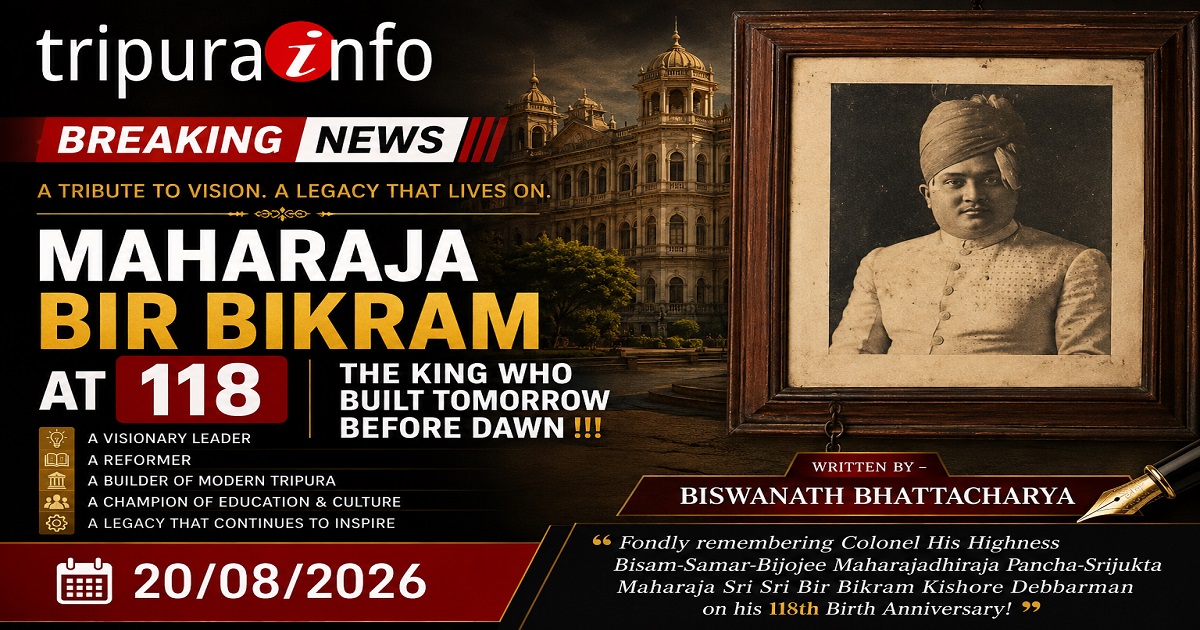 On this August morning, Tripura seems to breathe through memory. The hills hold their silence like folded prayer, the lake keeps its old shimmer, and from the corridors of time there returns the footfall of a young king who did not live long enough to grow old, yet lived deeply enough to make a state dream beyond its own horizon.
Maharaja Bir Bikram Kishore Manikya Bahadur was born on 19 August 1908, but dates alone cannot contain him. He was born, it seems, into a twilight between worlds: the fading glow of princely India, the gathering thunder of freedom, the far-off rumble of global war. Around him, history sharpened its edges. Yet he did not retreat into velvet and ceremony. He stood before the storm with the calm of one who knew that sovereignty, if it is to endure, must become service.
He inherited a kingdom of rivers and ritual, of forest paths and ancestral music, of fragile communities standing at the edge of change. In other hands, such inheritance might have hardened into possession. In his, it became responsibility. He looked upon Tripura not as a jewel to be displayed, but as a living body to be healed, strengthened, educated, and prepared for the century waiting outside the palace gates.
He understood, with the instinct of a poet and the discipline of a statesman, that a kingdom is not modern because it builds monuments. It is modern when its people are no longer left in darkness. So he planted schools like lamps across the land. He made education walk towards tribal hamlets, minority households, and daughters whose futures had too often been folded away before they could open. Maharaja Bir Bikram College was not merely an institution; it was a doorway through which Tripura’s youth could enter history with their heads unbowed.
His reforms carried the fragrance of justice. He saw the vulnerability of indigenous lands and understood that progress without protection is another name for loss. He encouraged new agricultural practices, yet did not ask memory to burn itself for modernity. He sought roads without erasing roots, fields without breaking faith, development without dispossession. In an age when power often spoke downward, he listened outward—to the hill, the plain, the farmer, the child, the silent margins of the state.
Agartala still carries the geometry of his dream. Its planned avenues, civic imagination, and widening sense of public life were sketched before the Republic had fully arrived. He laid foundations not with the vanity of a builder seeking applause, but with the melancholy wisdom of one who knew he may never see the full bloom of what he began. Some rulers build for their portrait. Bir Bikram built for mornings he would not witness.
And then there is Neermahal, rising upon Rudrasagar like moonlight taught to take shape. Palace, poem, mirage, memory—it floats between water and sky as if the Maharaja had asked architecture to sing. In its domes and arches, in its mingling of styles, in its dreamlike whiteness trembling over the lake, Tripura sees the other half of his genius: that bread is necessary, but beauty too is nourishment; that a people must be governed, but also enchanted.
His was a court where culture did not sit as ornament but breathed as conviction. He wrote, composed, patronised, and honoured. When he conferred upon Rabindranath Tagore the title Bharat Bhaskar, he was not merely saluting a poet; he was acknowledging the radiance by which a civilisation recognises itself. When he supported Visva-Bharati, when he commissioned Benuban Vihar, when he held together music, theatre, faith, and public life, he revealed a secular grace rare in any age: the ability to bow before many forms of light.
The world beyond Tripura was restless, and he had seen its restless faces. Europe was darkening; power strutted in uniforms; the century was preparing its brutal theatre. Yet foreign capitals and imperial spectacles did not seduce him away from his people. He returned with eyes sharpened, not dazzled. He understood that the true test of leadership was not how magnificently one appeared before the powerful, but how faithfully one stood beside the vulnerable.
That faithfulness found its deepest note in famine. When hunger moved like a shadow across Bengal and human anguish came knocking at the doors of authority, he did not answer with distance. Granaries opened. Relief moved. Compassion took administrative form. In those years, when hunger stripped dignity from countless lives, the Maharaja showed that mercy, when placed in the hands of power, can become policy.
Then, with frightening suddenness, the lamp dimmed. In 1947, before independent India had fully gathered Tripura into its constitutional embrace, Maharaja Bir Bikram was gone. He was only thirty-eight. The sentence of his life ended too soon, but its meaning did not. Maharani Kanchanprava Devi carried forward the grave passage of transition, and Tripura’s eventual merger with India unfolded with a dignity that bore the imprint of the trust he had sown.
Today, the Maharaja is not only remembered in ceremonies. He is present in quieter things: in the runway that lifts Tripura toward the world, in the college corridors where young voices gather courage, in Agartala’s civic bones, in Neermahal’s reflection trembling upon water, in the protected memory of the hills, and in every public dream that chooses harmony over hatred, progress over vanity, service over spectacle.
He remains Tripura’s beautiful, unfinished dawn. A sovereign, yes—but more than that, a custodian of possibility. A modernist with reverence in his hands. A dreamer who knew that dreams must be given roads, schools, banks, laws, grain, songs, and shelter if they are to survive the night.
So we bow to him not because he wore a crown, but because he understood its burden. We honour him not because he ruled, but because he served. We mourn him still because in a life so brief, he made tomorrow audible. And even now, across Tripura’s rain-washed mornings and moonlit waters, his vision moves like a hymn—haunting, tender, sovereign, and alive.
আরও পড়ুন...