Classical Journalism in India Has Lost Its Ethical Soul
Sanjeev S
August 3, 2026
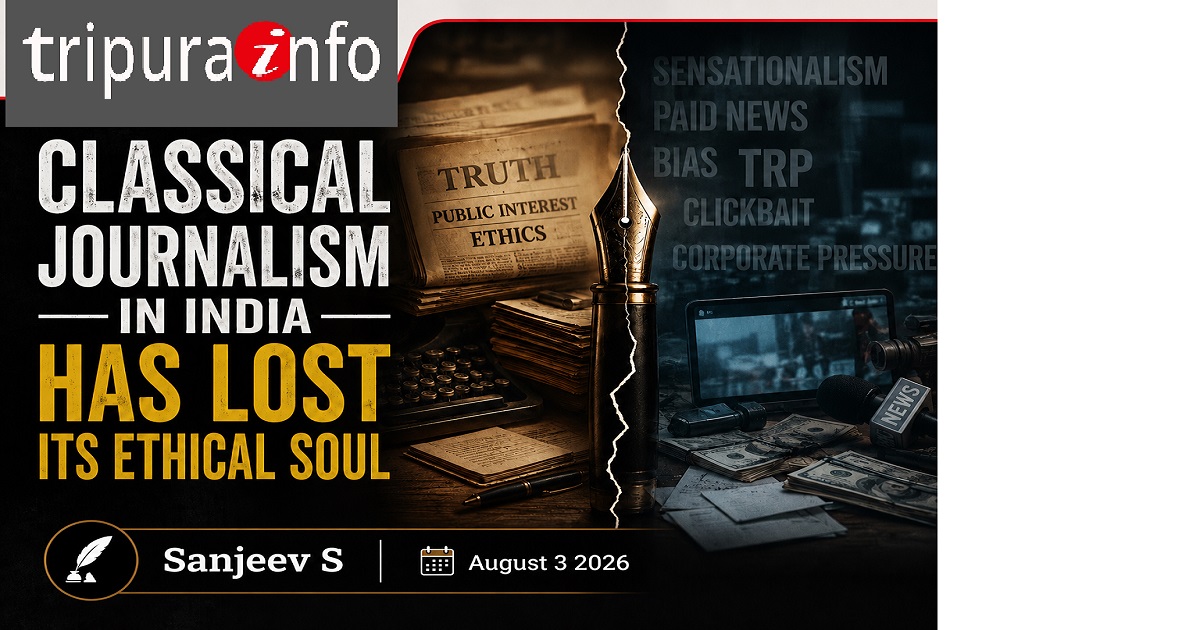 Classical journalism in India, as a profession with discernible and identifiable ethics, is all but gone. We are left largely with individuals who have professional access to public media and yet erroneously call themselves journalists. They are no longer bound by the values that once defined journalism as a profession independent of national, racial, religious or political affiliations.
Perhaps the most important discipline a journalist must acquire is neutrality, particularly when reporting on internal or external conflicts whether social, religious, political or economic or even on a war. In such situations, NEWS alone should be the outcome of ground reporting, not a running commentary coloured by personal biases, ideological leanings, or instinctive national, ethnic or religious prejudices.
The US lost the Vietnam War and abandoned its operations in Afghanistan not because it had simply found itself militarily weaker, but because sustaining such wars became politically and publicly untenable at home. A strong and independent US media played an important role in this by reporting atrocities committed by US forces, questioning the conduct and purpose of the wars, and exposing the widening gap between official claims and ground realities. Journalists doing so were not branded anti-national; some were, in fact, honoured for their work.
Investigative journalist Seymour Myron Hersh famously exposed the My Lai massacre in Vietnam, helping intensify public criticism of his own government's conduct during the war, something difficult to imagine in many countries including India today. He won the Pulitzer Prize for International Reporting for his coverage. It was an example of a free media exposing wrongdoing by its own country's forces during wartime, without treating criticism of the government as disloyalty to the nation.
Watergate provides another, perhaps even more powerful, example of independent journalism. Even today, the US President can be mocked, caricatured and criticised mercilessly in the US media without people routinely running to the police to file complaints against every harsh critic as we often see here. That reflects a certain maturity both of democracy and of its political leadership.
Over time, the media has ceased to be merely a side column of democracy and has become one of its central pillars, helping maintain a balance among its various institutions and centres of power. Independence does not mean that journalism will be free of errors, poor judgement or the unintended intrusion of personal biases. It means that such bias should not become the institutional policy of a media organisation. Political powers or business interests should not be determining, moderating or filtering the news that people are allowed to read, watch or hear.
Even India witnessed a largely independent and assertive media for decades after Independence. Nehru was criticised and questioned regularly by the press. In those days, many of those who ran major media organisations were themselves influential figures, fiercely independent and often willing to confront those who ran governments.
The Emergency was, of course, a major rupture, when formal censorship was imposed on the press. Yet, rather than willingly publish praise of the government, some newspapers chose resistance, silence or other forms of protest. There was censorship, but relatively few instances of fabricated stories and deliberate falsehoods masquerading as news. The greater problem was what the press was prevented from reporting, rather than being compelled to manufacture and publish falsehoods.
Recall also the Indian Express's sustained and fierce confrontation with the Rajiv Gandhi government in the late 1980s, when its front pages repeatedly carried reports and commentary deeply critical of the government. In the 1990s, investigative reporting and relentless media scrutiny contributed to the political and legal pressure surrounding Prime Minister P. V. Narasimha Rao in various controversies and corruption cases.
Something similar was visible during 2009–14. The government of the day faced relentless scrutiny over corruption allegations, policy failures and major controversies. The press did not consider criticism of the government incompatible with national interest. Questioning those in power was understood to be an essential part of its democratic function. Despite occasional tensions between the government and the media, a degree of institutional balance was maintained.
Contrast all this with large section of the allegedly policy-driven and biased mainstream media in India today, which can hardly conceal its political leanings. Such media outlets often end up delivering news content seemingly shaped by political exigencies and favouring only one side. They are rarely critical of the actions of the government or the ruling party, or even of its supporters. This gives politicians at the helm of government a seemingly unwarranted sense of infallibility, allowing their actions to go unchecked and uncorrected. Under such a protective cover, even well-intentioned actions of the government may go unquestioned and unreviewed, leading to deficiencies in the quality of governance and delivery because of the absence of credible and trustworthy feedback.
Ultimately, it is the public that suffers.
আরও পড়ুন...