Baro-Bhuyans of Tripura Police: The Twelve Chieftains Who Still Walk the Corridors of Fear!!!
Biswanath Bhattacharya
July 31, 2026
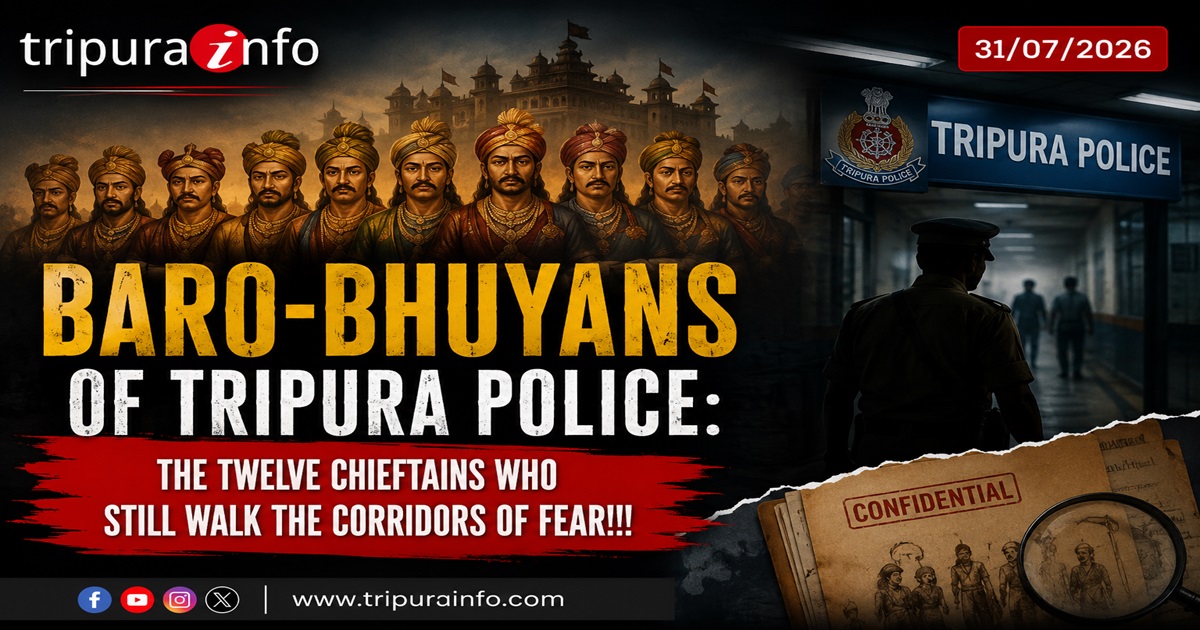 There are names that do not merely survive in records; they move like footfalls in the corridor after the lamps have gone out. In the old police lines of Tripura, in the half-lit verandahs of thanas, in the memories of men who measured danger by instinct and silence, one such name still rises with a faint chill: the Baro-Bhuyans of Tripura Police.
They were not medieval landlords, not zamindars with forts in the watery plains of Bhati, not river-warriors waiting for Mughal cavalry to sink in Bengal’s marshes. Yet in the imagination of Tripura’s policing folklore, the name fitted them with uncanny precision. Twelve men, directly recruited as Sub-Inspectors after Independence, joined Tripura Police in February 1951. They went to Police Training College, Barrackpore, where discipline was hammered into them with the old severity of post-Independence police training, and returned to Tripura in 1952 to enter the stern theatre of mainstream policing.
Tripura itself was still settling into a new constitutional life. The organized police tradition of the State had travelled a long road from princely arrangements, indigenous agencies, Laskars, Thanadars, and the slow modernization that came under later Manikya rulers. The early post-Independence force therefore needed more than clerks in uniform. It needed men who could stand before unrest, crime, intrigue, fear, and administrative uncertainty without lowering their eyes. Into that gap stepped these twelve officers, and gradually the legend began.
The roll call itself has the weight of an oath: Shri Krishanu Ranjan Chakraborty, Shri Rathindra Rakshit, Shri Nirmal Kumar Balow Majumdar, Shri Sunil Kantha Mukherjee, Shri Ramanuj Bhattacharjee, Shri Biswa Bhushan Mukherjee, Shri Rafiqul Islam, Shri Haripada Majumdar, Shri A. B. Bose, and Shri Ramaprassana Gupta, remembered among the prominent names of that formidable fraternity.
They were close-knit, almost fraternal in their loyalty to one another, yet intensely individual in style. Some were quiet strategists. Some were field men whose arrival at a police station changed the air inside the room. Some built networks of intelligence with the patience of hunters. Some commanded by voice, others by silence, and a few by that old, controversial symbol of authority remembered in police folklore: the unmistakable stamp of the boot, the footfall that announced to the accused, the informer, the habitual offender, and sometimes even the subordinate that order had entered the room.
To picture them is to picture an older Tripura at dusk: dim kerosene lamps in outpost rooms, damp case diaries on wooden tables, constables straightening abruptly at the sound of approaching boots, and informers lowering their voices as though the walls themselves might report them. The Baro-Bhuyans were not merely names on a government list. They were silhouettes against hurricane lamps, stern profiles in khaki, men whose eyes seemed to read not only the complaint before them but the lie hidden behind it. They carried the gravity of the State in their shoulders and the impatience of command in their stride.
In the folklore surrounding them, each officer acquired the shade of a chieftain. One could break silence with a single question. Another could trace a fugitive through rumor, tea-stall whispers, and the trembling hesitation of a reluctant witness. Another knew the border routes as if they were veins in his own hand. They were not identical men, but together they created an atmosphere so strong that even absence became presence. A criminal might not see them, yet still imagine them waiting at the next bend of the road.
For nearly four decades, from the 1950s into the late 1980s and early 1990s, they held important assignments and shaped the temperament of policing in Tripura. Three of the twelve rose so high that they were inducted into the Indian Police Service, a recognition that turned local legend into institutional history. At the pinnacle of their careers, they were spoken of as substantially influential, not merely because of rank, but because they knew the terrain, the people, the criminal mind, and the psychology of command.
In those days, so the stories go, criminals trembled at the utterance of their names. It may be that memory enlarges men after they leave the field; it may be that fear adds height to old shadows. Yet every police culture preserves a few figures who seem larger than their files. The Baro-Bhuyans belonged to that rare category. They were invoked not as officers alone, but as a system: a compact brotherhood of investigation, discipline, presence, intimidation, and administrative reach.
The comparison with the medieval Baro-Bhuyans of Bengal is irresistible. In history, the Baro-Bhuyans were a confederacy of independent-minded warrior-chiefs and zamindars who resisted Mughal expansion under Akbar and Jahangir in the riverine Bhati region. Though baro means twelve, the number was symbolic rather than exact; the confederacy included more than twelve regional powers, united when danger came from outside and fiercely sovereign when peace returned. Isa Khan of Sonargaon became the central figure, the architect of resistance, while Musa Khan, his son, carried forward the inheritance of defiance.
Transfer that image from the flooded plains of Bengal to the hills, valleys, markets, borderlands, and police stations of Tripura, and the metaphor begins to glow in the dark. If Isa Khan gathered chieftains against imperial pressure, Krishanu Ranjan Chakraborty may be imagined as the Isa Khan of this police brotherhood: a figure around whom legend congealed. And if Musa Khan bore forward a paternal legacy through a new and more complicated age, Krishnendu Chakraborty, scion of Krishanu Ranjan Chakraborty, stands as a modern echo of that succession. He alone, among the known descendants of that renowned group, carried the legacy forward as a second-generation police officer and rose to become Inspector General of Police (Intelligence), a decorated IPS officer .
This is not a dry historical equation. It is a literary bridge between two worlds: one of medieval Bengal, where boats cut through mist and cannon smoke, and another of post-Independence Tripura, where a new police force had to define authority in a young administrative landscape. The old Baro-Bhuyans resisted conquest; the police Baro-Bhuyans resisted disorder. The old chiefs held forts and river routes; the twelve officers held police stations, intelligence channels, case diaries, and the unspoken map of fear. The old confederacy made emperors pause; the Tripura twelve made criminals pause before crossing the invisible line.
My own entry into this legend did not come from an archive. It came through memory. I first heard the name Baro-Bhuyans from my father-in-law, himself a Sub-Inspector of Police, and later from my brother Brajanath, who served as an Inspector of Police. From both of them I heard not merely names, but atmospheres: the sudden silence when one of these officers entered a room, the whispered warning passed from one criminal ear to another, the professional awe they inspired among juniors, and the uneasy respect they commanded from those who tried to bend the law for private advantage. Among the names, Shri Haripada Majumdar carries for me an especially intimate resonance. If he was the Haripada Majumdar of Sabroom, as I believe and remember, then my connection with his family was not distant admiration but lived association. I had close contact with him, and I had the privilege of tutoring both his sons, Mantoo and Prabir. Mantoo, who became a doctor, is no more; Prabir went on to become a successful businessman. Through them, the legend of the Baro-Bhuyans ceased to be only police folklore and entered the warm, fragile territory of personal memory.
The interest that had slept in me for years was rekindled during a conversation with the noted journalist Subir Bhowmick, known for his long association with international journalism, including the BBC and Reuters. Subir advised me to contact Krishnendu and gather the relevant information. I lost no time. I contacted Krishnendu immediately, and through that conversation the fading corridor of memory opened again. In that sense, the ownership of this article does not belong to me alone. A part of it belongs to Krishnendu, who inherited the bloodline and burden of the story, and a part to Subir, who pointed me back toward the source. Interestingly, Subir is also the younger brother of my friend Indrajit, and thus the trail of this article passed through family, friendship, journalism, and police memory before it reached the page.
Yet the most unsettling question is not whether the Baro-Bhuyans were feared. They were. It is not whether they were influential. They were. It is not whether their methods would invite debate in a later age of procedure, rights, technology, and scrutiny. They surely would. The question is darker and more difficult: how did twelve officers leave behind a legend so large that, even in an age when Tripura Police has more than a thousand officers and many in or near the Indian Police Service, people still recall those twelve as if they had once ruled the State?
Perhaps numbers do not create command. Perhaps files do not create fear. Perhaps authority, in its most primal form, is a mystery composed of courage, timing, intelligence, ruthlessness, loyalty, and reputation. The Baro-Bhuyans of Tripura Police understood that mystery. They did not merely enforce law; they performed power. They did not merely investigate crime; they entered the imagination of crime itself.
And that is why their story refuses to end neatly. Somewhere between Barrackpore in 1951, Tripura in 1952, the rise of three officers into the Indian Police Service, the long careers that stretched into the twilight of the eighties and nineties, and the second-generation ascent of Krishnendu Chakraborty, there remains a locked room in the history of Tripura Police. No official inventory lists what lies inside it. No government note explains why its silence still feels occupied. Inside that room are twelve chairs. Some are empty. Some still seem warm. On the table lies an unfinished case diary. At the door, dust gathers; yet beneath the dust, the old boot marks refuse to fade.
And when the last lamp goes out in the police lines, listen carefully—because somewhere beyond the locked room, twelve unseen boots may already be climbing the stairs.
আরও পড়ুন...