Gen Z Is Asking Questions We Never Had the Courage to Ask
Tapas Mahajan
July 29, 2026
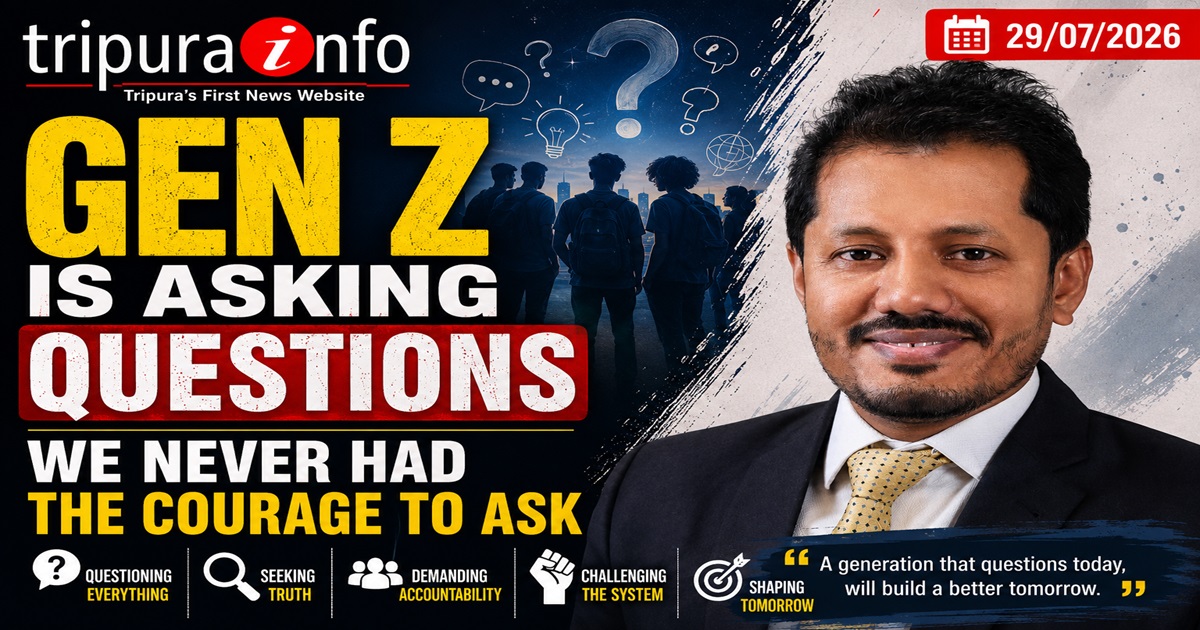 Across India, Gen Z has demonstrated a willingness to challenge authority in ways that many previous generations did not. Whether on issues of education, governance, or public accountability, young people today are increasingly organizing, mobilizing, and demanding answers from those in power through democratic means. The recent protests seeking accountability from Union Education Minister Dharmendra Pradhan are one such example. While opinions on the specific demands may differ, the movement has triggered an unexpected feeling among many millennials like me - not disagreement, but regret. Regret that when our generation faced issues we believed were equally important, we largely chose silence over collective action.
I am one of those millennials who grew up in Tripura during the 2000s and early 2010s. Let's pick one of the most defining issues of that era - government jobs. Between the late 1990s and around 2012, the government recruitment system became a source of deep public frustration in Tripura. Recruitment for many state government posts often took place without competitive written examinations, relying instead on opaque criteria such as seniority, merit lists, interviews, and various discretionary categories, with little transparency in how final selections were made. Merit frequently took a back seat, while political affiliation, proximity to influential leaders, and personal political networks often determined who secured government employment. As a result, academically accomplished candidates were overlooked, while many less-qualified individuals obtained government jobs. These experiences became the whispers of a generation, shared in homes and tea stalls but rarely spoken aloud in public.
The system also created a deeply divided generation. Young people associated with the ruling party often expected that their political involvement would improve their prospects for government employment. Those aligned with opposition parties or who chose to remain politically independent getting a government job sound impossible, knowing that academic excellence alone often offered little assurance of success within the state. For many, the only realistic path forward was to excel academically and build careers outside Tripura, where they hoped opportunities would be determined more by merit than political connections.
Many deserving graduates spent years waiting for opportunities that never came. Others gave up on the dream of a government job and turned to small businesses, farming, or whatever work they could find to support themselves and their families. Those with the financial means left Tripura in search of opportunities elsewhere, hoping to build careers where ability, hard work, and merit would be rewarded more fairly. Yet, despite witnessing these realities unfold around us, our generation rarely came together to demand accountability or push for systemic reform. We accepted, adapted, debated, and moved on - but we seldom united to challenge a system that had failed so many of us.
From around 2012 onwards, there were signs of change. Some job aspirants began challenging specific recruitment processes by approaching the courts and filing legal petitions against the government, alleging irregularities and seeking greater transparency. Although these were isolated and individual acts of protest rather than mass movements, they represented an important shift. For perhaps the first time, some young people chose to challenge the system through legal means instead of silently accepting it. However, these voices remained very few, and widespread collective action continued to be largely absent.
Looking back, I often wonder whether our silence allowed these problems to persist longer than they should have. We convinced ourselves that nothing would change, that challenging the system was pointless, and that adapting was easier than organizing. Watching today's Gen Z rejects that mindset is both inspiring and unsettling. Their greatest strength is not that they protest, but that they believe public institutions must answer the people. That belief was missing from my generation, and it is perhaps the reason many millennials now look back with one lingering regret: we should have found our voice much sooner.
The lesson extends well beyond one protest or one government. Democracies are strengthened when citizens participate peacefully, question authority, and demand transparency, regardless of which political party is in power. If Gen Z succeeds in building a culture where accountability matters more than political loyalty, they will have achieved something many of us only wished for after it was too late.
আরও পড়ুন...