A Better Measure of Success in Mediation - Disagreement into a workable solution
ANINDYA KUMAR BHATTACHARYA
July 10, 2026
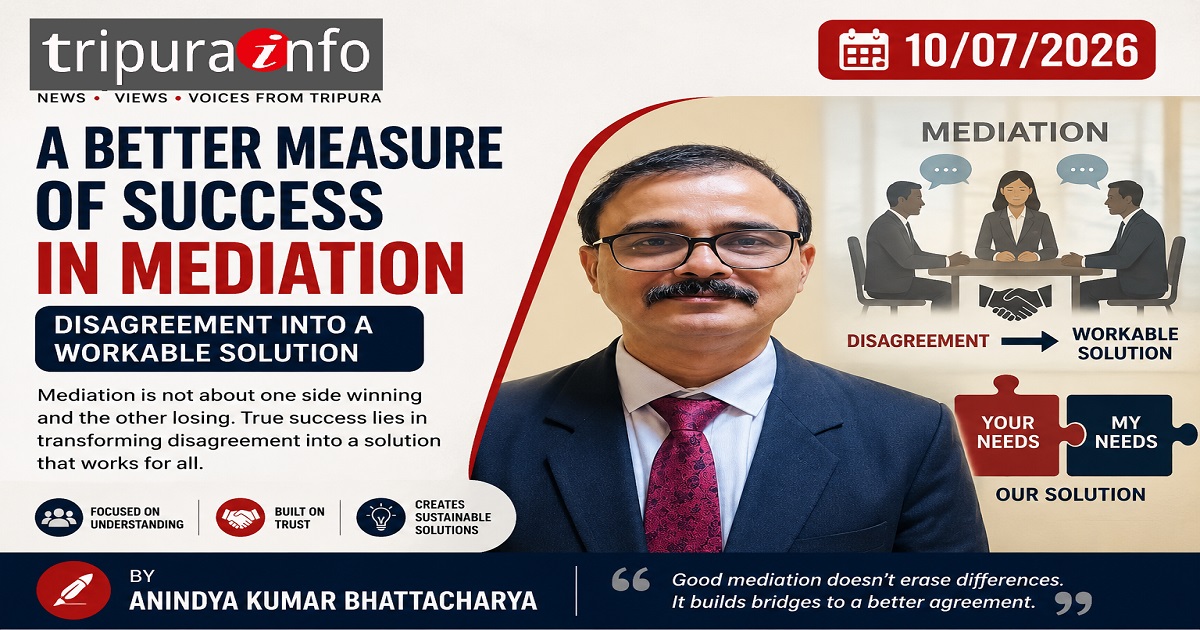 Success in mediation is often misunderstood. Many people enter the process believing that success means forcing the other side to accept defeat, extracting the highest possible amount of money, or making the smallest possible concession. This approach treats mediation as another form of courtroom combat. But mediation is not a battle in which one party must win and the other must lose. It is a structured process in which disputing parties attempt to find a practical, acceptable and lasting solution. The real measure of success is therefore not surrender, humiliation or domination. It is whether the final outcome protects legitimate interests, reduces risk, saves time and expense, and enables the parties to move forward.
Moving Beyond the Idea of Victory
In litigation, success is usually measured through a judgment. One party succeeds and the other fails. The court determines rights and liabilities, and the parties are bound by the decision. Mediation works differently. The mediator does not impose an outcome. The parties themselves decide whether to settle and on what terms. As a result, the process requires a broader understanding of success. A settlement may not give either side everything it originally demanded. Yet it may still be highly successful if it avoids years of litigation, reduces legal expenses, preserves privacy and eliminates uncertainty. A party that gives up a small part of its claim may gain something more valuable—peace of mind, early payment, confidentiality, restoration of reputation or preservation of an important relationship. Success in mediation must therefore be judged by the total value of the agreement, not merely by the amount won or conceded.
Protecting Legitimate Interests
A successful mediation outcome must protect the client’s genuine interests. These interests are often wider than strict legal rights. A commercial claimant may seek payment, but may also want future business opportunities. An employee may seek compensation, but may also want a proper service certificate or restoration of dignity. A family member may demand property, but may also wish to preserve relationships and avoid public hostility. The lawyer’s responsibility is to identify these interests before and during mediation. This requires careful discussion with the client. The advocate must ask what the client truly needs, what risks the client can tolerate and what future consequences may arise from accepting or rejecting a settlement. Without such preparation, parties may become trapped in narrow positions and overlook solutions that would better serve them.
Reducing Uncertainty and Expense
Court proceedings involve uncertainty. Even a strong case may fail because of evidentiary problems, procedural defects, conflicting interpretations or witness difficulties. Appeals may continue for years, increasing costs and emotional strain. Mediation allows parties to manage these risks. A negotiated agreement provides certainty because the parties know the precise terms of settlement. They do not have to wait for a judge or arbitrator to decide their future. The process can also significantly reduce legal expenses. Litigation requires repeated hearings, documentation, professional fees and considerable management or personal time. Mediation may resolve the dispute in a much shorter period. Saving expenses does not mean accepting an unfair agreement. It means considering the real cost of continuing the conflict and comparing it with the practical benefits of settlement.
The Qualities of an Effective Mediation - mediator
The finest mediation advocates are not necessarily those who speak the loudest or make the strongest threats. Aggressive conduct may impress a client temporarily, but it can also make settlement more difficult. An effective mediation lawyer listens carefully. Listening helps the advocate understand not only the other side’s position but also the interests and concerns behind it. A skilled advocate also asks intelligent questions. Instead of immediately rejecting a proposal, the lawyer may ask how it was calculated, what concern it seeks to address and whether another arrangement could meet the same need. Good mediation advocates understand the real problem. A legal claim may be only the visible part of a deeper conflict involving mistrust, anger, misunderstanding, damaged reputation or fear of future loss. Once the real problem is understood, the lawyer can assist in developing practical options. These may include instalment payments, revised contractual terms, apologies, confidentiality clauses, future cooperation or other non-monetary arrangements.
Problem-Solving Is Not Weakness
Some mediators or lawyers fear that a cooperative attitude may be seen as weakness. This is a serious misconception. Problem-solving does not mean abandoning the client’s case or accepting an unreasonable demand. A lawyer must remain loyal, prepared and determined. The advocate must understand the law, evidence, risks and available alternatives. The difference lies in how that strength is used. Instead of relying mainly on confrontation, the problem-solving lawyer uses preparation, reasoning, creativity and communication. Such an advocate can firmly reject an unfair proposal while still keeping the negotiation constructive. The lawyer can protect the client without insulting the other side and can make strong arguments without destroying the possibility of settlement. A Workable and Lasting Agreement
A settlement is successful only if it can be implemented. An agreement that is vague, unrealistic or one-sided may create further disputes. The terms must therefore be clear, practical and capable of performance. Payment dates, responsibilities, confidentiality provisions and consequences of non-compliance should be carefully recorded. Parties are more likely to honour an agreement when they have participated in creating it and believe that their concerns were heard. The ultimate strength of mediation lies in its ability to transform conflict. The strongest advocate is not the one who leaves the other side feeling defeated. It is the one who helps convert disagreement into a workable resolution. A better measure of success in mediation is therefore simple: Does the agreement protect important interests, reduce uncertainty, save unnecessary cost and provide a durable way forward? When the answer is yes, mediation has truly succeeded.
আরও পড়ুন...