Tripura’s Corruption Crisis : When the Small State Becomes a Big Bazaar!!!
Biswanath Bhattacharya
July 10, 2026
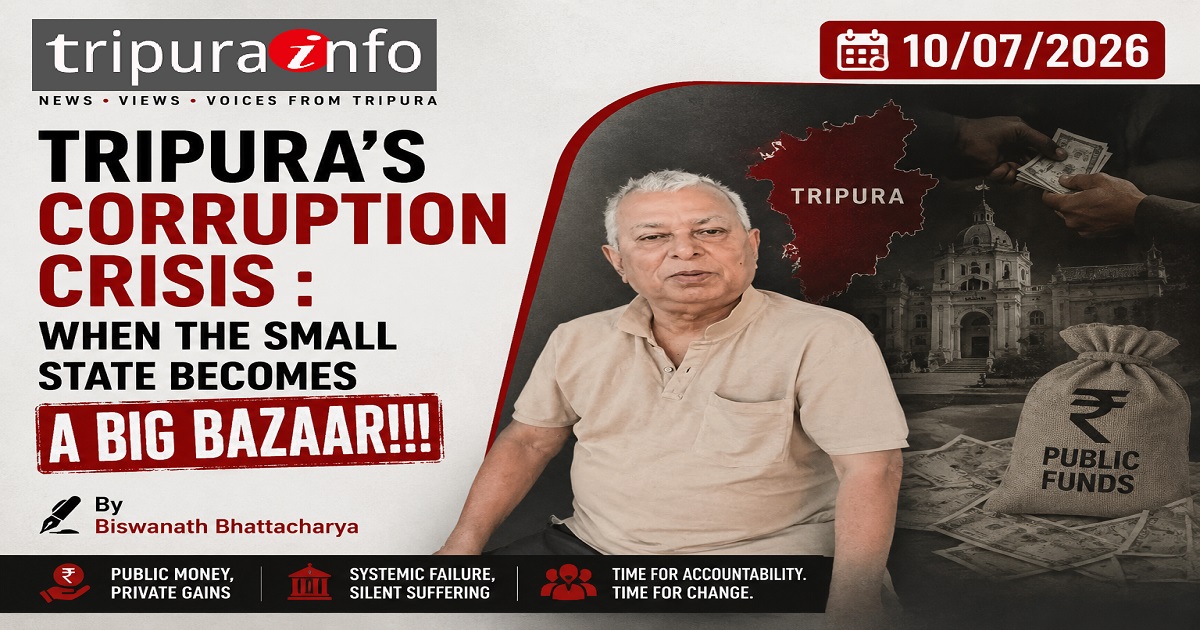 There are moments when a scandal is not merely a scandal. It becomes a window. It allows citizens to see, if only for a brief and disturbing moment, the machinery that usually operates behind curtains, files, seals, whispers and signatures. Tripura, a small state with limited resources and enormous public dependence on government, is now passing through such a moment. Corruption has not merely entered the room; it appears to have been let loose across the landscape with a confidence that should alarm every citizen.
The latest controversy involving senior IAS officers has shaken public faith because it touches the very nerve of governance. Two IAS officers have reportedly been placed on compulsory waiting, and an FIR has been filed against one of them in connection with an alleged multi-crore tender fraud. The allegations involve fake government tenders, forged documents and the use of official proximity to inspire trust. These are still allegations, and guilt must be determined by investigation and court. But the political and moral question cannot wait for a final judgment: how could such a thing even be imagined in a state administration unless the climate around power had already become permissive, cynical and dangerously transactional?
Tripura is not Delhi, Mumbai or Bengaluru. It is not a vast administrative ocean where one scam may vanish into a thousand departments. It is a compact state. Everybody knows everybody. A tender rumour travels faster than a government circular. A transfer order becomes public gossip before the ink dries. In such a state, corruption cannot grow without protection, indifference or fear. When money begins to move through the system, it leaves footprints: in offices, in banks, in files, in phones, in political circles, in business networks and in the sudden lifestyle upgrades of people who were once ordinary functionaries. If the state still claims surprise, citizens are entitled to ask whether the rulers were blind, asleep, complicit, or all three.
The public anger is sharpened by a familiar Indian suspicion: nothing will happen. A few officers may be shifted. A few names may be allowed to circulate. A file may be opened, then cooled. A committee may be formed, then forgotten. One accused may be paraded as proof of action, while the ecosystem that made the alleged fraud possible remains untouched. Money, after all, does not merely change hands; it changes outcomes. It softens voices, delays action, manages evidence, manufactures respectability and converts public outrage into procedural fog.
It would be unfair, and intellectually lazy, to paint every IAS officer with the same brush. Tripura still has officers who are upright, disciplined and quietly committed to public service. Some remain squeaky clean in a system that often punishes honesty more efficiently than it punishes theft. But that is precisely why the present moment is so dangerous. When the clean are isolated and the compromised become influential, the bureaucracy stops being an instrument of governance and becomes a marketplace of access.
Rabindranath Tagore’s moral warning may be rendered for a pan-Indian audience in this simple line: when the protector becomes the predator, who will protect the house? That is the question Tripura must confront. The issue is not one officer, one FIR, one tender, or one department. The issue is the collapse of the idea that public office is a trust. Once that idea collapses, every chair becomes a counter, every signature becomes a commodity, and every citizen becomes a potential victim.
This is where Tripura’s crisis fits into a larger Indian paradox. Corruption is again visible, spoken of openly and felt in daily life. Yet the possibility of a credible anti-corruption movement looks weaker than ever. People are angry, but exhausted. They suspect wrongdoing, but doubt punishment. They see scandals, but expect settlements. The old moral energy that once gathered around anti-corruption politics has been drained by disappointment, party opportunism and the realisation that many who shouted against corruption merely wanted their own turn at the table.
In Tripura, this fatigue is especially damaging. A small state cannot afford big corruption. Every rupee stolen from a public project is not an abstraction; it is a road not repaired, a school not improved, a hospital not strengthened, a young person not given a fair chance. When corruption infects tenders, it attacks development at the source. When it enters education-related contracts, it mocks students. When it enters welfare, it steals from the poor. When it enters recruitment, it murders merit. And when it reaches the higher bureaucracy, it tells the citizen that the ladder of accountability has been kicked away from the top.
The ruling establishment cannot escape by treating this as an administrative aberration. Governments love to claim credit for every bridge, road, subsidy and appointment. They cannot then plead helplessness when the same state machinery is accused of being used for fraud. If the government is powerful enough to control transfers, postings, contracts, police priorities and political narratives, it is powerful enough to answer a simple question: who enabled this atmosphere?
There is another, quieter humiliation that citizens know too well: public letters, petitions and representations are often treated with disdain, as if the act of writing to the government is itself an irritation. They are received, stamped, pushed from table to table, and then allowed to disappear into official silence. Acknowledgements are rare, reasoned replies rarer still, and accountability almost absent. This degradation did not begin yesterday. Its roots go back to the long Left Front regime, when the culture of administrative distance and political arrogance first hardened into habit. What began as indifference has now become, in effect, an order of the state: citizens may complain, but the state need not answer. Such contempt for public communication is itself a form of corruption, because it converts democratic government into a closed club and reduces the citizen to a supplicant outside the door.
Then there is the scandal hiding in plain sight: the recurring reemployment of retired IAS and TCS officers, year after year, as if the state has run out of competent serving officers or as if administration has become a private club with permanent members. One or two officers are said to have returned five, six, even seven times, each extension presented as necessity, each appointment wrapped in the language of experience, continuity and administrative convenience. Consider the general pattern: an officer retires after occupying influential posts, is brought back as an adviser, consultant, chairman, special officer or head of a mission, then receives another extension when the first term ends, and then another, until retirement becomes a revolving door rather than a constitutional endpoint. Meanwhile, a serving officer who should naturally move into that responsibility is left waiting outside the room, learning the bitter lesson that merit and seniority matter less than proximity and usefulness. But citizens are entitled to ask: is this streamlined administration, or is it the streamlining of patronage? If retirement no longer means retirement, if the same familiar faces are recycled while capable direct IAS officers and serving state cadre officers are made to wait, watch and swallow their frustration, then morale is not merely damaged; it is systematically corroded. Naturally, honest and ambitious officers feel frustrated. They study, compete, serve, and wait for responsibility, only to find that the corridors of power are blocked by those who have already had their innings and yet keep being brought back through side doors. Almost all sections of the so-called fourth pillar, except one or two honourable exceptions, remain strangely silent. The watchdog has too often become a house pet. When the press refuses to bark, the public must ask who has fed it into silence.
The opposition, too, cannot simply issue statements and wait for the next headline. Anti-corruption politics requires moral credibility, not just opportunistic outrage. Tripura needs more than press conferences. It needs relentless public scrutiny, protection for whistleblowers, independent investigation, time-bound prosecution, disclosure of tender processes, audit trails that citizens can inspect, and consequences that climb upward rather than stopping conveniently at the weakest link.
For years, corruption in India has been explained away as a cost of doing business. That cynical phrase is now inadequate. What citizens fear today is not merely that business has become expensive, but that governance itself has become unsafe. If official documents can allegedly be forged, if access to government contracts can allegedly be sold as influence, if people can be persuaded that proximity to power is more important than legality, then the state begins to resemble not an administration but an auction house.
Tripura deserves better than this. Its people have endured insurgency, neglect, unemployment, fragile infrastructure and the indignities of being treated as peripheral by national power. They cannot now be asked to accept corruption as destiny. A tiny state needs a larger moral spine, not a smaller standard of accountability. The first step is to stop pretending that compulsory waiting is justice. It is not. It is at best an administrative pause. Justice means investigation without fear, prosecution without selective mercy, recovery of public money, exposure of networks and punishment that reaches every beneficiary of the rot.
This is also a moment for citizens to stop being spectators. People must ask questions at public meetings, demand disclosure of tenders and contracts, use the Right to Information Act wherever necessary, preserve documents, report irregularities, support honest officers, protect whistleblowers and refuse to normalise the language of “setting” and “management” that feeds corruption. Civil society groups, lawyers, students, journalists, retired officials and ordinary taxpayers must build a lawful, persistent public watch over every major contract and investigation. In a small state, silence helps the corrupt more than secrecy does. If citizens speak together, document together and demand answers together, the cost of corruption can finally be made higher than the profit from it.
If nothing happens, the message will be devastating: that in Tripura, corruption is not an exception but an arrangement; not a breach but a business model; not a stain but a system. That is why this moment matters. The state must decide whether it will cleanse the stables or perfume the stench. The people are watching. And this time, silence will not look like patience. It will look like permission.
আরও পড়ুন...