Vincent van Gogh’s Portrait of Dr. Gachet: The Painting That Refused to Die!!!
Biswanath Bhattacharya
June 29, 2026
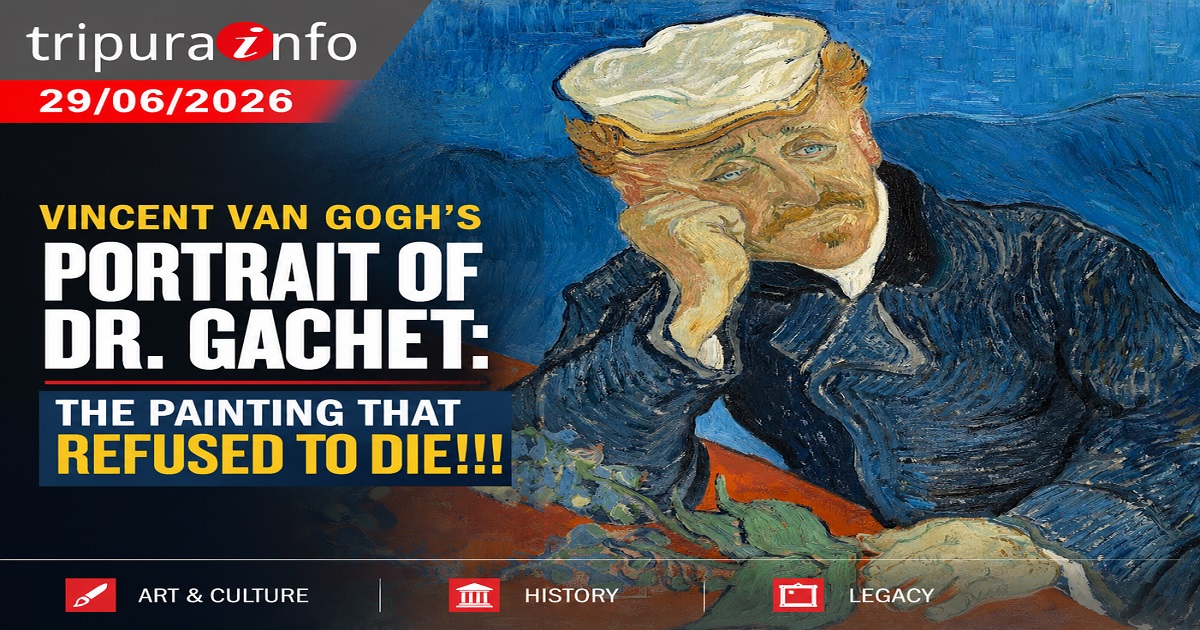 On a warm evening in May 1990, the salesroom at Christie’s in New York seemed to hold its breath. Dealers leaned forward. Collectors watched with the stillness of gamblers at the edge of ruin. Somewhere in that glittering room, beneath the chandeliers and the polite violence of wealth, a tired doctor stared out from a canvas painted a century earlier. His head rested on his hand. His eyes did not plead. They endured.
Then the bidding rose like fever. Twenty million became thirty, thirty became fifty, and still the portrait remained there, mute and implacable, as if it had already survived worse things than money. When the gavel finally fell at $82.5 million, the sound cracked through the room like a sentence. The painting was sold for Rs 7,78,47,41,250.00—seven hundred seventy-eight crore, forty-seven lakh, forty-one thousand, two hundred and fifty rupees—establishing a historic benchmark in the international art market. Can you pronounce the amount? I could not. The world called it a record. The room called it history. But the painting itself seemed to whisper something older and colder: I have been bought before. I have been hunted before. I have not disappeared.
Vincent van Gogh painted Portrait of Dr. Gachet in June 1890 at Auvers-sur-Oise, in the final, blazing weeks of his life. He had come from the asylum at Saint-Rémy-de-Provence into the care of Dr. Paul Gachet, a homeopathic physician, amateur artist, and friend of painters. Gachet was meant to be a healer. Yet Van Gogh saw in him something more troubling: a man touched by the same inward weather, the same collapse behind the eyes. The doctor, Van Gogh wrote, seemed “sicker than I am.”
The portrait is not merely a likeness. It is a diagnosis. Gachet leans into his right hand as though the century has pressed him down. Before him lies the foxglove plant, source of digitalis, a medicine for the heart and a symbol too perfect to feel accidental. Around him, the blues and greens shiver with that Van Gogh intensity in which color becomes nerve, air becomes pulse, and sorrow becomes visible. He painted a doctor, but he also painted fatigue, compassion, helplessness, and the strange dignity of those who cannot save the people they love.
There are two authenticated painted versions of Dr. Gachet, both made that June, and there is also an etching. The second version remained with Gachet and later entered the French national collection; today it hangs in the Musée d’Orsay in Paris, still surrounded by questions that have never quite lost their charge. But the first version—the one with the more turbulent destiny—became something else entirely. It became a fugitive.
After Van Gogh’s death, the canvas began its long pilgrimage through the hands of people who believed they possessed it, though possession was always the portrait’s darkest illusion. It passed through the Van Gogh family, through dealers and collectors, from Paris to Copenhagen, from Berlin galleries to one of Germany’s great museums. In 1911, the Städel in Frankfurt acquired it, and for a time the painting seemed to have found a public home. It belonged not to a drawing room, but to civilization; not to one owner, but to everyone willing to stand before grief and recognize it.
Then came the darkness that tried to rename truth as corruption. In 1937, under the Nazi campaign against so-called “degenerate art,” the portrait was confiscated. The insult was almost unbearable: a painting born from vulnerability and honesty was condemned because it refused to flatter power. It was taken from the museum, pulled into the machinery of ideology and profit, and passed through the hands of men for whom beauty was another asset to be seized, traded, hidden, and converted.
Yet the canvas survived. It moved through dealers, bankers, private rooms, and wartime uncertainty. It crossed borders like a witness under false names. Siegfried Kramarsky eventually carried it into exile in New York, where the doctor’s bowed head waited through decades of the twentieth century’s aftershocks. By then, the painting had absorbed more than brushwork. It had absorbed displacement, greed, rescue, fear, and silence.
So when it appeared at Christie’s on May 15, 1990, it did not arrive as a mere masterpiece. It arrived as evidence. The buyer was Ryoei Saito, a Japanese businessman whose winning bid made Portrait of Dr. Gachet the most expensive painting ever sold at auction at that time. Newspapers measured the shock in money; the art world measured it in awe. But what could any number really mean beside a face painted in the last weeks of a man who had almost nothing?
After Saito’s death in 1996, the first version withdrew from public sight. Rumors thickened around it. The Städel, which had once shown the portrait as part of its own soul, later opened an exhibition with an empty frame—a quiet accusation, a shrine to absence. The painting had not died. Worse, perhaps: it had vanished into the privacy of wealth, where masterpieces can become ghosts with climate control.
That is why Dr. Gachet still unsettles us. The painting is not lost in the simple sense. Its image is everywhere. Its history is documented. Its second self hangs in Paris. And yet the first version, the one that passed through the furnace of modern history, remains withheld from ordinary sight. It exists as both object and legend, both survivor and hostage, both portrait and wound.
Thirteen owners, perhaps more, have leaned toward it and imagined they understood its heart. Collectors guarded it, scholars mourned it, dealers priced it, regimes condemned it, and museums remembered it. But the truth is simpler and more haunting: Portrait of Dr. Gachet has never belonged to any one person. It belongs to its passage through human hunger and human ruin. Van Gogh painted a doctor. History made him a witness. The market made him a trophy. Absence made him a myth.
Somewhere, in a room we cannot enter, the doctor still rests his weary head on his hand. The foxglove still waits on the table. The blue still trembles. And in that trembling blue, something refuses extinction—something bright in spite of grief, something wounded but undefeated, something that has crossed war, ideology, obsession, money, and disappearance without surrendering its terrible light.
আরও পড়ুন...